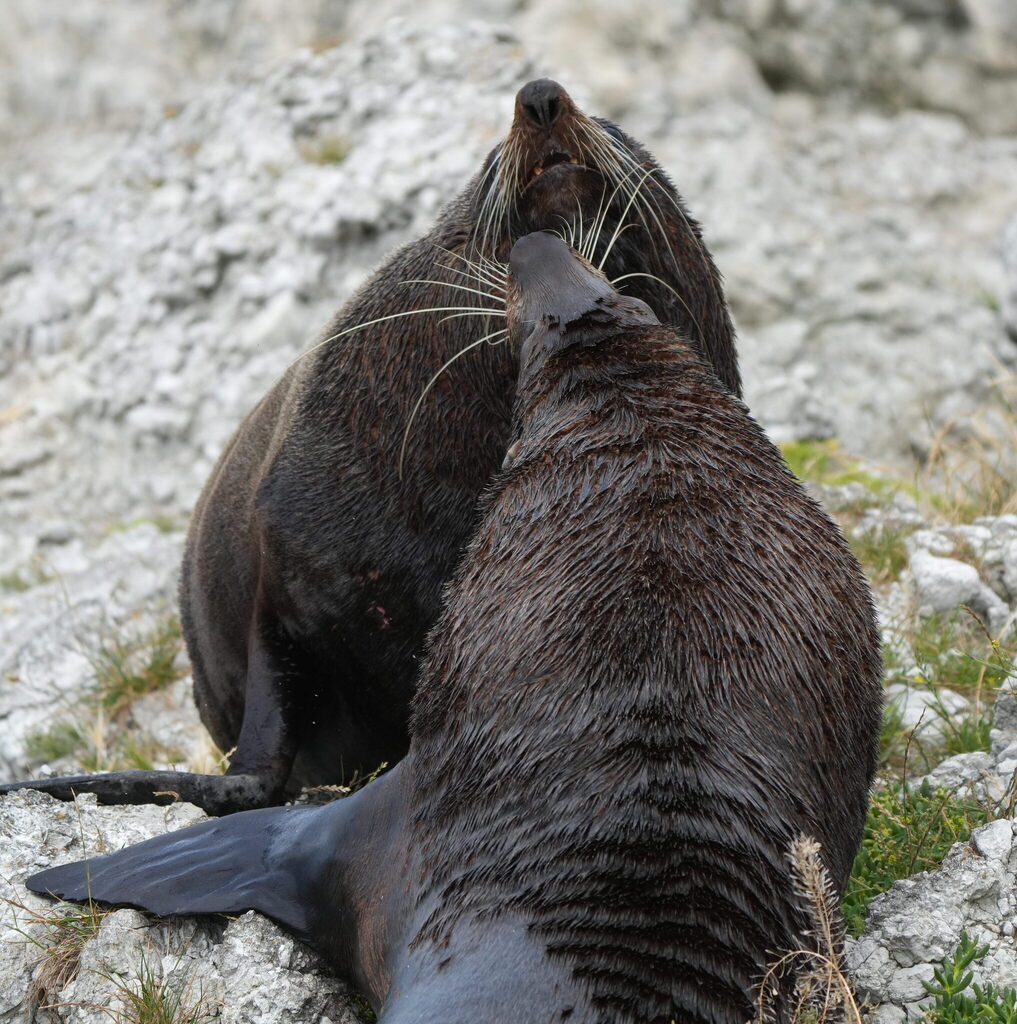
New Zealand Fur Seal
Photo © William Harland
Photo © William Harland — CC BY 4.0 — Source: iNaturalist #330676045Identification
The New Zealand fur seal is a robust marine mammal with distinctive features that set it apart from true seals. Males are substantially larger than females, averaging around 126 kg and reaching up to 2 metres in length, while females typically weigh 30–50 kg and measure up to 1.5 metres. Like all fur seals, they possess external ears and hind flippers that rotate forward—visible characteristics that immediately distinguish them from true seals. Their most striking feature is a pointed nose adorned with long, pale whiskers. Their coat displays a grey-brown coloration on the back with a lighter belly, and some individuals have white-tipped longer hairs that create a silvery sheen.
Newborn pups are remarkably small, weighing just 3.3–3.9 kg and measuring 40–55 cm in length. All fur seals are covered by two layers of fur, providing insulation in cold southern waters. Historically, seals found on remote subantarctic islands such as Antipodes Islands and Macquarie Island were claimed to represent a distinct subspecies with thicker fur, though their genetic distinctiveness remains unclear.
Range & Habitat
This species inhabits the coastal waters and offshore islands of southern regions across the Tasman Sea. In Australia, they are found from the south-western corner of Western Australia to just east of Kangaroo Island in South Australia, including southern Tasmania and the subantarctic Macquarie Island. Small populations are expanding in Bass Strait and along the coasts of Victoria and New South Wales as far as the mid-north coast. Before human arrival in New Zealand, these seals bred around the entire mainland and its subantarctic islands. Today, established and expanding colonies are found around the entire South Island, Stewart Island, and all New Zealand subantarctic islands, with newly established breeding colonies now appearing on the North Island.
Behaviour & Diet
New Zealand fur seals are among the ocean's most accomplished divers. Females can dive for approximately 9 minutes to depths around 312 metres, with even greater capabilities in autumn and winter. Males are even more impressive, capable of diving for about 15 minutes to depths near 380 metres—deeper and longer than any other fur seal species. However, typical dives last only 1–2 minutes. These seals exhibit remarkable adaptability: they dive deeper during the day when prey migrates to greater depths, and shallower at night when prey returns to shallower waters. When porpoising across the surface at speed, they briefly leap clear of the water. Lactating females modify their diving patterns to care for young, reducing dive duration to around 5 minutes. This sexual division of foraging grounds—with males working deeper continental shelf breaks and females utilising shallower continental shelves—minimises competition between sexes for food resources.
Communication involves distinct vocalizations: males produce barks or whimpers ranging from guttural threats to submissive calls, while females growl and emit high-pitched pup-attraction wails that carry over distance. Pups begin diving from 6–10 months of age, learning to forage while still nursing until weaning at 8–11 months. Young seals initially consume cephalopods before transitioning to fish, reflecting both prey availability and developing hunting skills.
Best Time & Places to See It
New Zealand fur seals are most reliably encountered around the established colonies of the South Island, Stewart Island, and the New Zealand subantarctic islands. In Australia, southern coastal regions and offshore islands offer viewing opportunities. The species is present year-round, though breeding seasons provide opportunities to observe territorial behaviour and pup interactions. The expanding populations on the North Island of New Zealand and along the coasts of Victoria and New South Wales represent emerging viewing destinations for those seeking to witness range recovery.
Photography Tips
Photograph these seals during breeding season to capture dramatic territorial displays, where males perform full neck displays as non-combative dominance assessments. The contrast between the grey-brown upper fur and lighter belly offers good compositional opportunities. Capture their distinctive pointed nose and pale whiskers for compelling close-up portraits. Their porpoising behaviour at the water's surface presents dynamic action shots—be positioned to catch them leaping clear of the water when travelling at speed. Pups offer particularly photogenic subjects, especially during the vulnerable weaning period when they begin diving independently. The silver-tipped appearance of some individuals is enhanced by backlighting and can create striking images against darker water backgrounds.
Sydney Harbour National Park
Sydney, Australia
+203 birds+26 mammals
Where Sydney Harbour's sheltered waters meet the sandstone headlands of New South Wales, a mosaic of coastal heathland, eucalyptus woodland and rocky shores creates one of…
VIEW NATIONAL PARKRoyal National Park
Sydney, Australia
+296 birds+46 mammals
Where sandstone ridges plunge toward the Tasman Sea, Royal National Park unfolds across 343 square kilometres of southeastern Australian coastal wilderness. The park's defining character emerges…
VIEW NATIONAL PARKBribie Island National Park
Brisbane, Australia
+284 birds+20 mammals
Across tidal flats and shallow waterways north of Brisbane, Bribie Island National Park spreads across nearly four hundred square kilometres of subtropical coastal wilderness—a patchwork of…
VIEW NATIONAL PARKFlinders Chase National Park
Australia
+142 birds+14 mammals
Granite ridges and windswept mallee scrubland define this 1,630-square-kilometre expanse on Kangaroo Island, where ancient rock formations rise abruptly from coastal heathland and woodland mosaics. The…
VIEW NATIONAL PARKBouddi National Park
Gosford, Australia
+147 birds+17 mammals
Sandstone ridges rise sharply from the Tasman Sea along the central New South Wales coast, their weathered faces etched by millennia of salt spray and storm…
VIEW NATIONAL PARKKu-ring-gai Chase National Park
Sydney, Australia
+216 birds+39 mammals
Where Hawkesbury sandstone cliffs plunge toward sheltered bays and creeks, Ku-ring-gai Chase National Park unfolds across rugged terrain just north of Sydney, a mosaic of eucalyptus…
VIEW NATIONAL PARKBen Boyd National Park
Eden, Australia
+255 birds+47 mammals
Where the temperate forests of the far south coast meet towering sea cliffs, Ben Boyd National Park unveils one of New South Wales' most dramatic coastal…
VIEW NATIONAL PARKCoorong National Park
Australia
+217 birds+15 mammals
Where the Murray River meets the Southern Ocean, a chain of shallow lagoons stretches across the South Australian coast, separated from the sea by a ribbon…
VIEW NATIONAL PARKFreycinet National Park
Coles Bay, Australia
+115 birds+9 mammals
Granite peaks rise abruptly from the Tasmanian coast where Coles Bay opens into the Freycinet Peninsula, sculpting one of southeastern Australia's most dramatically vertical national parks.…
VIEW NATIONAL PARKNo community photos yet. Log in to add the first one.
No community observations of this species yet.