North African Hedgehog
Photo © Christoph Moning
Photo © Christoph Moning — CC BY 4.0 — Source: iNaturalist photo #186190119Identification
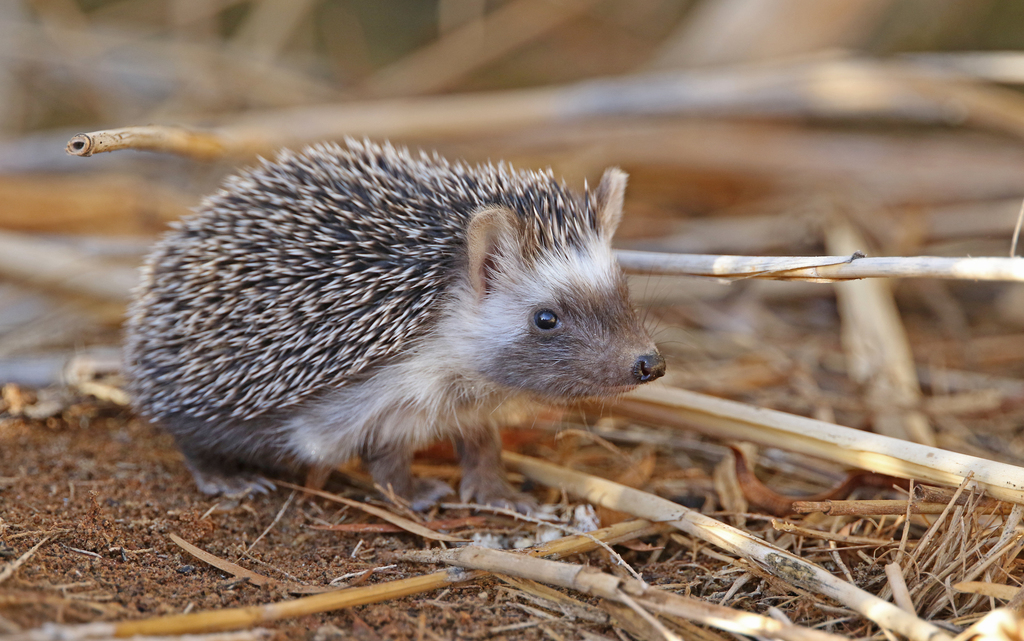
The North African hedgehog is a compact mammal measuring between 20 and 25 cm long and weighing up to 650 grams. While it closely resembles the European hedgehog, several distinctive features set it apart. Its face is characteristically light-coloured, usually white, with a brown head and legs. The most reliable distinguishing feature is the absence of spines on the crown of the head—lacking the "widow's peak" visible in related species. Its ears are notably large and highly visible, and it possesses longer legs and a longer snout than other African hedgehog species, contributing to its reputation as a faster runner.
The body is covered in soft spines that are predominantly white with darker banding, creating a subtle pattern across the back. The underbelly varies in colour, appearing either brown or white. Despite its small size compared to the European hedgehog, the North African hedgehog is larger than its African cousins, making size and leg length useful identification clues when distinguishing it from related species.
Range & Habitat
The North African hedgehog is native to North Africa and parts of southern Europe, occurring across Algeria, Libya, Malta, Morocco, Spain, Tunisia, and the Canary Islands. It is the only African hedgehog species found outside the African continent. Though little is known about its specific habitat preferences, it favours Mediterranean conifer and mixed forest climates, particularly in the mountainous regions of southern Spain and northern Africa. Notably, it cannot survive in dry desert regions, confining it to more temperate areas.
Within suitable regions, this adaptable hedgehog can often be spotted in gardens and parks, suggesting it tolerates human-modified landscapes. The species has been extirpated from France, and its presence in some locations suggests possible human introduction, particularly to Spain and the Canary Islands.
Behaviour & Diet
North African hedgehogs have a gestation period of 30 to 40 days, with females typically producing two litters per season between October and March. Litters contain between three and 10 hoglets, born with hairless, pinkish skin and soft spines. These initial spines are shed at around four weeks of age, when the juveniles develop their characteristic harder quills. Hoglets weigh between 12 and 20 grams at birth and reach sexual maturity at eight to ten weeks old.
This species does not participate in pair bonding and does not mate for life, with individuals remaining largely solitary. Little else is documented about their specific dietary and behavioural ecology in the wild.
Best Time & Places to See It
The North African hedgehog's breeding season runs from October to March, when activity may be heightened due to reproductive behaviour and the presence of young. Gardens and park areas within suitable Mediterranean forest regions offer the best chances of encounters. Northern Africa from Morocco to Libya, plus Spain's southern mountainous regions, the Canary Islands, and the Balearics are prime locations. However, detailed information about peak activity times or specific wildlife hotspots remains limited.
Photography Tips
The North African hedgehog's distinctive features—particularly its light face, large visible ears, and absence of crown spines—make these worth highlighting in images. Its relatively small size and nocturnal or crepuscular habits may present challenges; patience and low-light photography techniques may be necessary. The contrasting white-and-dark-banded spines photograph well when properly lit, and close-ups of the head and facial features can emphasize the identifying characteristics that distinguish it from related species. Garden and park settings, where individuals are more accessible, offer more predictable photography opportunities than wild habitat.
L’Albufera Natural Park
València, Spain
+321 birds+18 mammals
Where shallow lagoons meet Mediterranean coastal marshland, L'Albufera Nature Park unfolds as one of Spain's most vital wetland complexes. This protected landscape, designated under IUCN Category…
VIEW NATURAL PARKTeide National Park
La Orotava, Spain
+83 birds+7 mammals
At nearly 3,900 metres, Spain's highest peak rises from the Canary Islands as a singular volcanic monument, its slopes sweeping through five distinct climate zones in…
VIEW NATIONAL PARKDelta de l’Ebre Natural Park
Eucaliptus, Spain
+341 birds+18 mammals
Where the Ebro River spreads into a vast labyrinth of shallow lagoons, reed beds, and brackish marshes before surrendering to the Mediterranean, one of southern Europe's…
VIEW NATURAL PARKTúria Natural Park
València, Spain
+150 birds+21 mammals
Where the Túria riverbed winds through the lowlands south of Valencia, a sprawling natural park of nearly 440 square kilometres unfolds across one of Spain's most…
VIEW NATURAL PARKMontseny Natural Park
Viladrau, Spain
+156 birds+30 mammals
The Montseny Natural Park is one of Catalonia’s most remarkable protected areas, offering an extraordinary blend of biodiversity, scenic landscapes, and cultural heritage within easy reach…
VIEW NATURAL PARKNo community photos yet. Log in to add the first one.
No community observations of this species yet.