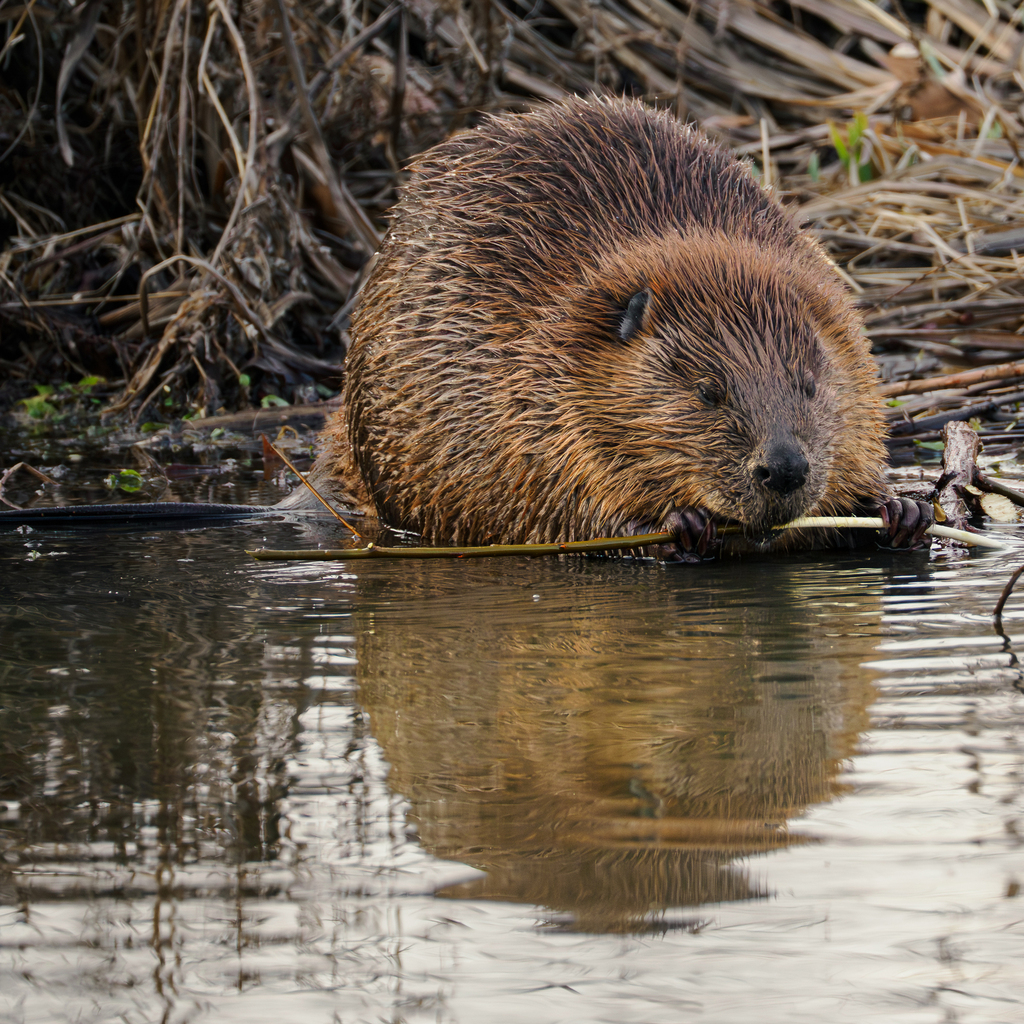
North American Beaver
Photo © Michael
Photo © Michael — CC BY 4.0 — Source: iNaturalist photo #619514167Identification
The North American beaver is the largest rodent in North America, typically weighing between 11 and 32 kg (24 to 71 lb), though 20 kg (44 lb) is average. Adults measure 74–90 cm (29–35 in) from head to body, with tails adding a further 20–35 cm (7.9–13.8 in). Exceptional individuals can exceed 40 kg (88 lb). The beaver's most distinctive features include a large, scaly, paddle-shaped tail, webbed hind feet, and smaller unwebbed front feet with prominent claws and surprising dexterity. Its fur is typically dark brown, consisting of long outer hairs over short, fine inner fur that provides excellent waterproofing.
The beaver's body is perfectly adapted for semiaquatic life. Its eyes are covered by a nictitating membrane allowing underwater vision, while nostrils and ears seal when submerged. Uniquely, the beaver's lips close behind its front teeth, enabling it to gnaw underwater. A thick layer of insulating fat underlies the skin. Like all rodents, beavers possess continuously growing incisors—a feature essential to their lifestyle as prolific gnawers.
Range & Habitat
North American beavers are widespread across the continental United States, Canada, southern Alaska, and parts of northern Mexico. Historically, they were practically ubiquitous, living from south of the arctic tundra to the deserts of northern Mexico, and from the Atlantic to the Pacific Oceans. Extensive trapping for economic gain and political competition led to regional extirpation across many areas, particularly the Great Plains. The species has also been introduced to South America (Patagonia) and Europe (primarily Finland and Karelia).
Beavers are one of Canada's national symbols and the official state mammal of both Oregon and New York, reflecting their historical and ongoing importance across the continent.
Behaviour & Diet
The North American beaver is a hindgut fermenter, equipped with a specialized cecum populated by symbiotic bacteria that enable efficient digestion of plant-based material, particularly lignocellulose-heavy diets. The beaver uses its highly dexterous front feet for digging, feeding, and maneuvering small stems as it gnaws bark from trees. Its continuously growing incisors are perfectly suited to this wood-consuming lifestyle.
Scent glands near the beaver's genitals secrete an oily substance called castoreum, which serves to waterproof its fur. Additional oil glands produce unique chemical identifiers in the form of waxy esters and fatty acids, allowing beavers to communicate through scent marking.
Best Time & Places to See It
Beavers are found across diverse habitats throughout North America, from forested regions of Canada to southeastern waterways and the Missouri River system. Their widespread distribution means viewing opportunities exist across the continent, from New England to the Northwest Territory. Look for beaver signs—felled trees, dams, lodges, and characteristic tooth marks on bark—near freshwater habitats including rivers, streams, and wetlands.
Photography Tips
Photographing beavers requires patience and waterside positioning, particularly during dawn and dusk when they are most active. Position yourself quietly near water bodies where beavers are known to inhabit. The beaver's dark fur blends well with water and shadows, so look for silhouettes and the distinctive tail breaking the water surface. Capture the beaver's characteristic behaviors: gnawing wood, diving with its paddle tail, or swimming with only its head above water. The nictitating membrane and underwater vision adaptations make for compelling close-up subjects if you can approach safely.
Tombstone Territorial Park
Acadia National Park
Alaska Maritime National Wildlife Refuge
Algonquin Provincial Park
Alligator River National Wildlife Refuge
Arches National Park
Arctic National Wildlife Refuge
Banff National Park
Bear River Migratory Bird Refuge
Nothing matches these filters.
No community photos yet. Log in to add the first one.
No community observations of this species yet.