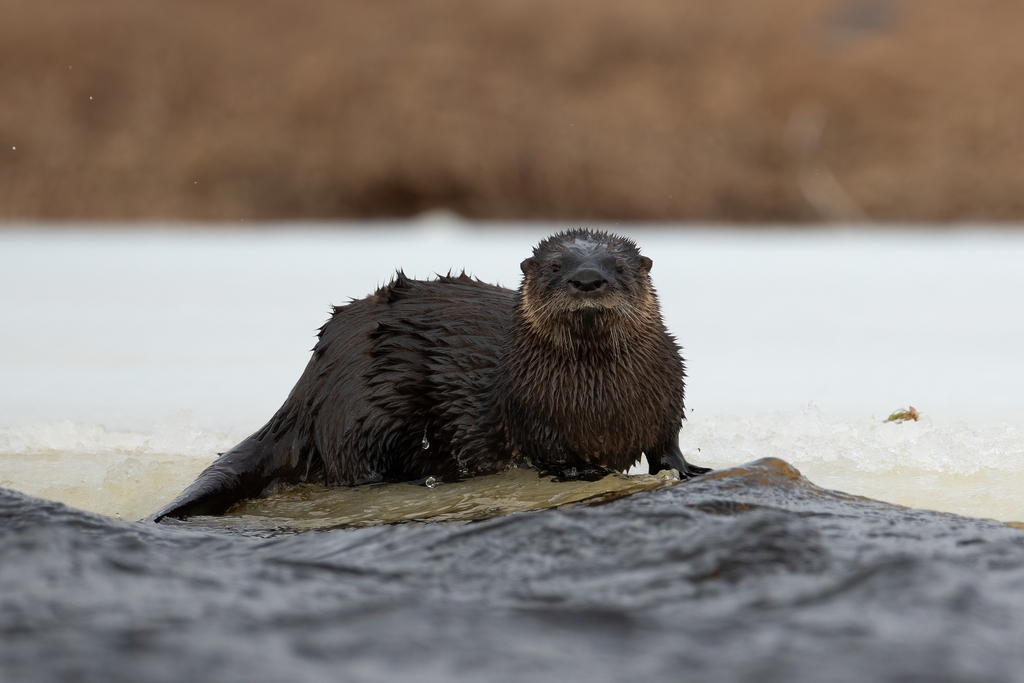
North American River Otter
Photo © Blair Dudeck
Photo © Blair Dudeck — CC BY 4.0 — Source: iNaturalist photo #115358200Identification
The North American river otter is a sleek, semiaquatic mammal belonging to the weasel family. Adults weigh between 5 and 14 kilograms, with males averaging around 11.3 kg and females 8.3 kg. Their body length ranges from 66 to 107 centimetres, with a distinctive long, tapered tail comprising about one-third of their total length. River otters are instantly recognizable by their thick, water-repellent fur coat, long thin whiskers used to detect prey in murky water, and streamlined body perfectly adapted for aquatic life. They differ from their Eurasian cousins by their longer neck, narrower face, smaller ear spacing, and proportionally shorter tail.
One notable behavioural quirk of river otters is their near-sightedness, an adaptation for underwater vision that causes them to approach boats and shoreline observers within just a few metres out of curiosity rather than caution. Their eyes are protected while swimming by a transparent inner eyelid called a nictitating membrane. With their specialized dentition—36 teeth including sharp canines, carnassials, and large molars for crushing shells—they are formidable predators.
Range & Habitat
The North American river otter is endemic to the North American continent, found throughout most of Canada and along the coasts and inland waterways of the United States. Their range extends from the Atlantic states and Pacific Northwest to the Gulf of Mexico, throughout Alaska including the Aleutian Islands, and the north slope of the Brooks Range. They also inhabit forested regions near the Pacific coast.
River otters are highly versatile and establish burrows close to the water's edge in diverse ecosystems including rivers, lakes, swamps, coastal shorelines, tidal flats, and estuaries. Their dens typically feature multiple tunnel openings, with at least one providing direct access to water—an ideal layout for these semi-aquatic hunters.
Behaviour & Diet
River otters are equally competent hunters in water and on land. They are opportunistic predators that primarily target the most readily accessible prey species in their environment. Fish form their staple diet, with perch, suckers, and catfish being the most commonly consumed species. However, their diet is remarkably diverse, including amphibians such as salamanders and frogs, freshwater clams, mussels, snails, small turtles, and crayfish.
Females give birth in their burrows to litters of one to six young. Beyond their standard aquatic prey, river otters will occasionally consume small animals such as mice, squirrels, and birds, demonstrating their adaptability as predators.
Best Time & Places to See It
To observe North American river otters, focus on pristine waterways throughout their range—rivers, lakes, and coastal areas in Canada, the Pacific Northwest, Atlantic states, and Gulf regions are all productive. Early morning and late afternoon are typically the best times for otter activity. Their curious nature and near-sightedness mean they may approach observers closely, offering excellent viewing opportunities for patient wildlife watchers.
Wetland areas, swamps, and estuaries are particularly reliable locations. The species' presence indicates healthy water ecosystems with abundant fish populations and minimal pollution.
Photography Tips
River otters' inquisitive approach to boats and shore-based observers provides excellent photo opportunities, but keep movements slow and deliberate to avoid startling them. Their streamlined form and graceful swimming create dynamic shots, particularly at dawn or dusk when side lighting enhances their sleek fur texture. Capture their characteristic whiskers and expressive face in close-ups when they surface or approach.
Patience is essential—position yourself quietly near water's edge and wait for otters to emerge naturally. Their diving and swimming behaviour, playful interactions, and hunting sequences all offer compelling photographic moments. Waterproof equipment or protective barriers are recommended given the unpredictable water environment.
Acadia National Park
Alaska Maritime National Wildlife Refuge
Algonquin Provincial Park
Alligator River National Wildlife Refuge
Banff National Park
Blackwater National Wildlife Refuge
Bombay Hook National Wildlife Refuge
Cape May Point State Park
Chassahowitzka National Wildlife Refuge
Nothing matches these filters.
No community photos yet. Log in to add the first one.
No community observations of this species yet.