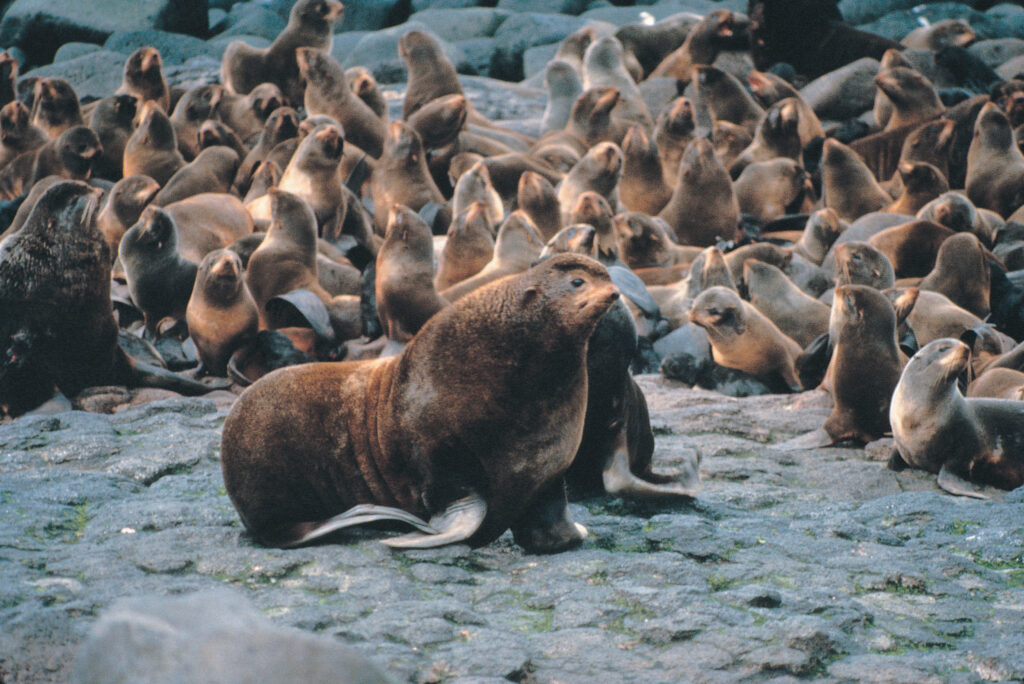
Northern Fur Seal
Photo © M. Boylan
Photo © M. Boylan — CC0 1.0 — Source: Wikimedia CommonsThe northern fur seal (Callorhinus ursinus) is an eared seal found along the north Pacific Ocean, the Bering Sea, and the Sea of Okhotsk. It is the largest member of the fur seal subfamily (Arctocephalinae) and the only living species in the genus Callorhinus. A single fossil species, Callorhinus gilmorei, is known from the Pliocene of Japan and western North America. == Description == Northern fur seals have extreme sexual dimorphism, with males being 30–40% longer and more than 4.5 times heavier than adult females. The head is foreshortened in both sexes because of the very short, down-curved muzzle, and small nose, which extends slightly beyond the mouth in females and moderately in males. The pelage is thick and luxuriant, with a dense underfur in a creamy color. The underfur is obscured by the longer guard hairs, although it is partially visible when the animals are wet. Features of both fore and hind flippers are unique and diagnostic of the species. Fur is absent on the top of the fore flippers and an abrupt "clean line" is seen across the wrist where the fur ends. The hind flippers are proportionately the longest in any otariid because of extremely long, cartilaginous…
St. Paul Island
Saint Paul, United States
+255 birds+8 mammals
Windswept tundra rolls across this remote Pribilof island, where volcanic basalt cliffs plunge into the Bering Sea and fog rolls in thick enough to erase the…
VIEW PROTECTED LANDSCAPEAlaska Maritime National Wildlife Refuge
Alaska, United States
+391 birds+58 mammals
Where the North Pacific collides with Alaska's rugged coastline, a sprawling archipelago of islands, rocky outcrops, and coastal headlands forms one of North America's most remote…
VIEW WILDLIFE SANCTUARYFarallon National Wildlife Refuge
San Francisco, United States
+384 birds+16 mammals
Windswept granite peaks rising abruptly from the Pacific, the Farallon Islands form a wildlife sanctuary of extraordinary seabird abundance and ecological significance just twenty-seven miles west…
VIEW WILDLIFE SANCTUARYNo community photos yet. Log in to add the first one.
No community observations of this species yet.