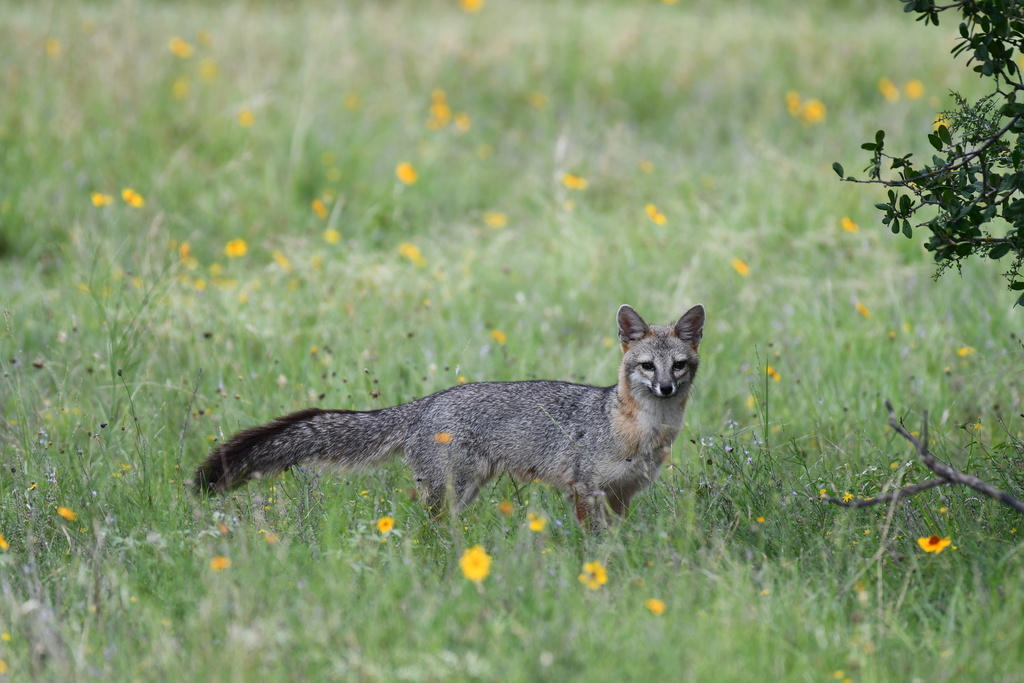
Northern Gray Fox
Photo © Cody Stricker
Photo © Cody Stricker — CC BY 4.0 — Source: iNaturalist photo #545416484Identification
The Northern Gray Fox is a small canid distinguished by its grizzled upper parts, distinctive black stripe running down the center of its tail, and strong neck ending in a black-tipped tail. Readily separated from the red fox by its lack of "black stockings," the gray fox displays white on its ears, throat, chest, belly, and hind legs, with black markings around the eyes, lips, and nose. Reddish coloration appears on the legs, sides, feet, chest, and the back and sides of the head and neck. The species has a characteristic U-shaped skull formation of temporal ridges, angular ears and muzzle, and notably longer, curved claws than most other canids.
The gray fox typically weighs 3.6 to 7 kg (7.9 to 15.4 lb), with exceptional individuals reaching 9 kg (20 lb). Total body length ranges from 76 to 112.5 cm (29.9 to 44.3 in), with the tail measuring 27.5 to 44.3 cm (10.8 to 17.4 in). A key distinguishing feature is its oval pupils—unlike the slit-like pupils of red foxes—and individual guard hairs distinctly banded with white, gray, and black. Sexual dimorphism is minimal, with females only slightly smaller than males.
Range & Habitat
The Northern Gray Fox occurs throughout most rocky, wooded, and brushy regions from southern Canada (Manitoba through southeastern Quebec) southward to the northern part of South America (Venezuela and Colombia), excluding the mountains of the northwestern United States. It is the only canid whose natural range spans both North and South America. Once the most common fox in the eastern United States, the species has maintained strong populations in the Pacific States and Great Lakes region, and has demonstrated remarkable adaptability in urban and suburban environments, with southern Florida offering one of the best examples of this flexibility.
The species shows distinct habitat preferences across its range. In the Midwest, it prefers a mix of wooded and agricultural land; in the west, juniper forests and ponderosa pine are favored; deciduous forests characterize eastern preferences. In some areas, high population densities exist near brush-covered bluffs. Towards the southern part of its range, particularly in Belize and southeastern Mexico, the gray fox favors mixed forest and agricultural land, and often inhabits areas with human presence such as near roads.
Behaviour & Diet
The Northern Gray Fox possesses a remarkable adaptation unique among canids: it is specifically adapted to climb trees. Its strong, hooked claws allow it to scramble up vertical trunks to heights of 18 metres (59 ft) and jump from branch to branch with agility. The fox uses this ability to escape predators such as domestic dogs or coyotes, and to access tree-bound or arboreal food sources. It descends primarily by jumping from branch to branch, or by backing down slowly like a domestic cat, making it one of the most arboreal canids in North America.
As an omnivorous mammal, the gray fox has a diverse diet that likely contributes to its success in varied environments. This dietary flexibility, combined with its exceptional climbing ability and adaptability to human-modified landscapes, has allowed the species to thrive despite competition from red foxes and habitat loss.
Best Time & Places to See It
The Northern Gray Fox can be encountered throughout its extensive range, with particularly strong populations in the Pacific States and Great Lakes region. Southern Florida represents one of the most accessible locations for observing this species, as it has successfully adapted to urban and suburban environments there. The species remains widespread in its preferred mixed forest and agricultural habitats across North America, though sightings are most likely in areas with suitable cover of rocky, wooded, or brushy terrain.
While the gray fox is primarily nocturnal, patient observers in appropriate habitats may encounter them during dawn or dusk hours. Areas near brush-covered bluffs, mixed woodlands, and rural-suburban transitions offer the best opportunities for sightings. In regions where the species remains common, such as the Pacific States, dedicated wildlife watchers with knowledge of local populations will have better success.
Photography Tips
Photographing the Northern Gray Fox requires patience and attention to detail, as the species is primarily nocturnal. The fox's distinctive markings—the black stripe down the tail, white throat and chest, and reddish leg coloration—are most effectively captured in natural light. The striking facial features, including the black eye-patches and the characteristic U-shaped skull profile visible from certain angles, make compelling photographic subjects when the animal's head is clearly visible.
The gray fox's unique climbing behavior offers exceptional photographic opportunities. Capturing the fox on a tree trunk or ascending a branch showcases its remarkable adaptation and produces distinctive wildlife images rarely obtained of other canids. Early morning or late evening light will best emphasize the grizzled texture of its upper parts and the banded coloration of its guard hairs. Given the species' adaptability to suburban areas, particularly in southern Florida, these more accessible locations may offer better opportunities than remote wilderness settings.
Santa Rosa National Park
Santa Elena, Costa Rica
+359 birds+30 mammals
Where Pacific-facing slopes descend from volcanic uplands toward the Guanacaste lowlands, Santa Rosa National Park unfolds across a mosaic of tropical dry forest, gallery woodland, and…
VIEW NATIONAL PARKBig Bend National Park
Brewster County, United States
+345 birds+34 mammals
Where the Chisos Mountains rise abruptly from the Sonoran Desert floor, Big Bend National Park spans over 7,300 square kilometers of one of North America's most…
VIEW NATIONAL PARKSaguaro National Park
Rincon Valley, United States
+354 birds+40 mammals
Where the Sonoran Desert meets sky-island mountains, two geographically separated districts of Saguaro National Park sprawl across nearly two thousand square kilometers of Arizona's most iconic…
VIEW NATIONAL PARKPinnacles National Park
San Benito County, United States
+197 birds+33 mammals
Jagged volcanic spires thrust from chaparral-covered ridges across 222 square kilometers of central California's inner Coast Ranges, their pale stone crowns catching the afternoon light like…
VIEW NATIONAL PARKGreat Basin National Park
White Pine County, United States
+170 birds+19 mammals
Where the Great Basin's high desert plateaus rise above 10,000 feet, ancient bristlecone pines endure on moonscape ridges of limestone and quartzite, creating one of North…
VIEW NATIONAL PARKCarlsbad Caverns National Park
Eddy County, United States
+309 birds+18 mammals
Beneath the Chihuahuan Desert floor of southern New Mexico lies one of North America's most spectacular subterranean landscapes. Carlsbad Caverns National Park encompasses over 518 square…
VIEW NATIONAL PARKZion National Park
Washington County, United States
+244 birds+30 mammals
Towering sandstone cliffs in shades of crimson, rust, and cream rise abruptly from the Virgin River's winding canyon floor, their sculpted faces bearing witness to millions…
VIEW NATIONAL PARKCapitol Reef National Park
Garfield County, United States
+196 birds+22 mammals
Wrinkled ridges of crimson and gold sandstone rise from the floor of south-central Utah, their weathered faces carved by the Fremont River into one of the…
VIEW NATIONAL PARKEverglades National Park
Monroe County, United States
+345 birds+22 mammals
Where freshwater marsh meets subtropical sky, the Everglades sprawls across southwestern Florida as one of North America's most expansive wetland ecosystems. Spanning over 13,000 square kilometers,…
VIEW NATIONAL PARKGreat Smoky Mountains National Park
Sevier County, United States
+244 birds+40 mammals
Where the southern Appalachian ridgeline reaches its most densely forested expression, over 4,200 square kilometres of temperate woodland rise and fall across Tennessee and North Carolina,…
VIEW NATIONAL PARKYosemite National Park
Mariposa County, United States
+224 birds+28 mammals
Granite cliffs soar nearly a kilometer above the valley floor in this expanse of high Sierra wilderness, where glacial U-shaped valleys sculpt a landscape of dramatic…
VIEW NATIONAL PARKRedwood National Park
Humboldt County, United States
+343 birds+43 mammals
Where the Pacific fog rolls deep into northern California's coastal valleys, some of the tallest trees on Earth rise from a landscape shaped by tectonic forces…
VIEW NATIONAL PARKSequoia National Park
Tulare County, United States
+187 birds+27 mammals
Granite peaks rising above 3,600 meters dominate the southern Sierra Nevada, where Sequoia National Park sprawls across one of North America's most vertically compressed wilderness zones.…
VIEW NATIONAL PARKDeath Valley National Park
Inyo County, United States
+339 birds+25 mammals
Across nearly 3.5 million acres of southeastern California's Inyo County, vast salt flats meet sculpted badlands and alluvial fans in a landscape so extreme it defines…
VIEW NATIONAL PARKNatural el Cocuy National Park
Güicán, Colombia
+313 birds+3 mammals
Where the Andes rise to their highest peaks in Colombia's eastern cordillera, El Cocuy National Park sprawls across more than 6,600 square kilometers of some of…
VIEW NATIONAL PARKPoint Pelee National Park
Leamington, Canada
+296 birds+14 mammals
Where Lake Erie's shallow waters meet the Ontario shoreline, a slender sandy peninsula juts into the Great Lakes like a natural funnel for migrating wildlife. This…
VIEW NATIONAL PARKSian Ka’an
Chunyaxché, Mexico
+350 birds+16 mammals
Where the Yucatán Peninsula dissolves into wetland and mangrove, a vast mosaic of forest, lagoon, and coastal margin creates one of Mexico's most biodiverse strongholds. Across…
VIEW BIOSPHERE RESERVEEl Vizcaíno
Laguna San Ignacio, Mexico
+317 birds+29 mammals
Where the Baja California peninsula thins into a tapestry of salt lagoons and coastal desert, one of Mexico's most biodiverse reserves sprawls across half a million…
VIEW BIOSPHERE RESERVESierra de Tamaulipas
El Porvenir, Mexico
+98 birds+19 mammals
Where limestone peaks thrust skyward through dense subtropical forest, Mexico's northeastern frontier reveals one of the continent's most biodiverse mountain ranges. Canyons carved by perennial rivers…
VIEW NATURE RESERVEParque Nacional Grutas de Cacahuamilpa
Pilcaya, Mexico
+97 birds+12 mammals
Where limestone ridges rise abruptly from the tropical deciduous forests of central Guerrero, the Grutas de Cacahuamilpa National Park shelters one of Mexico's most extensive cave…
VIEW NATIONAL PARKMontes Azules
Candelaria, Mexico
+395 birds+47 mammals
Where jungle-clad limestone plateaus plunge into canyon systems carved by the Usumacinta River, Mexico's most pristine rainforest reserve unfolds across the Lacandón region of Chiapas. Montes…
VIEW BIOSPHERE RESERVETutuaca
Tosanachi, Mexico
+147 birds+13 mammals
Where copper canyons plunge deeper than the Grand Canyon itself, Mexico's remote Sierra Madre Occidental unfolds in dramatic vertical relief. Tutuaca anchors this wilderness realm, a…
VIEW PROTECTED LANDSCAPETikal National Park
Tikal, Guatemala
+399 birds+16 mammals
Dense rainforest canopy rises above the limestone plateau of Petén, where archaeological wonder and ecological richness merge seamlessly across one of Central America's most biodiverse landscapes.…
VIEW NATIONAL PARKLaguna del Tigre National Park
Petén, Guatemala
+399 birds+29 mammals
Where the Petén lowlands dissolve into wetland and forest, Laguna del Tigre National Park protects one of Guatemala's most ecologically vital landscapes. This sprawling reserve encompasses…
VIEW NATIONAL PARKGrand Canyon National Park
United States
+277 birds+35 mammals
A mile-deep chasm of rust-red rock and purple shadow cuts through the high desert plateau of northern Arizona, revealing nearly two billion years of geological history…
VIEW NATIONAL PARKGuadalupe Mountains National Park
Culberson County, United States
+262 birds+14 mammals
Where fossil-laden limestone ridges thrust skyward above the Chihuahuan Desert floor, Guadalupe Mountains National Park reveals a landscape sculpted by ancient seas and relentless aridity. These…
VIEW NATIONAL PARKShenandoah National Park
Page County, United States
+243 birds+31 mammals
Ridges of ancient quartzite rise above the Shenandoah Valley floor, their slopes dressed in a mosaic of oak and hickory forest that yields to cove hardwoods…
VIEW NATIONAL PARKBosque del Apache National Wildlife Refuge
Socorro County, United States
+345 birds+17 mammals
Where the Rio Grande emerges from its desert canyon in central New Mexico, a narrow ribbon of riparian woodland defies the arid landscape that surrounds it.…
VIEW WILDLIFE SANCTUARYOkefenokee National Wildlife Refuge
Charlton County, United States
+206 birds+14 mammals
Vast wetlands of cypress and blackwater creeks define this wildlife sanctuary straddling the Georgia–Florida border, where the landscape shifts between open marsh, dense swamp forest, and…
VIEW WILDLIFE SANCTUARYKofa National Wildlife Refuge
Yuma County, United States
+142 birds+10 mammals
Desert mountains rise in sculptured ridges across northwestern Arizona, where the Colorado River's distant influence fades into some of the most austere terrain in the American…
VIEW WILDLIFE SANCTUARYDon Edwards San Francisco Bay National Wildlife Refuge
Fremont, United States
+286 birds+20 mammals
Where the San Francisco Bay's shallow margins dissolve into tidal salt marshes and mudflats, this wildlife sanctuary preserves one of California's most ecologically vital estuarine systems.…
VIEW WILDLIFE SANCTUARYAlligator River National Wildlife Refuge
Dare County, United States
+288 birds+17 mammals
Where the coastal plain of North Carolina meets the Albemarle Peninsula, a sprawling mosaic of freshwater marshes, pocosins, and swamp forest creates one of the Atlantic…
VIEW WILDLIFE SANCTUARYSt. Marks National Wildlife Refuge
Saint Marks, United States
+324 birds+16 mammals
Where the Apalachee Bay begins to define the Florida coastline, salt marshes and freshwater impoundments merge into one of the southeastern United States' most productive wildlife…
VIEW WILDLIFE SANCTUARYNo community photos yet. Log in to add the first one.
No community observations of this species yet.