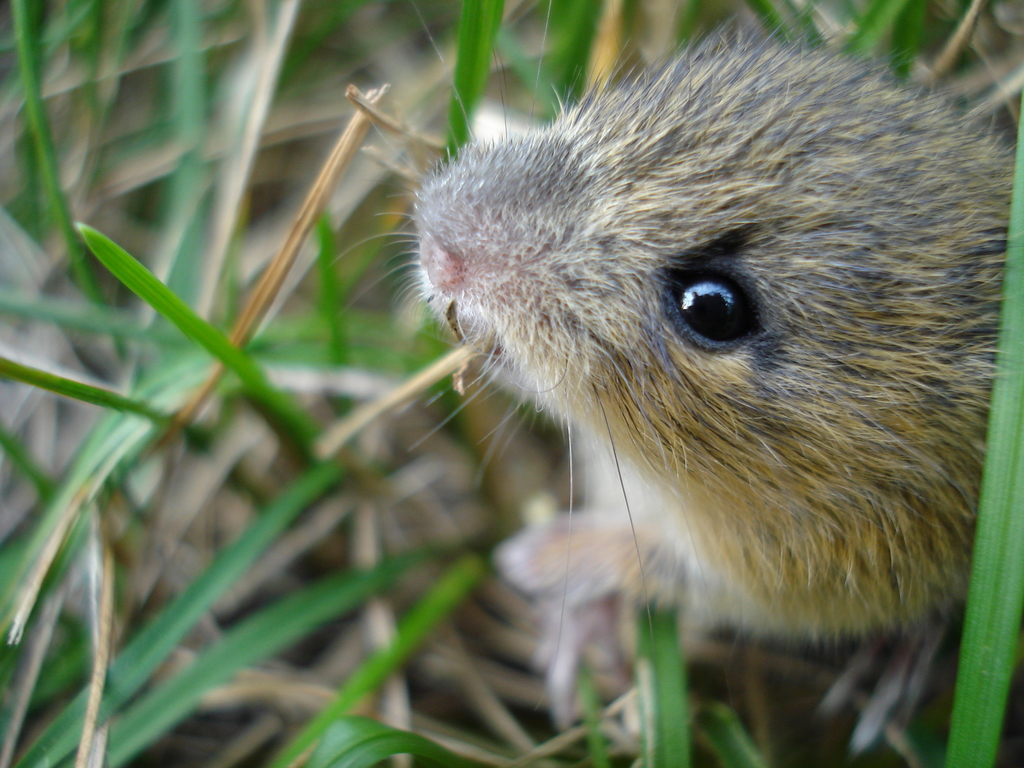
Northern Meadow Jumping Mouse
Photo © Ryan Hodnett
Photo © Ryan Hodnett — CC BY-SA 4.0 — Source: iNaturalist photo #6563457The meadow jumping mouse (Zapus hudsonius) is the most widely distributed mouse in the family Zapodidae. Its range extends from the Atlantic coast in the east to the Great Plains west, and from the arctic tree lines in Canada and Alaska to the north, and Georgia, Alabama, Arizona, and New Mexico to the south. In mid-2014, the New Mexico subspecies of the meadow jumping mouse, Zapus hudsonius luteus, was listed as an endangered species under the federal Endangered Species Act. == Description == The meadow jumping mouse can range in length, from 180 mm to 240 mm, with its tail taking credit for most of its length, usually about 108 mm to 165 mm. A distinct characteristic about this species is its enlarged hind feet, which can be 28 to 35 mm long, and relatively short forelimbs. This gives it a kangaroo rat-like look, although its tail shows that it is not a kangaroo rat because it is not bushy at the tip. The pelage of this creature is short, and with somewhat dense, coarse hair. The color of the pelage has a few variations, but a broad dorsal stripe is always present. This broad dorsal stripe is of a…
Mont-Saint-Bruno National Park
Saint-Bruno-de-Montarville, Canada
+200 birds+13 mammals
Hardwood forests rise steeply from the suburbs of Montreal to crown a distinctive peak in the Monterégian Hills, their ancient geology pushing through mixed deciduous woodland…
VIEW NATIONAL PARKKatmai National Park
Lake and Peninsula Borough, United States
+160 birds+19 mammals
Across southwestern Alaska's Lake and Peninsula Borough, nearly 27,000 square kilometers of subarctic wilderness sprawl between volcanic peaks and coastal wetlands, anchored by the confluence of…
VIEW NATIONAL PARKCuyahoga Valley National Park
Brecksville, United States
+255 birds+27 mammals
Where the Cuyahoga River carves through a glaciated landscape of Ohio, the valley reveals a temperate deciduous forest ecosystem shaped by four distinct seasons and reliable…
VIEW NATIONAL PARKNo community photos yet. Log in to add the first one.
No community observations of this species yet.