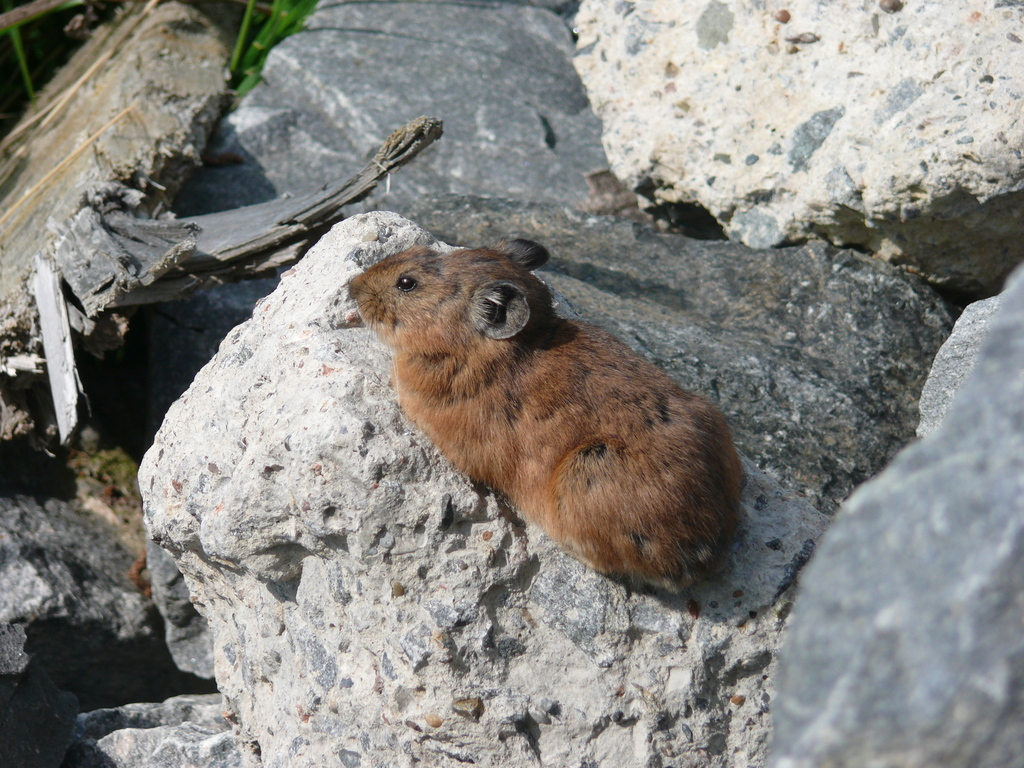
Northern Pika
Photo © Dmitry Kulakov
Photo © Dmitry Kulakov — CC BY 4.0 — Source: iNaturalist photo #215955356Identification
The northern pika is a diminutive mammal, measuring just 12.5–18.5 centimeters in body length with a tiny tail of only 0.5–1.2 centimeters. Despite its small size, it is easily recognized by its small rounded ears, short legs with five toes on each foot, and furry soles. The most striking feature is its seasonal coat change: in summer the pika displays a reddish-brown fur, which transforms to a grayish-brown in winter. The underparts are white with a reddish-brown tinge, and males and females are indistinguishable in appearance. Size and coloring vary across its extensive range, with eight recognized subspecies adapted to different regional conditions.
Range & Habitat
The northern pika inhabits mountainous regions spanning from the Ural Mountains eastward through Siberia, including Sakhalin Island, to northern Mongolia, Manchuria, North Korea, and Japan's Hokkaido island. This vast distribution reflects the species' adaptation to diverse alpine and subalpine environments.
Within its range, the northern pika favors scree slopes, rocky terrain, boulder fields, and dry alpine meadows, typically at elevations between 400 and 2,000 meters. It also inhabits damp areas among coniferous forests. The species generally occurs at higher altitudes than the related Alpine pika and is typically found near the edges of large rock formations, where it constructs shallow burrows in nearby turf.
Behaviour & Diet
Northern pikas are crepuscular, showing peak activity and feeding around dawn and dusk. They navigate their mountainous terrain using short jumps, though they can also walk, run, and climb agilely over rocks and cliffs. Beneath ground, they maintain extensive burrow networks with numerous entrances and passages connecting to surface feeding areas. Above ground, they spend time feeding, grooming, and perching on prominent rocks, often remaining stationary for up to ten minutes while apparently sunbathing or watching for predators.
The species is strictly herbivorous, consuming grasses, twigs, needles, stems, and leaves. Food is typically carried in the mouth to eating points near burrow entrances. Remarkably, northern pikas do not hibernate but instead collect fresh plant material, dry it deliberately, and store these "hay piles" in dry caches for winter consumption. They selectively gather species of high nutritive value rather than the most abundant plants, and can tunnel beneath snow to access their caches and forage for winter food. Communication occurs through various shrill calls, including a distinctive "Kitz" warning cry when alarmed, and territorial scent marking using cheek glands and urine.
Best Time & Places to See It
Observers seeking northern pikas should visit mountainous regions within the species' range during the warmer months when the animals are most active. Focus on rocky slopes, boulder fields, and alpine meadows at altitudes between 400 and 2,000 meters. Early morning and late afternoon offer the best opportunities, coinciding with the pika's natural activity peaks. Watch near distinctive burrow entrances, particularly at the edges of large rock formations where pikas prefer to establish their territories.
Photography Tips
Photographing northern pikas requires patience and stealth. Position yourself near prominent rocks or tree stumps where pikas are known to perch, as they often spend considerable time in these exposed lookout spots. Early morning and dusk light will enhance the visibility of the seasonal coat colors—warm reddish-brown in summer or silvery grayish-brown in winter. Move slowly and avoid sudden approaches, as alarmed pikas will disappear rapidly into their burrows with a sharp call. A telephoto lens is essential to maintain distance and capture intimate behavioral details without disturbing these wary animals. Watch for characteristic grooming behavior and alert postures that showcase their small, rounded ears and engaging facial expressions.
Baikal National Park
Ольхонский район, Russia
+184 birds+11 mammals
Where the world's deepest freshwater lake meets ancient Siberian taiga, Baikal National Park sprawls across 66,203 square kilometers of one of Earth's most singular ecosystems. The…
VIEW NATIONAL PARKTransbaikal National Park
Barguzinsky Rayon, Russia
+83 birds+7 mammals
Where the eastern shore of Lake Baikal meets the Barguzinsky Range, a vast wilderness of boreal forest, alpine tundra, and rocky shoreline unfolds across more than…
VIEW NATIONAL PARKYugyd Va National Park
Vuktyl Municipal District, Russia
+37 birds+3 mammals
Where granite massifs pierce the boreal wilderness of Russia's far northeast, Yugyd Va sprawls across one of Europe's largest intact forest ecosystems. Spanning nearly 54,000 square…
VIEW NATIONAL PARKGorkhi-Terelj National Park
Ulaanbaatar, Mongolia
+137 birds+5 mammals
Where granite monoliths rise abruptly from rolling steppe grasslands, Gorkhi-Terelj National Park unfolds across the landscape north of Ulaanbaatar, a sanctuary where forest and alpine meadow…
VIEW NATIONAL PARKNo community photos yet. Log in to add the first one.
No community observations of this species yet.