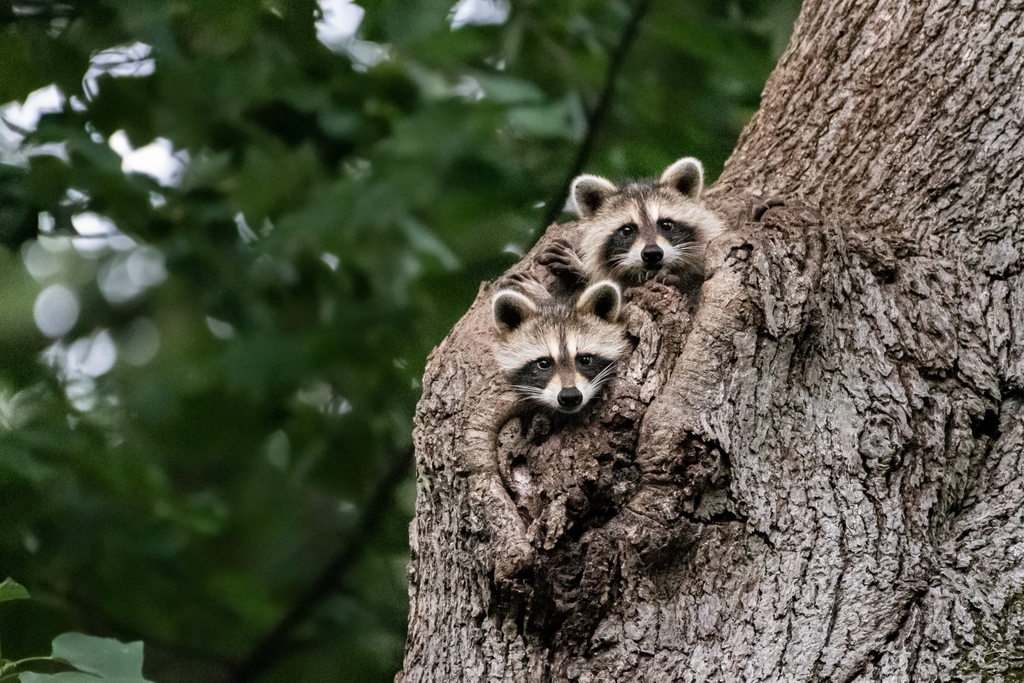
Northern Raccoon
Photo © Troy B
Photo © Troy B — CC BY 4.0 — Source: iNaturalist photo #87560608Identification
The northern raccoon is the largest member of the procyonid family, with a body length of 40 to 70 cm (16 to 28 inches) and weighing between 5 and 26 kg (11 to 57 pounds). Its grayish coat consists of dense underfur that provides excellent insulation against cold weather. The species is unmistakable in the field, distinguished by three highly recognizable features: extremely dexterous front paws, a distinctive black facial mask across the eyes, and a heavily ringed tail. These characteristic markings have made the raccoon a prominent figure in the mythologies of Indigenous peoples throughout the Americas.
Raccoons are noted for their remarkable intelligence; studies have demonstrated that they can remember solutions to tasks for at least three years. This cognitive ability, combined with their manual dexterity, makes them highly adaptable problem-solvers in diverse environments.
Range & Habitat
Native to North America, raccoons originally inhabited deciduous and mixed forests. Their exceptional adaptability has allowed them to extend their range dramatically, now occupying mountainous areas, coastal marshes, and urban environments where they have become established residents in many cities. In some locations, their presence around human settlements has led homeowners to regard them as pests.
Beyond their native range, raccoons have been introduced to central Europe, the Caucasus region, and Japan through escapes and deliberate releases during the mid-20th century. In Europe, the species is now listed as an Invasive Alien Species of Union Concern, with strict regulations preventing its importation, breeding, transportation, commercialization, or intentional release throughout the European Union.
Behaviour & Diet
Raccoons are primarily nocturnal and omnivorous, with a diet comprising approximately 40% invertebrates, 33% plants, and 27% vertebrates. Once thought to be solitary animals, research has revealed complex sex-specific social behaviors. Related females often share common areas, while unrelated males form groups of up to four individuals to maintain territorial dominance during mating season and against potential invaders. Home range sizes vary considerably, from as little as 3 hectares (7.4 acres) for females in urban areas to 5,000 hectares (50 square kilometers) for males in prairie habitats.
After a gestation period of approximately 65 days, females give birth to two to five young called kits in spring. Mothers raise their kits alone until the young disperse in late fall. Although captive raccoons may live over 20 years, wild raccoons typically have a life expectancy of only 1.8 to 3.1 years, with hunting and vehicular injury being the most common causes of mortality in many areas.
Best Time & Places to See It
As nocturnal animals, raccoons are most active and visible during evening and night hours. They are encountered most frequently in mixed and deciduous forests, their original native habitat. However, increasingly, they can be spotted in urban and suburban areas, particularly around human settlements where food sources are readily available. Wetland areas and coastal marshes also provide excellent viewing opportunities.
Spring and early summer offer good chances to observe raccoons, particularly mothers with their dependent kits. Urban parks and gardens adjacent to natural areas often provide reliable sightings, especially in regions where raccoon populations are well-established.
Photography Tips
Photograph raccoons during twilight hours or night, using appropriate lighting techniques such as flash or infrared equipment. Their distinctive facial mask and ringed tail photograph exceptionally well and should be prioritized in composition. The contrast between their dark mask and lighter facial areas creates striking images, particularly when side-lit or backlit.
Patience is essential for raccoon photography, as they are naturally cautious and nocturnal. Using remote cameras or long lenses allows you to capture natural behavior without disturbance. Look for opportunities to photograph them foraging, climbing, or interacting with their environment—their manual dexterity and intelligent expressions make for compelling wildlife images that capture their distinctive character.
Acadia National Park
Alaska Maritime National Wildlife Refuge
Algonquin Provincial Park
Alligator River National Wildlife Refuge
Arches National Park
Arenal Volcano National Park
Avesnois Regional Nature Park
Barra del Colorado National Wildlife Refuge
Bear River Migratory Bird Refuge
Nothing matches these filters.
No community photos yet. Log in to add the first one.
No community observations of this species yet.