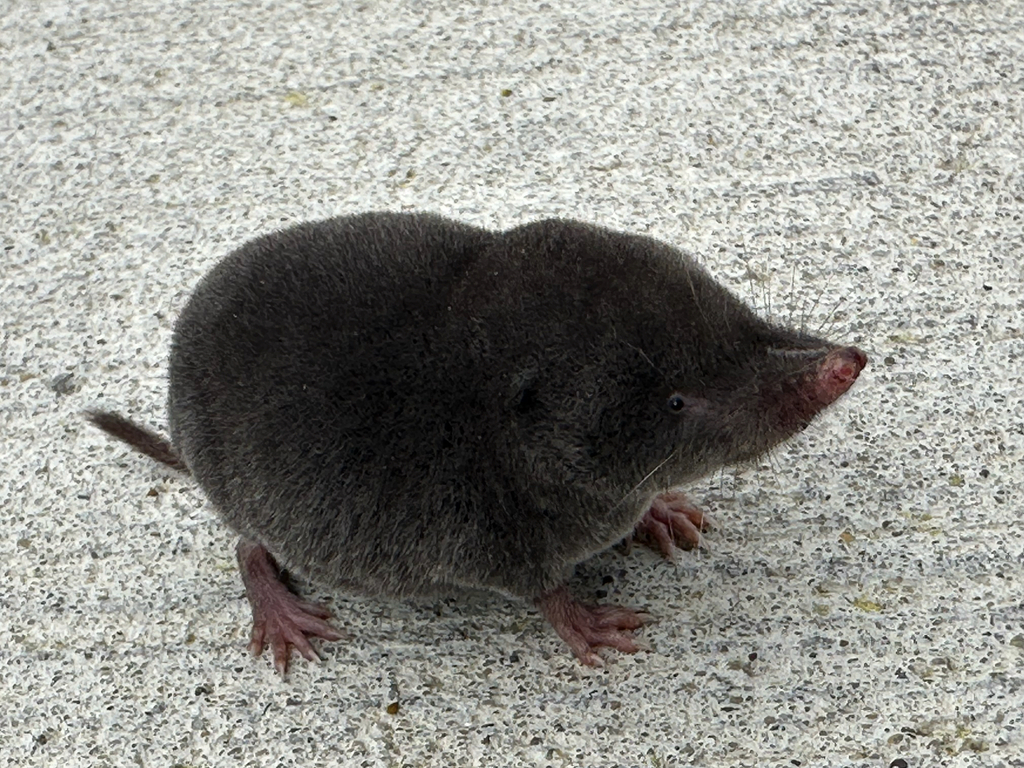
Northern Short-tailed Shrew
Photo © Tommy
Photo © Tommy — CC0 1.0 — Source: iNaturalist photo #497621894Identification
The northern short-tailed shrew is the largest member of the genus Blarina, a compact mammal measuring 108 to 140 mm in total length, with a characteristically short tail comprising less than 25% of its body length. Adults weigh between 15 and 30 grams, with males slightly larger than females. The dorsal fur is thick and velvety, ranging from black and brownish-black to silvery gray, while the ventral fur is lighter and grayer. The shrew undergoes seasonal molting, shedding its shorter, paler summer coat in October and November for a thicker winter pelage, then molting back again between February and July.
A distinctive feature of this species is its red-toothed dentition—a characteristic shared with related shrews. The shrew possesses three well-developed scent glands, including one on each side and one ventral gland, which it uses for territorial marking. Despite these adaptations, the northern short-tailed shrew has poor vision, with degenerated eyes capable only of detecting light; instead, it relies on echolocation and a keen sense of touch to navigate its environment.
Range & Habitat
This shrew is found throughout central and eastern North America, from southern Saskatchewan to Atlantic Canada, extending south to northern Arkansas and Georgia. It is probably the most common shrew in the Great Lakes region. Population densities typically range from five to 30 shrews per hectare, though they rarely exceed 200 per hectare, with individual shrews maintaining home ranges of approximately 2.5 hectares that may slightly overlap with those of other shrews.
Northern short-tailed shrews occupy both disturbed and undisturbed habitats, including grasslands, old fields, fencerows, marshy areas, deciduous and coniferous forests, and household gardens. They show a preference for moist environments with abundant leaf litter or thick plant cover. However, they are slow to recolonize burned-over forests and quickly abandon clear-cut areas, making intact forest structure important for their persistence.
Behaviour & Diet
The northern short-tailed shrew is a highly active, semifossorial insectivore with an extraordinary appetite, consuming up to three times its own weight in food daily. Though it eats small quantities of subterranean fungi and seeds, it is predominantly carnivorous, preferring insects such as beetles, earthworms, voles, snails, and other shrews. Notably, this species consumes vertebrates more frequently than other shrews, and its diet also includes salamanders, frogs, snakes, birds, and mice. The shrew forages primarily within a few hours after sunset, though it remains active during cloudy days. Remarkably, it caches 87% of its captured prey, eating only 9% immediately and leaving 4% at kill sites—a behavior particularly pronounced during fall and winter or times of prey abundance.
One of the few venomous mammals, the northern short-tailed shrew uses a specialized hunting weapon: its saliva contains a kallikrein-like protease secreted from submaxillary glands. This toxin, delivered through grooves in the lower incisors, is potent enough to paralyze and subdue prey larger than the shrew itself, and it produces painful bites in humans who handle the animal.
Best Time & Places to See It
Observing northern short-tailed shrews in the field is challenging due to their small size, cryptic behavior, and primarily nocturnal activity patterns. They are most active during twilight hours and overcast days, making early evening or cloudy afternoon periods the best times for potential encounters. The Great Lakes region offers the highest probability of encountering this species, where it reaches peak abundance.
Search in moist habitats with thick leaf litter and dense plant cover—ideal conditions include the edges of forests, marshy areas, and hedgerows. Since these shrews require access to water sources and prefer undisturbed areas with substantial ground cover, focusing on the margins between open grasslands and forested areas, particularly near streams or wet ground, increases your chances of observation.
Photography Tips
Photographing the northern short-tailed shrew presents considerable challenges. Its small size, poor eyesight, and preference for activity during low-light conditions mean that traditional daytime photography is unlikely to be successful. The best approach involves setting up camera traps with infrared triggers in promising habitat, particularly along foraging routes near water sources and within areas of dense ground cover.
If attempting to photograph this shrew directly, use high-speed flash equipment and be prepared for extremely brief exposure windows. Wide-angle macro lenses will be necessary to capture useful detail of this diminutive animal. Exercise caution when handling the shrew for photography, as its venomous bite can be painful; observation from a distance using telephoto lenses is strongly recommended for both safety and animal welfare.
Cape Breton Highlands National Park
Cape Breton Highlands National Park, Canada
+215 birds+18 mammals
Where the Atlantic coast of Nova Scotia rises in weathered cliffs and glacially carved valleys, Cape Breton Highlands National Park spans a landscape where boreal and…
VIEW NATIONAL PARKPointe-Taillon National Park
Lac-Saint-Jean-Est, Canada
+157 birds+10 mammals
Where boreal forest meets the shores of Lac-Saint-Jean, Pointe-Taillon National Park unfolds across a landscape shaped by glacial legacy and water. Sandy peninsulas and islands rise…
VIEW NATIONAL PARKMauricie National Park
Shawinigan, Canada
+184 birds+12 mammals
Where the Canadian Shield meets boreal forest, Mauricie National Park unfolds across a landscape of granite ridges, crystalline lakes, and dense coniferous woodland that defines the…
VIEW NATIONAL PARKVoyageurs National Park
Northwest Saint Louis, United States
+198 birds+13 mammals
Where the boreal forest meets the glacially sculpted lakes of northwestern Minnesota, Voyageurs National Park sprawls across nearly two thousand square kilometres of a landscape shaped…
VIEW NATIONAL PARKIndiana Dunes National Park
Porter, United States
+304 birds+15 mammals
Along the southern shore of Lake Michigan, where glacial geology meets temperate woodland and open water, sprawls a landscape of extraordinary ecological complexity. The dunes themselves—massive…
VIEW NATIONAL PARKGreat Smoky Mountains National Park
Sevier County, United States
+244 birds+40 mammals
Where the southern Appalachian ridgeline reaches its most densely forested expression, over 4,200 square kilometres of temperate woodland rise and fall across Tennessee and North Carolina,…
VIEW NATIONAL PARKÎles-De-Boucherville National Park
Boucherville, Canada
+243 birds+8 mammals
Where the Saint Lawrence River braids into a labyrinth of islands and channels, Îles-de-Boucherville National Park sprawls across approximately 18 square kilometres of riverine wilderness just…
VIEW NATIONAL PARKAcadia National Park
Bar Harbor, United States
+291 birds+27 mammals
Where the Maine coast rises in granite cliffs and spruce-clad headlands, Acadia National Park unfolds across Mount Desert Island and its surrounding waters, a landscape carved…
VIEW NATIONAL PARKCuyahoga Valley National Park
Brecksville, United States
+255 birds+27 mammals
Where the Cuyahoga River carves through a glaciated landscape of Ohio, the valley reveals a temperate deciduous forest ecosystem shaped by four distinct seasons and reliable…
VIEW NATIONAL PARKShenandoah National Park
Page County, United States
+243 birds+31 mammals
Ridges of ancient quartzite rise above the Shenandoah Valley floor, their slopes dressed in a mosaic of oak and hickory forest that yields to cove hardwoods…
VIEW NATIONAL PARKChincoteague National Wildlife Refuge
Chincoteague, United States
+362 birds+16 mammals
Across the barrier islands and salt marshes of Virginia's Eastern Shore, where Atlantic tides sculpt an intricate mosaic of sandy spits and tidal flats, lies one…
VIEW WILDLIFE SANCTUARYBombay Hook National Wildlife Refuge
Kent County, United States
+323 birds+15 mammals
Tidal marshes and brackish shallows define this sanctuary on Delaware's Atlantic coast, where the meeting of freshwater and salt creates some of the Mid-Atlantic's most dynamic…
VIEW WILDLIFE SANCTUARYAlligator River National Wildlife Refuge
Dare County, United States
+288 birds+17 mammals
Where the coastal plain of North Carolina meets the Albemarle Peninsula, a sprawling mosaic of freshwater marshes, pocosins, and swamp forest creates one of the Atlantic…
VIEW WILDLIFE SANCTUARYNo community photos yet. Log in to add the first one.
No community observations of this species yet.