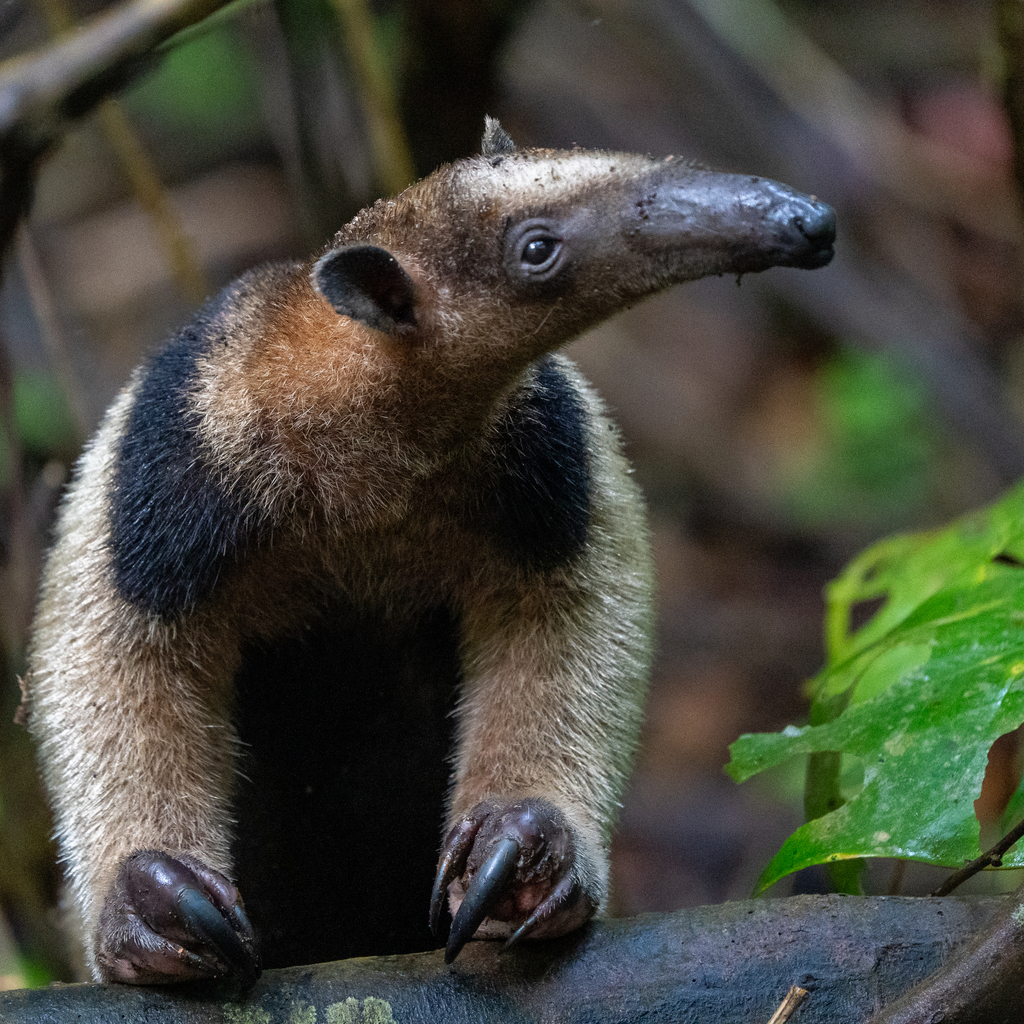
Northern Tamandua
Photo © Anthony Batista
Photo © Anthony Batista — CC BY 4.0 — Source: iNaturalist #344696790Identification
The northern tamandua is a medium-sized anteater instantly recognizable by its distinctive two-tone coloration: pale yellow fur covers most of the body, while a bold black patch extends across the flanks, back, and shoulders in a vest-like pattern. Adults measure 102 to 130 centimetres in total length, including a prehensile tail, and weigh between 3.2 to 5.4 kilograms. They have a characteristically long snout, small eyes and ears, and a semi-hairless tail that bears fur only on its upper third. The forefeet have four toes while the hind feet have five; the middle toe of the forefoot bears an unusually large claw used for ripping open wood.
The northern tamandua's entire anatomy reflects its specialized diet. Its tongue is extraordinarily long and extensible, covered in sticky saliva that adheres to ants and termites. The jaw is reduced and fragile, as the animal possesses no teeth whatsoever. Unlike the larger giant anteater, this species is also adapted for climbing, with prehensile forefeet capable of gripping branches and tree projections.
Range & Habitat
The northern tamandua inhabits tropical and subtropical forests from southern Mexico southward through Central America and into South America, reaching western Colombia, Venezuela, Ecuador, and the northwestern corner of Peru. The species shows considerable geographic variation, with four recognized subspecies occupying different regions of this vast range.
These adaptable animals thrive in diverse forest types including evergreen and deciduous forests, mangrove swamps, cloud forests, and secondary growth areas. They occupy solitary home ranges of 25 to 70 hectares throughout their preferred habitats.
Behaviour & Diet
Northern tamanduas are primarily nocturnal but regularly active during daylight hours, spending roughly 40 percent of their time in the trees and the remainder foraging on the ground. Active for approximately eight hours daily, they rest in hollow trees during their inactive periods. These solitary animals locate their prey—ants and termites—entirely by scent, using their powerful claws to excavate nests. They may consume up to 9,000 insects daily from 50 to 80 different nests, targeting larger insects exceeding 4 millimetres in length. Despite their feeding activities, they cause little permanent damage to colonies, likely because they spend minimal time at each nest before being driven away by the insects' defensive behavior.
When threatened, northern tamanduas can rear up on their hind legs and tail, using a tree or rock for support while lashing out with their claws. Jaguars, harpy eagles, and large snakes are known predators. Communication occurs primarily through scent marking via anal glands, though infants are vocal while adults rarely vocalize.
Best Time & Places to See It
Northern tamanduas are most active during night hours and early morning, making these the optimal times for observation. They can be encountered throughout their range from southern Mexico through Central America to northern South America, though sightings require patience and luck due to their cryptic nocturnal habits.
Cloud forests and other undisturbed forest habitats offer the best opportunities. Since these animals spend about 40 percent of their time in trees, observers should scan both canopy levels and the forest floor. Listen for the sound of claws digging into wood and watch for fresh excavations in termite mounds and dead wood.
Photography Tips
The northern tamandua's distinctive black-and-yellow vest pattern makes for striking images. Focus on capturing the animal's unique silhouette when it rears up on its hind legs and tail—a defensive posture that clearly displays its remarkable anatomy and adaptations. The prehensile tail and climbing behavior offer excellent opportunities for dynamic composition when the animal is photographed in trees.
Use a fast shutter speed to freeze movement during nocturnal encounters, and employ a headlamp or red light source to minimize disturbance. The animal's long snout and small facial features are worth capturing in detail, as is the texture of its specialized claws. Early morning light offers better opportunities than deep night for quality color photography.
Manuel Antonio National Park
Quepos, Costa Rica
+426 birds+22 mammals
Where tropical rainforest descends steeply to a rocky Pacific coastline, Manuel Antonio National Park distills Central American biodiversity into one of Costa Rica's most compressed and…
VIEW NATIONAL PARKArenal Volcano National Park
Peñas Blancas, Costa Rica
+551 birds+21 mammals
Straddling the border between Alajuela and Guanacaste in northwestern Costa Rica, this national park rises dramatically around one of Central America's most active volcanic systems. The…
VIEW NATIONAL PARKTortuguero National Park
Roxana, Costa Rica
+420 birds+23 mammals
Canals and lagoons thread through a labyrinth of lowland rainforest where the Caribbean coast of Costa Rica meets the wetland frontier. This is terrain shaped by…
VIEW NATIONAL PARKBraulio Carrillo National Park
Las Horquetas, Costa Rica
+547 birds+18 mammals
Where the Caribbean slope descends from the central volcanic cordillera toward the humid lowlands of Heredia, Braulio Carrillo National Park preserves one of Costa Rica's most…
VIEW NATIONAL PARKPiedras Blancas National Park
Golfito, Costa Rica
+386 birds+24 mammals
Where the Golfo Dulce meets the southwestern Pacific coast of Costa Rica, Piedras Blancas National Park protects a dramatic transition zone where lowland rainforest descends toward…
VIEW NATIONAL PARKSanta Rosa National Park
Santa Elena, Costa Rica
+359 birds+30 mammals
Where Pacific-facing slopes descend from volcanic uplands toward the Guanacaste lowlands, Santa Rosa National Park unfolds across a mosaic of tropical dry forest, gallery woodland, and…
VIEW NATIONAL PARKGuanacaste National Park
Santa Elena, Costa Rica
+461 birds+17 mammals
Where the Pacific slopes of northwestern Costa Rica rise toward the Continental Divide, dry tropical forest gives way to cloud-laden peaks and misty ridges—a landscape that…
VIEW NATIONAL PARKGeneral de División Omar Torrijos Herrera National Park
La Pintada, Panama
+401 birds+2 mammals
Across the highlands of central Panama, where the continental divide funnels moisture-laden trade winds into steep river valleys, the terrain rises and falls in a landscape…
VIEW NATIONAL PARKSoberanía National Park
Cristóbal, Panama
+495 birds+34 mammals
Rainforest and riverine woodland blanket the rolling terrain of this 714-square-kilometre national park in Colón Province, where the Caribbean watershed feeds a maze of streams and…
VIEW NATIONAL PARKMontes Azules
Candelaria, Mexico
+395 birds+47 mammals
Where jungle-clad limestone plateaus plunge into canyon systems carved by the Usumacinta River, Mexico's most pristine rainforest reserve unfolds across the Lacandón region of Chiapas. Montes…
VIEW BIOSPHERE RESERVETikal National Park
Tikal, Guatemala
+399 birds+16 mammals
Dense rainforest canopy rises above the limestone plateau of Petén, where archaeological wonder and ecological richness merge seamlessly across one of Central America's most biodiverse landscapes.…
VIEW NATIONAL PARKLaguna del Tigre National Park
Petén, Guatemala
+399 birds+29 mammals
Where the Petén lowlands dissolve into wetland and forest, Laguna del Tigre National Park protects one of Guatemala's most ecologically vital landscapes. This sprawling reserve encompasses…
VIEW NATIONAL PARKCarara National Park
Tárcoles, Costa Rica
+397 birds+19 mammals
Where the Pacific coastal plain meets transitional forest, Carara National Park straddles one of Central America's most dynamic ecological boundaries. The park's landscape encompasses lowland deciduous…
VIEW NATIONAL PARKPalo Verde National Park
Bagaces, Costa Rica
+318 birds+24 mammals
Dry forest spreads across Palo Verde's low-lying terrain in northwestern Guanacaste, where seasonal rivers and lagoons etch through deciduous woodland that sheds its canopy each winter.…
VIEW NATIONAL PARKCahuita National Park
Talamanca, Costa Rica
+359 birds+15 mammals
Where the Caribbean shoreline dissolves into mangrove creeks and coral gardens, Cahuita's mosaic of habitats unfolds across the Limón coast. The park's signature feature—a living coral…
VIEW NATIONAL PARKRincón de la Vieja National Park
Liberia, Costa Rica
+451 birds+30 mammals
Where volcanic slopes rise abruptly from the Guanacaste lowlands, Rincón de la Vieja National Park sprawls across a landscape shaped by geothermal drama and seasonal extremes.…
VIEW NATIONAL PARKTapantí Macizo de la Muerte National Park
Orosi, Costa Rica
+503 birds+18 mammals
Where montane cloud forest rises steeply from the Orosi Valley, Tapantí Macizo de la Muerte National Park enfolds a landscape of perpetual moisture and emerald complexity.…
VIEW NATIONAL PARKLa Amistad International Park
Crorina, Costa Rica
+532 birds+20 mammals
Where the Caribbean slopes of Costa Rica's Talamanca Mountains rise steeply inland from Limón, the boundary between two nations dissolves into an unbroken expanse of rainforest.…
VIEW NATIONAL PARKVolcán Tenorio National Park
Guatuso, Costa Rica
+480 birds+12 mammals
Where volcanic slopes rise through Costa Rica's northwestern borderlands, Volcán Tenorio National Park sprawls across terrain shaped by ancient lava flows and mineral-rich springs. The park's…
VIEW NATIONAL PARKMarino Ballena National Park
Bahía Ballena, Costa Rica
+336 birds+8 mammals
Where mangrove forests meet coral-fringed shorelines along Costa Rica's southern Pacific coast, Marino Ballena National Park encompasses a marine and terrestrial mosaic that ranks among Central…
VIEW NATIONAL PARKMarino Las Baulas National Park
Santa Cruz, Costa Rica
+246 birds+9 mammals
Where the Pacific meets a mosaic of dry forest and mangrove estuary, this coastal national park protects one of Central America's most dynamic wildlife theatres. The…
VIEW NATIONAL PARKCaño Negro National Wildlife Refuge
Caño Negro District, Costa Rica
+486 birds+16 mammals
Where the San Juan River's seasonal floodplain opens into expansive wetlands, Caño Negro Wildlife Sanctuary sprawls across one of Central America's most productive freshwater ecosystems. This…
VIEW WILDLIFE SANCTUARYBarra del Colorado National Wildlife Refuge
Tortuguero, Costa Rica
+462 birds+36 mammals
Where the Caribbean's restless waters meet the Limón Province coastline, Barra del Colorado National Wildlife Sanctuary unfolds across a landscape of extraordinary ecological complexity. This equatorial…
VIEW WILDLIFE SANCTUARYCurú National Wildlife Refuge
Paquera, Costa Rica
+249 birds+8 mammals
Where the Pacific coast of Puntarenas dissolves into dry deciduous forest and mangrove fringe, Curú Wildlife Sanctuary holds one of Costa Rica's most ecologically vital yet…
VIEW WILDLIFE SANCTUARYNo community photos yet. Log in to add the first one.
No community observations of this species yet.