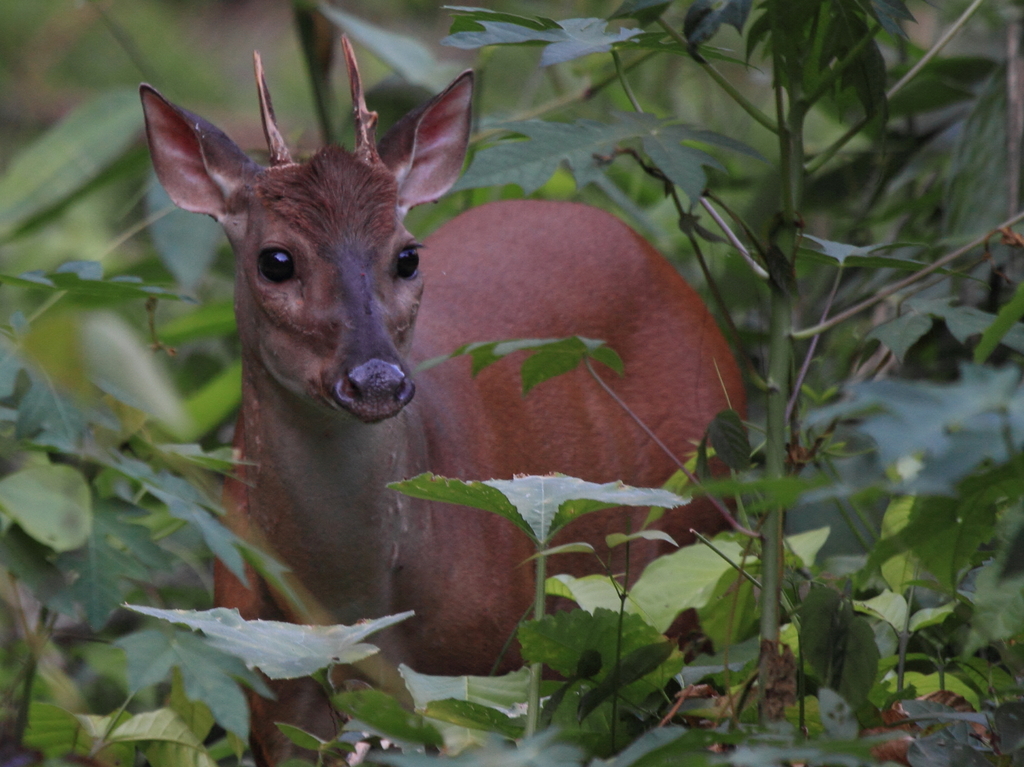
Northwestern Red Brocket
Photo © Fábio Olmos
Photo © Fábio Olmos — CC BY 4.0 — Source: iNaturalist photo #73723109Identification
The Northwestern Red Brocket is the largest of the brocket deer species, with a distinctive reddish-brown body, lighter grayish-brown head and neck, and partially blackish legs. The inner thighs and underside of the tail are white, providing a useful field mark when the deer moves through dense vegetation. Only adult males bear antlers, which are small and spike-like rather than branched. Fawns are spotted white and lack the dark coloration on the legs seen in adults.
These compact but sturdy deer stand 67–80 cm at the shoulder, with a head and body length of 105–144 cm. Most individuals weigh 24–48 kg, though exceptional males may reach 65 kg. The small stature, stocky build, and cryptic coloration are all adaptations to life in dense tropical forest.
Range & Habitat
The Northwestern Red Brocket has the widest range of any brocket species, occurring throughout forests in South America from northern Argentina to Colombia and the Guianas. It is notably present on the Caribbean island of Trinidad, though it has been extirpated from Tobago in very recent historical times. The species is highly dependent on dense jungle habitat, where it stays concealed among thick vegetation.
Over much of its range, this deer is sympatric with the smaller Amazonian brown brocket, though the latter maintains significantly lower population densities. Considerable taxonomic confusion remains within red brocket populations across this vast range, reflecting the challenges of studying secretive forest deer across diverse habitats.
Behaviour & Diet
The Northwestern Red Brocket is generally solitary, spending its time in dense jungles where it browses on grasses and tender green roots. The species shows a strong preference for fruit and seeds when these are available, and also feeds on fungi—a dietary strategy unusual among deer. This opportunistic approach allows the species to exploit the diverse food sources of tropical forests across seasons.
When its preferred foods become scarce, the red brocket will eat stems, bark, petioles, leaves, and even animal matter. When alarmed, the deer alerts nearby individuals by snorting or stamping its hooves, a distinctive behaviour that may help other forest inhabitants detect predators.
Best Time & Places to See It
Finding the Northwestern Red Brocket requires patience and access to intact tropical forest. The species' range extends across Colombia, the Guianas, and into Argentina, offering opportunities in various protected areas and forest reserves throughout northern South America. Trinidad also supports populations, making it a more accessible destination for some travellers. Early morning and late afternoon are typically the best times to encounter forest deer.
The species' preference for dense jungle and generally solitary, cryptic behaviour means sightings are never guaranteed. Guided walks in primary or mature secondary forest, particularly near fruiting trees and areas with fungi growth, offer the best chances of encounters.
Photography Tips
Photographing the Northwestern Red Brocket demands patience, as these solitary forest dwellers are naturally wary and well-concealed in dense vegetation. Fast film or high ISO settings are essential in the dim light of the jungle understory. A telephoto lens (at least 200mm) allows you to maintain distance and avoid alarming the animal, which may respond by snorting and stamping rather than fleeing.
Look for the white underside of the tail and inner thighs as the deer moves through forest—these bright patches can catch your eye in otherwise dark surroundings. Focus on capturing the distinctive reddish-brown colouration and the characteristic lighter head and neck, which are key identification features. Patience near fruiting trees at dawn or dusk may yield the best opportunities for close, natural-behaviour shots.
Yasuní National Park
Aguarico, Ecuador
+601 birds+43 mammals
Where the western Amazon basin converges with Ecuador's Orellana Province, lowland rainforest reaches toward the horizon in an unbroken canopy of staggering botanical density. Yasuní National…
VIEW NATIONAL PARKCampos Amazónicos National Park
Amazonas, Brazil
+434 birds+7 mammals
Sprawling across the southwestern Amazon basin in Amazonas state, this 27,263-square-kilometre national park encompasses some of the region's most pristine lowland rainforest, where terra firme forest…
VIEW NATIONAL PARKManu National Park
Manu, Peru
+892 birds+26 mammals
Across the eastern slopes of the Peruvian Andes, tropical rainforest descends into the Amazon basin with a complexity that few terrestrial ecosystems match. Manu National Park…
VIEW NATIONAL PARKNo community photos yet. Log in to add the first one.
No community observations of this species yet.