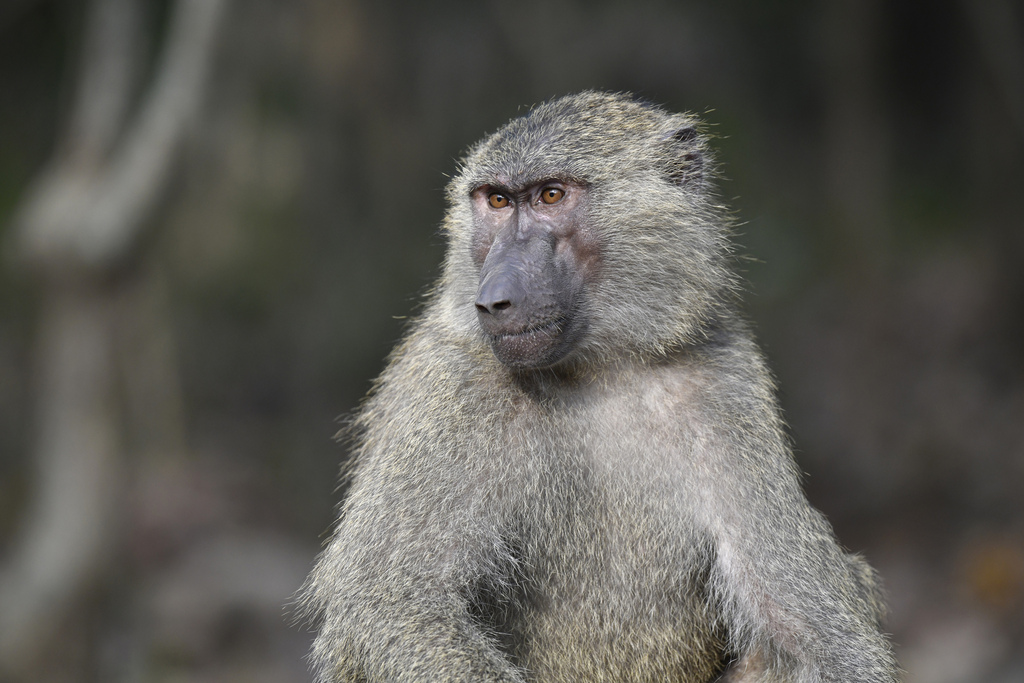
Olive Baboon
Photo © Zac Peterson
Photo © Zac Peterson — CC BY 4.0 — Source: iNaturalist photo #475631929Identification
The olive baboon takes its name from its distinctive coat, which appears as a shade of green-grey when viewed from a distance. At closer range, the coat reveals a multicoloured pattern created by rings of yellow-brown and black on individual hairs. The face is covered in coarser hair ranging from dark grey to black. Males are noticeably larger than females and possess a prominent mane of longer hair that tapers down the back, giving them a distinctive silhouette. Like all baboons, olive baboons have an elongated, dog-like muzzle and a characteristic tail that stands erect for the first quarter before dropping sharply, almost as if broken. The bare patch on their rump is smaller than in related species.
Olive baboons are among the largest monkey species. Males typically stand 70 cm tall and weigh around 24 kg on average, though some individuals may reach 50 kg. Females are considerably smaller, averaging 60 cm in height and 14.7 kg in weight. Head-and-body length ranges from 50 to 114 cm, with an average of around 85 cm. Their four-legged gait and overall proportions give them a distinctly canine appearance.
Range & Habitat
The olive baboon is the most wide-ranging of all baboon species, occurring across 25 African countries in an equatorial strip extending from Mali in the west to Ethiopia and Tanzania in the east. Isolated populations also persist in mountainous regions of the Sahara. The species' range overlaps considerably with other baboon species, leading to hybridisation with hamadryas baboons in Ethiopia and documented cross-breeding with yellow baboons and Guinea baboons in other regions.
Olive baboons are highly adaptable and inhabit diverse ecosystems including savannahs, steppes, grasslands, rainforests, and deserts. They show a strong preference for grasslands, particularly those adjacent to open woodland. Dense tropical forest populations are notably present in Uganda and the Democratic Republic of the Congo, demonstrating their ecological flexibility across their vast continental range.
Behaviour & Diet
Olive baboons are highly social animals living in groups of 15 to 150 individuals composed of several males, many females, and their offspring. Female social rank is inherited matrilineally, with daughters acquiring their mother's position in the troop hierarchy. Related females form the stable core of baboon society, staying close together, grooming one another, and cooperating in aggressive encounters. These strong female kinship bonds persist because females do not leave their birth groups.
A fascinating aspect of olive baboon society is the formation of long-lasting "friendships" between unrelated males and females. These nonsexual bonds benefit both partners: males gain assistance integrating into new groups after immigration, while females receive protection for themselves and their infants. Males occasionally babysit for their female friends, allowing females to forage freely. Vocal and non-vocal communication systems facilitate the coordination necessary for their complex social structure, though the source does not specify their diet in detail.
Best Time & Places to See It
Olive baboons are widely distributed across East and Central Africa, making them accessible to wildlife travellers across numerous countries and protected areas. Their presence in diverse habitats—from savannahs to rainforests—means they can be encountered in various ecosystems. The Democratic Republic of the Congo and Uganda offer opportunities to see them in forest settings, while savannah reserves across the broader range provide excellent viewing in more open terrain. Their large group sizes and diurnal activity make them relatively conspicuous compared to many primate species.
Photography Tips
The olive baboon's striking appearance offers excellent photographic opportunities. The multicoloured coat with its distinctive yellow-brown and black hair rings creates visual interest, particularly in good natural light. Males' prominent manes provide dramatic subject matter and help distinguish them from females in photographs. Their characteristic dog-like profile and expressive faces are highly photogenic, especially during social interactions within groups.
Their tendency to live in open grasslands and near woodland edges often provides good lighting conditions and natural backgrounds. Capturing the troop's complex social dynamics—females grooming one another, males interacting, or the characteristic broken-tail silhouette—can yield compelling wildlife images. Early morning or late afternoon light will enhance the subtle green-grey colouration of their coat.
Serengeti National Park
Tanzania
+558 birds+57 mammals
Across Tanzania's northern plateau, where volcanic soils meet acacia woodland and open grassland, unfolds one of Earth's most dynamic ecosystems. The Serengeti National Park sprawls across…
VIEW NATIONAL PARKArusha National Park
Tanzania
+555 birds+16 mammals
Where the slopes of Mount Mawenzi rise above the Arusha region, a compact yet ecologically rich national park unfolds across montane forest, moorland, and alpine zones.…
VIEW NATIONAL PARKVirunga National Park
Uganda
+418 birds+13 mammals
Where the Western Rift Valley fractures the landscape of North Kivu, Virunga National Park sprawls across terrain as geologically dramatic as it is ecologically vital. Volcanic…
VIEW NATIONAL PARKBwindi Impenetrable National Park
Kanyashogi, Uganda
+603 birds+26 mammals
Steep ridges cloaked in montane forest rise from Uganda's southwestern borderlands, where the landscape grows so dense and tangled that early explorers named it impenetrable. At…
VIEW NATIONAL PARKKidepo Valley National Park
Uganda
+478 birds+24 mammals
Where the Narus and Kidepo rivers carve through northeastern Uganda's semi-arid lowlands, a landscape of sparse acacia woodland, grassland, and riverine thickets creates one of East…
VIEW NATIONAL PARKMurchison Falls National Park
Uganda
+608 birds+33 mammals
Where the Victoria Nile compresses through a narrow gorge and explodes across a 45-meter precipice, the landscape speaks in thunder. Murchison Falls National Park sprawls across…
VIEW NATIONAL PARKLake Mburo National Park
Uganda
+505 birds+24 mammals
Rolling acacia woodland and scattered lakes define this intimate savanna preserve in southwestern Uganda, where the rift valley's geological drama shapes every water source and grassland.…
VIEW NATIONAL PARKTsavo East National Park
Athi ward, Kenya
+468 birds+50 mammals
Across the semi-arid lowlands of southeastern Kenya, where acacia woodland fragments into scrubland and the landscape rolls toward the Indian Ocean horizon, lies one of Africa's…
VIEW NATIONAL PARKTsavo West National Park
Mwatate, Kenya
+513 birds+49 mammals
Where volcanic ridges and weathered lava flows meet the semi-arid lowlands of south-central Kenya, Tsavo West National Park unfolds across a landscape sculpted by fire and…
VIEW NATIONAL PARKMount Elgon National Park
Matumbei ward, Kenya
+164 birds+7 mammals
Where the volcanic slopes of Mount Elgon rise above the Trans-Nzoia landscape, a montane wilderness unfolds across multiple ecological zones, each harbouring distinct communities adapted to…
VIEW NATIONAL PARKAmboseli National Park
Etonet/Lenkism ward, Kenya
+501 birds+43 mammals
Where the Amboseli basin opens toward the Tanzanian frontier, a shallow alkaline lake mirrors vast skies across one of East Africa's most iconic savanna landscapes. The…
VIEW NATIONAL PARKMount-Kenya National Park
Abothuguchi west ward, Kenya
+334 birds+11 mammals
Where the slopes of Kenya's second-highest mountain rise steeply from the Meru County foothills, a landscape of profound ecological richness unfolds across Mount Kenya National Park.…
VIEW NATIONAL PARKTarangire National Park
Tanzania
+527 birds+50 mammals
Acacia woodland and grassland sweep across the Manyara Region where the Tarangire River carves through low hills and volcanic soils, creating one of East Africa's most…
VIEW NATIONAL PARKNgorongoro Conservation Area
Tanzania
+626 birds+55 mammals
Volcanic calderas and open grassland dominate this high plateau in northern Tanzania, where the landscape rises above 2,000 metres and ancient geological forces have shaped both…
VIEW WILDLIFE MANAGEMENT AREAToro-Semliki Proposed National Park
Uganda
+474 birds+5 mammals
Where the Albertine Rift's western escarpment rises above the Semliki River valley, a vast mosaic of forest, savanna and wetland converges to create one of East…
VIEW NATIONAL PARKQueen Elizabeth National Park
Uganda
+672 birds+30 mammals
Across the southwestern escarpment of Uganda, where the Western Rift Valley descends through ancient volcanic terrain, Queen Elizabeth National Park sprawls across more than 8,300 square…
VIEW NATIONAL PARKBale Mountains National Park
Ethiopia
+397 birds+20 mammals
Where the Ethiopian highlands rise above 4,000 metres, the Bale Mountains create a landscape of stunning ecological extremes—from afroalpine grasslands swept by wind and mist to…
VIEW NATIONAL PARKMago National Park
Ethiopia
+128 birds+3 mammals
Where the Omo River cuts through southern Ethiopia's arid borderlands, Mago National Park sprawls across a landscape of dramatic escarpments, riverine forests, and semi-arid savanna that…
VIEW NATIONAL PARKAwash National Park
Didiga, Ethiopia
+473 birds+23 mammals
Where the Ethiopian Rift Valley carves through volcanic plateaus, a ribbon of riverine forest winds through acacia scrubland and grassland, creating a mosaic of habitats that…
VIEW NATURAL PARKNech Sar National Park
Arba Minch, Ethiopia
+191 birds+10 mammals
Where the East African Rift Valley plateaus drop dramatically toward the shore of Lake Abaya, a mosaic of habitats unfolds across sun-scorched savanna and acacia woodland.…
VIEW NATIONAL PARKNairobi National Park
Nairobi, Kenya
+515 birds+35 mammals
Just minutes from Kenya's capital, where the Nairobi River winds through acacia woodland and open grassland, lies one of Africa's most paradoxical wildlife sanctuaries. The park's…
VIEW NATIONAL PARKLake Nakuru National Park
Nakuru West, Kenya
+494 birds+32 mammals
Alkaline waters ringed by acacia woodland and grassland create one of East Africa's most distinctive wetland ecosystems, where the interplay of geology and climate sustains a…
VIEW NATIONAL PARKAberdare National Park
Mweiga ward, Kenya
+394 birds+30 mammals
Where the central highlands of Kenya rise to their elemental grandeur, the Aberdare range unfolds across Nyeri County as a montane stronghold of cool, misty forest…
VIEW NATIONAL PARKMeru National Park
Igembe Central, Kenya
+408 birds+38 mammals
Granite outcrops and acacia woodland rise across the northern reaches of Meru, where semi-arid savanna transitions into drier scrubland under the fierce equatorial sun. The park's…
VIEW NATIONAL PARKSamburu National Reserve
Samburu, Kenya
+430 birds+42 mammals
Across the arid plains of northern Kenya, where scattered acacia woodland gives way to rocky outcrops and dry riverbeds, Samburu National Park unfolds as one of…
VIEW NATURE RESERVEHell’s Gate National Park
Olkaria ward, Kenya
+388 birds+18 mammals
Volcanic scarps and geothermal vents dominate the floor of Hell's Gate, where the East African Rift has carved a dramatic gorge through crystalline rock formations. The…
VIEW NATIONAL PARKNo community photos yet. Log in to add the first one.