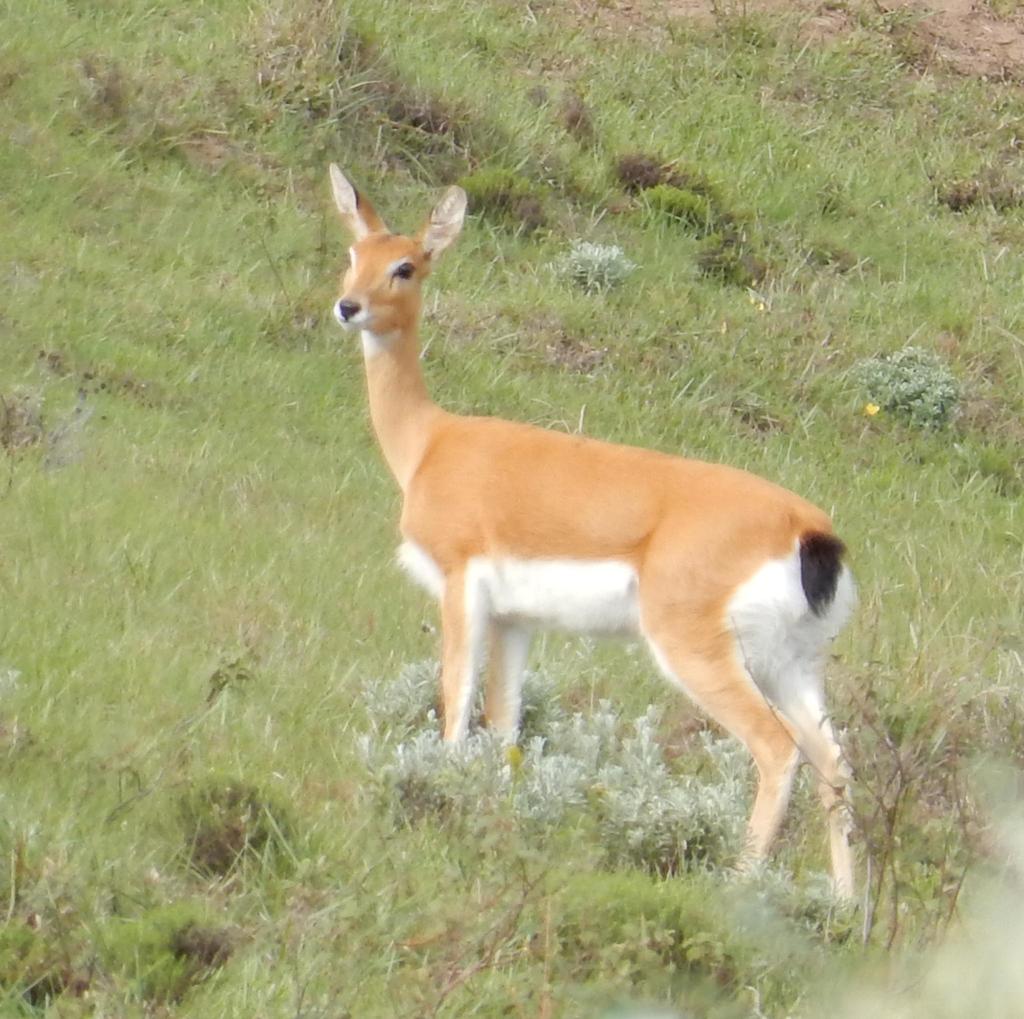
Oribi
Photo © Henry de Lange
Photo © Henry de Lange — CC BY 4.0 — Source: iNaturalist #10675738Identification
The oribi is a diminutive antelope, standing just 50–67 centimetres at the shoulder and weighing between 12–22 kilograms. Despite its small size, it cuts an elegant figure with a slightly raised back, notably long neck and limbs, and a glossy coat. The colouration is distinctive: a yellowish to rufous brown upper body contrasts sharply with white on the chin, throat, underparts and rump. The bushy tail is brown to black on the outer surface but white underneath.
The most reliable field mark for identifying males is the presence of horns—thin, straight structures measuring 8–18 centimetres long, smooth at the tips but ringed at the base. Females lack horns entirely. Both sexes possess well-developed scent glands, including prominent preorbital glands near the eyes, which are visible as notable facial features.
Range & Habitat
The oribi's range spans much of sub-Saharan Africa in a highly sporadic distribution, extending from Senegal in the west through to Ethiopia and Eritrea in the east, and southward to Angola and the Eastern Cape province of South Africa. Eight subspecies are recognised, each showing slight variations in colouration across their respective ranges.
This adaptable antelope occupies diverse grassland habitats, from savannahs and floodplains to tropical grasslands with grasses typically 10–100 centimetres tall. It also inhabits montane grasslands at low to moderate altitudes, reaching up to 2,000 metres elevation. The species is classified as Least Concern by the IUCN, though populations have declined due to agricultural expansion and competition from livestock.
Behaviour & Diet
The oribi is primarily diurnal, active throughout daylight hours, though some nocturnal activity occurs. It typically rests in cover during rain. Small herds of up to four members are common, with males defending territories ranging from 25–100 hectares. Unusually among small antelopes, oribi can exhibit three different mating systems depending on habitat conditions: polyandry, polygyny and polygynandry. Males mark their territories using preorbital gland secretions and excrement, with marking intensity increasing alongside the number of neighbouring males.
As a primarily grazer, the oribi prefers fresh grasses but browses occasionally on other vegetation. A fascinating behavioural trait is the "dung ceremony," in which all animals form temporary communal dung middens. When alarmed, oribi at least three months old produce distinctive alarm whistles—typically one to three calls—with adults and males whistling more frequently than juveniles. Mating is seasonal, with timing varying geographically; in southern Africa, births peak from November to December, following a six to seven-month gestation period. Calves are weaned at four to five months of age.
Best Time & Places to See It
Finding oribi requires patience and knowledge of local populations, as their distribution is highly sporadic across their range. The species occurs across eastern, southern and western Africa from Senegal to Ethiopia and southward to South Africa, but presence varies considerably by region. Your best chances depend on which African country you're visiting; consult local guides familiar with recent oribi sightings in your destination.
Since oribi are primarily diurnal and active during daylight hours, plan game drives or walks for morning and afternoon periods. The seasonal timing of breeding activity (peaking November–December in southern Africa) may influence movement patterns and visibility, though specific seasonal viewing recommendations vary by locality.
Photography Tips
The oribi's small size and preference for grassland habitats demand patience and a telephoto lens—at least 300mm is recommended to capture frame-filling portraits. The striking colour contrast between the rufous-brown upperparts and white underparts, chin and rump provides excellent compositional opportunities, particularly with side-on angles that showcase the sleek profile and long neck.
Early morning light is ideal for capturing the glossy coat's subtle sheen. Males with their diagnostic straight horns are particularly photogenic. Remember that these are wary animals that rest in grass cover; approach slowly and quietly. The preorbital glands and facial features are worth capturing in close-ups when possible. Their small herd sizes mean you may encounter just one or two individuals, so look for details—alarm postures, territorial marking behaviour, or the characteristic alert stance—that tell the story of their behaviour.
Serengeti National Park
Tanzania
+558 birds+57 mammals
Across Tanzania's northern plateau, where volcanic soils meet acacia woodland and open grassland, unfolds one of Earth's most dynamic ecosystems. The Serengeti National Park sprawls across…
VIEW NATIONAL PARKKidepo Valley National Park
Uganda
+478 birds+24 mammals
Where the Narus and Kidepo rivers carve through northeastern Uganda's semi-arid lowlands, a landscape of sparse acacia woodland, grassland, and riverine thickets creates one of East…
VIEW NATIONAL PARKMurchison Falls National Park
Uganda
+608 birds+33 mammals
Where the Victoria Nile compresses through a narrow gorge and explodes across a 45-meter precipice, the landscape speaks in thunder. Murchison Falls National Park sprawls across…
VIEW NATIONAL PARKNo community photos yet. Log in to add the first one.