Polar Bear
Photo © Morten Ross
Photo © Morten Ross — CC BY 4.0 — Source: iNaturalist photo #111316985Identification
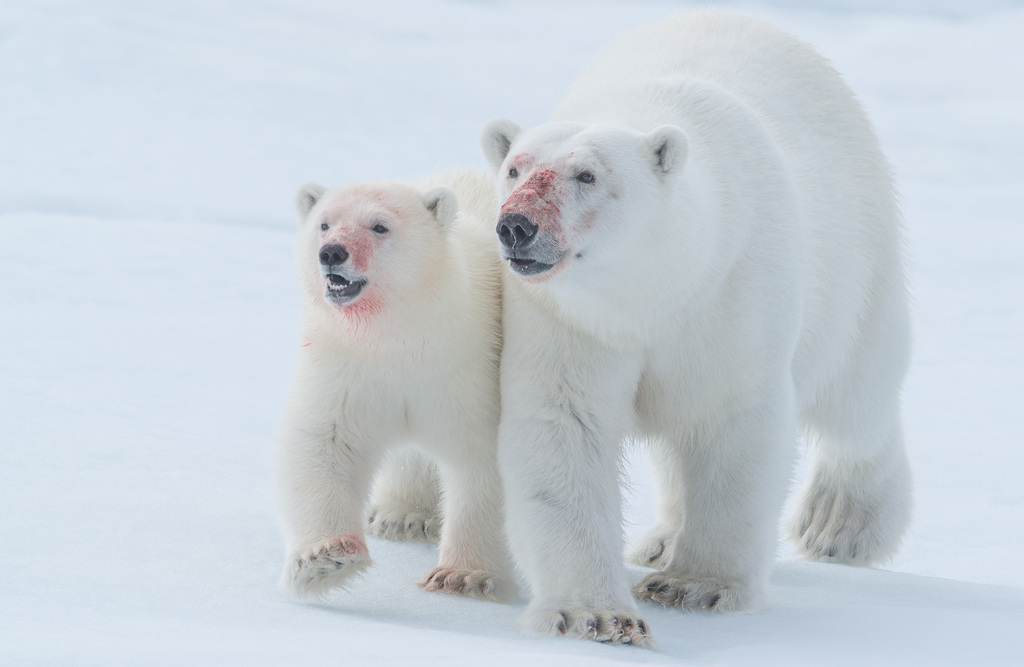
The polar bear is the largest extant species of bear and land carnivore by body mass, with adult males weighing 300–800 kg (660–1,760 lb). Females are considerably smaller, making this species distinctly sexually dimorphic. Polar bears are easily recognised by their white or yellowish fur paired with black skin underneath, and they possess a thick layer of fat for insulation in Arctic conditions. More slender than their brown bear cousins, polar bears have a narrower skull, longer neck, and lower shoulder hump. Their teeth are sharper and more specialised for cutting meat, and their large paws are perfectly adapted for walking on ice and paddling through water.
Range & Habitat
Polar bears are native to the Arctic and nearby areas, where they occupy a unique ecological niche as both terrestrial and ice-living animals. Classified as marine mammals due to their dependence on marine ecosystems, they prefer the annual sea ice where they spend much of their time. During summer months when ice melts, they move onto land, where they may spend extended periods waiting for conditions to change. This dual existence—equally adapted to frozen seas and solid ground—defines their survival strategy in one of Earth's most extreme environments.
Behaviour & Diet
Polar bears are mostly carnivorous and have become specialised hunters of seals, particularly ringed seals. They employ sophisticated hunting techniques, stalking prey across ice or in water, and patiently waiting at breathing holes or ice edges for seals to surface. Once successful, they primarily feed on the energy-rich blubber rather than consuming the entire animal. Other prey includes walruses, beluga whales, and terrestrial animals when available.
These bears are typically solitary hunters, though they gather in groups when on land. During breeding season, males guard females and actively defend them from rivals. Females give birth to cubs in maternity dens during winter, and young cubs remain dependent on their mothers for up to two and a half years, learning essential survival skills in this harsh environment.
Best Time & Places to See It
The polar bear is classified as vulnerable by the International Union for Conservation of Nature, with an estimated population of 22,000 to 31,000 individuals across the Arctic. However, viewing opportunities are limited and challenging due to their remote habitat and the logistical difficulties of Arctic travel. The bears' distribution and accessibility vary seasonally with sea ice conditions, which are increasingly unpredictable due to climate change. Those seeking to observe polar bears should consult with Arctic wildlife specialists and tour operators experienced in extreme-environment expeditions.
Photography Tips
Photographing polar bears presents extreme challenges and requires specialised equipment designed for Arctic conditions. The white and yellowish fur can be difficult to expose correctly against snow and ice, necessitating careful metering and potentially deliberate overexposure to retain detail in the subject. The bears' large size and powerful build make for dramatic compositions, but safety distances must be maintained at all times. Long lenses are essential both for capturing detail and for maintaining safe distances from these apex predators. Given climate change impacts on sea ice, documenting polar bears has become increasingly important for conservation awareness.
South Spitsbergen National Park
Norway
+41 birds+15 mammals
Glaciers and tundra meet in Norway's high Arctic, where South Spitsbergen National Park sprawls across the southernmost reaches of the Svalbard archipelago. Here, massive valley glaciers…
VIEW NATIONAL PARKNorthwest Spitsbergen National Park
Norway
+58 birds+17 mammals
Where the High Arctic converges with the Norwegian mainland, Northwest Spitsbergen National Park sprawls across one of Earth's most extreme and pristine wildernesses. Crowned by jagged…
VIEW NATIONAL PARKNorthern Isfjorden National Park
Norway
+40 birds+12 mammals
Where the Arctic fjord system cuts deep into Svalbard's northwestern coast, Northern Isfjorden National Park protects a landscape of stark geological drama—towering cliff faces, tidewater glaciers,…
VIEW NATIONAL PARKSirmilik National Park
Qikiqtaaluk Region, Canada
+58 birds+4 mammals
Where the Canadian Arctic archipelago fractures into a labyrinth of islands, Sirmilik National Park protects one of the High North's most pristine marine and terrestrial ecosystems.…
VIEW NATIONAL PARKWapusk National Park
Unorganized Division No. 23, Canada
+140 birds+6 mammals
Across the subarctic lowlands of northern Manitoba, where permafrost underlies a mosaic of stunted boreal forest, open muskeg, and coastal tundra, Wapusk National Park sprawls across…
VIEW NATIONAL PARKSassen-Bünsow Land National Park
Soere, Norway
+30 birds+10 mammals
Where Arctic tundra sprawls across glaciated plateaus in the remote Svalbard archipelago, a realm of raw geological drama unfolds. Sassen-Bünsow Land National Park encompasses a landscape…
VIEW NATIONAL PARKWrangel Island Nature Reserve
Wrangel Island, Russia
+25 birds+11 mammals
Where the Chukchi Sea fractures Arctic ice beneath an unforgiving sky, a lonely island holds one of Earth's most pristine ecosystems. Wrangel Island spans tundra so…
VIEW NATURE RESERVEScoresby Sund
Vandreblok, Greenland
+43 birds+9 mammals
Where granite peaks pierce an Arctic sky and the world's largest fjord system carves deep into northeastern Greenland, a primordial landscape unfolds in shades of ice-blue…
VIEW PROTECTED LANDSCAPENortheast Greenland National Park
Northeast Greenland National Park, Greenland
+34 birds+10 mammals
Where granite peaks plunge into the Arctic Ocean and pack ice dominates a landscape of incomparable vastness, one of Earth's most remote wildernesses reveals itself. Spanning…
VIEW NATIONAL PARKRussian Arctic National Park
Russia
+23 birds+3 mammals
Across the stark tundra of Russia's northwestern Arctic, where permafrost defines the land and sunlight dictates the rhythm of life, lies a landscape sculpted by ice…
VIEW NATIONAL PARKArctic National Wildlife Refuge
Arctic Village, United States
+132 birds+15 mammals
Across the northernmost reaches of Alaska's Unorganized Borough, where the Brooks Range rises from the coastal plain and tundra spreads endlessly toward the Arctic Ocean, lies…
VIEW WILDLIFE SANCTUARYAlaska Maritime National Wildlife Refuge
Alaska, United States
+391 birds+58 mammals
Where the North Pacific collides with Alaska's rugged coastline, a sprawling archipelago of islands, rocky outcrops, and coastal headlands forms one of North America's most remote…
VIEW WILDLIFE SANCTUARYNo community photos yet. Log in to add the first one.
No community observations of this species yet.