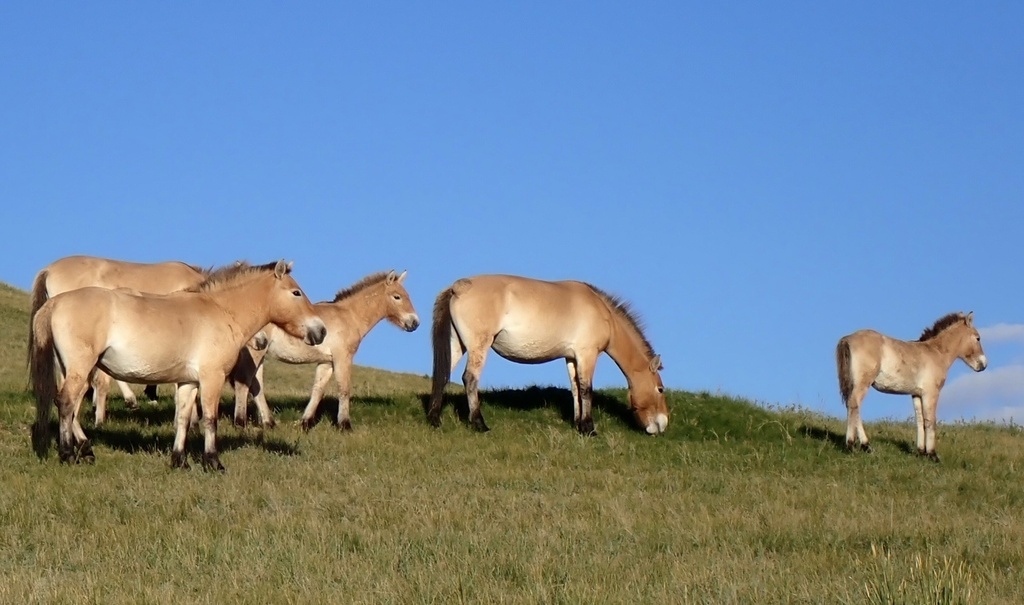
Przewalski’s horse
Photo © Peggy Schaeffer
Photo © Peggy Schaeffer — CC BY 4.0 — Source: iNaturalist photo #564557715Przewalski's horse (Equus ferus przewalskii or Equus przewalskii), also called the takhi, Mongolian wild horse or Dzungarian horse, is a rare and endangered wild horse originally native to the steppes of Central Asia. It is named after the Russian geographer and explorer Nikolay Przhevalsky. Once extinct in the wild, since the 1990s it has been reintroduced to its native habitat in Mongolia in the Hustai National Park, Takhin Tal Nature Reserve, Khomiin Tal, and several other locales in Central Asia and Eastern Europe. Several genetic characteristics of Przewalski's horse differ from those seen in modern domestic horses, indicating neither is an ancestor of the other. For example Przewalski's horse has 33 chromosome pairs compared with 32 for the domestic horse. Their ancestral lineages split from a common ancestor between 160,000 and 38,000 years ago, long before the domestication of the horse. Przewalski's horse was long considered the only remaining truly wild horse, in contrast with the American mustang and the Australian brumby, which are feral horses descended from domesticated animals. That status was called into question when domestic horses of the 5,000-year-old Botai culture of Central Asia were found to be more closely related to Przewalski's horses than to E.…
Hortobágy National Park
Hortobágy, Hungary
+260 birds+17 mammals
Across the North Great Plain of Hungary stretches one of Europe's most expansive semi-natural grassland systems, where horizon-wide vistas of steppe and wetland create a landscape…
VIEW NATIONAL PARKHustai National Park
Altanbulag, Mongolia
+198 birds+16 mammals
Where the steppe rolls endlessly beneath vast Mongolian skies, Hustai National Park preserves one of Central Asia's most dynamic grassland ecosystems. Rolling hills and open prairie…
VIEW NATIONAL PARKNo community photos yet. Log in to add the first one.
No community observations of this species yet.