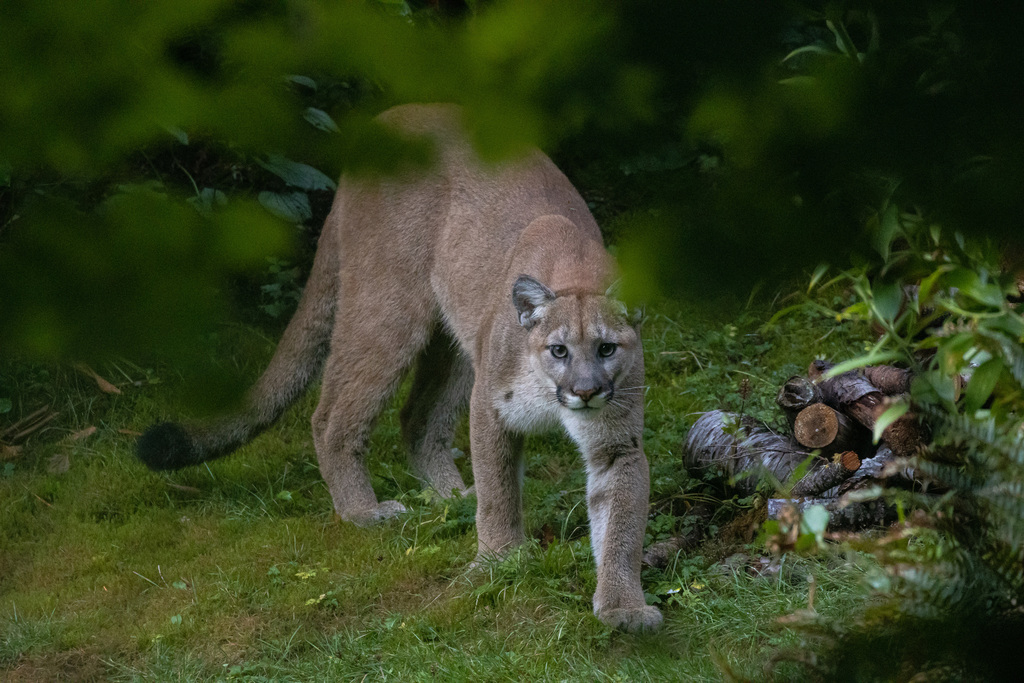
Puma
Photo © Jeff Bartlett
Photo © Jeff Bartlett — CC BY 4.0 — Source: iNaturalist photo #157098031Identification
The puma (Puma concolor) is a large feline with a distinctive appearance that makes it relatively easy to identify despite its many regional names. Its most notable feature is a long tail, which was specifically mentioned in the original scientific description. The species is solitary and largely avoids people, making direct sightings relatively uncommon for most travellers. It is not a true lion of the genus Panthera and lacks the ability to roar, despite being called "mountain lion" in parts of North America—a name that can be misleading since pumas inhabit far more than just mountainous regions.
Range & Habitat
The puma holds the distinction of being the most widely distributed wild terrestrial mammal in the Western Hemisphere. Its range spans from Yukon, British Columbia and Alberta in Canada, through the Rocky Mountains and western United States, down through Mexico, Central America, and into South America where it reaches the Amazon rainforest and the southern Andes Mountains in Patagonia.
This highly adaptable species occurs in most American habitat types. It shows a preference for habitats with dense underbrush and rocky areas that facilitate stalking prey, though it also inhabits open areas. Its ability to thrive in diverse environments—from temperate forests to tropical rainforests to high mountain regions—demonstrates its remarkable ecological flexibility.
Behaviour & Diet
Pumas are largely solitary animals with variable activity patterns depending on their environment. In protected areas they may be active during the day, while in areas with human presence or other predators they tend toward crepuscular (dawn and dusk) or nocturnal activity. They are ambush predators that pursue a wide variety of prey, with ungulates—particularly deer—forming their primary diet, though they also hunt rodents. Individual home ranges vary considerably depending on terrain, vegetation, and prey abundance.
These cats are highly territorial and maintain low population densities. Importantly, while large and powerful, they are not always the dominant apex predator in their range and may yield prey to other predators. Pumas are naturally reclusive and mostly avoid human contact. Fatal attacks on humans are rare, though incidents have increased in North America as human populations have expanded into cougar habitat and established farms.
Best Time & Places to See It
Observing pumas in the wild remains challenging due to their solitary nature, reclusive behaviour, and variable activity patterns. Your best opportunities exist in protected areas where pumas maintain more predictable routines. The species' presence across such an enormous range—from Canada to Patagonia—means potential sightings are theoretically possible across much of the Americas, though actual encounters require patience, luck, and often local knowledge.
The animal's tendency to avoid people means that dawn and dusk hours in remote, rugged terrain with dense vegetation offer the best chances. Rocky areas and locations with dense underbrush are preferred hunting grounds where you might detect signs of the species even if direct observation proves elusive.
Photography Tips
Photographing pumas presents a significant challenge due to their reclusive nature and low population densities. Patient wildlife photographers should focus on capturing the animal's distinctive long tail and lean, muscular frame. The species' preference for areas with dense underbrush and rocky terrain means you may need to work with challenging lighting conditions in shaded or textured environments.
Since pumas vary their activity patterns based on environmental pressure and human presence, scouting protected areas during quieter periods may yield better photographic opportunities. Early morning and late afternoon light are ideal for capturing this elusive cat. Remember that despite the puma's widespread range across the Americas, it remains a difficult subject requiring significant time investment and often the assistance of experienced local guides.
Antisana National Park
Arches National Park
Arenal Volcano National Park
Bahuaja Sonene National Park
Banff National Park
Barra del Colorado National Wildlife Refuge
Big Bend National Park
Bryce Canyon National Park
Calilegua National Park
Nothing matches these filters.
No community photos yet. Log in to add the first one.
No community observations of this species yet.