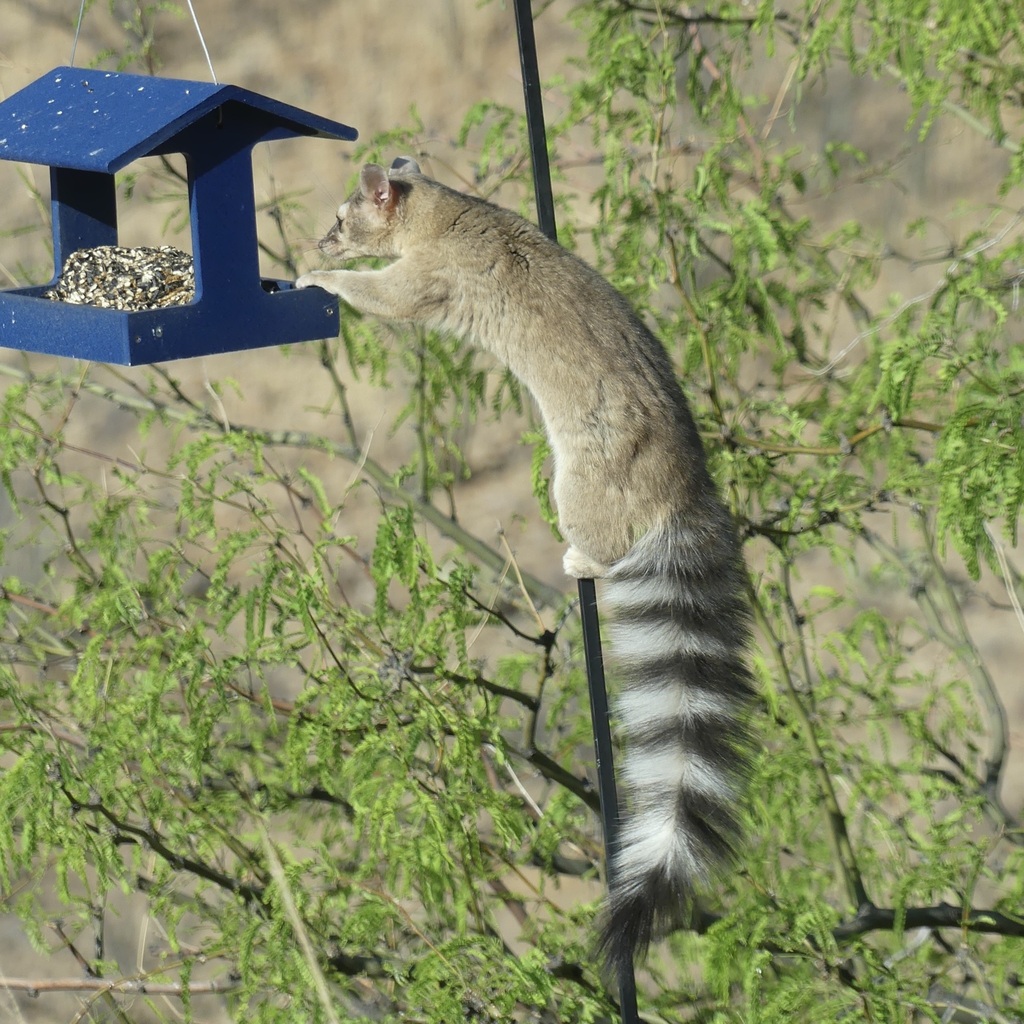
Ringtail
Photo © Sue Carnahan
Photo © Sue Carnahan — CC BY 4.0 — Source: iNaturalist #270081236Identification
The ringtail is a small, cat-like mammal with distinctive features that make it unmistakable in the field. Black to dark brown fur covers its body with pale underparts, and its face bears a striking mask-like pattern of dark brown and black hair surrounding the eyes. The animal's most characteristic feature is its long, black and white ringed tail, containing 14–16 stripes and measuring roughly the same length as its body. With a pointed muzzle, long whiskers, and fox-like facial structure, the ringtail resembles a miniature fox despite being a member of the raccoon family.
Smaller than a house cat, the ringtail typically weighs 0.7 to 1.5 kg (1.5 to 3.3 lb), with a body length of 30–42 cm (12–17 in) and a tail averaging 31–44 cm (12–17 in). Its large eyes and upright ears are adaptations for its nocturnal lifestyle. The animal possesses semi-retractable claws well-suited for climbing and an exceptionally flexible ankle joint capable of rotating over 180 degrees, enabling remarkable agility in rocky terrain and vertical ascents.
Range & Habitat
Native to arid regions of North America, the ringtail is widely distributed across the southwestern United States and northern Mexico. Its range extends from southern Oregon and California through Arizona, New Mexico, Colorado, Utah, Nevada, Oklahoma, Kansas, Texas, and Louisiana, with populations also found in Louisiana. In Mexico, the species ranges from Baja California south to Oaxaca. The ringtail thrives in rocky desert habitats including the Great Basin Desert, Sonoran Desert, and Chihuahuan Desert, where it nests in tree hollows and abandoned structures.
The species shows a strong preference for rocky habitats associated with water sources such as riparian canyons, caves, and mine shafts. In areas with abundant water, population densities can reach as high as 50 individuals per square mile. Male territories typically range from 50 to 100 acres and may overlap with the ranges of several females.
Behaviour & Diet
Ringtails are primarily nocturnal animals that lead solitary lives except during breeding season in early spring. As highly adept climbers, they use their long, ringed tails for balance while navigating narrow ledges and limbs, and can even perform cartwheels to reverse direction. Their flexible ankle joints and ability to "stem" or "ricochet" between narrow passages and cracks allow them to access areas unavailable to many predators. The white rings on their tails serve as a visual distraction, increasing the animal's chance of escape if a predator grabs the tail rather than the body.
Ringtails are omnivores with a diverse diet adapting to seasonal availability. Small vertebrates including rodents, rabbits, birds, snakes, lizards, frogs, and toads comprise the majority of their diet, particularly in winter. Insects and berries become primary foods in spring and summer, with favorites including juniper berries, hackberries, blackberries, persimmon, and prickly pear fruit. They occasionally consume fish and carrion. Notably, ringtails can survive for extended periods on water derived solely from their food and produce highly concentrated urine, an adaptation for maximum water retention in arid environments.
Best Time & Places to See It
Observing ringtails requires patience and nocturnal activity, as these animals are strictly night-active. Your best opportunities come in rocky desert regions with nearby water sources, particularly in riparian canyons and areas near caves or mine shafts throughout the southwestern United States. Arizona offers excellent viewing potential, as the ringtail is the state mammal. Spring is productive for observation, as increased activity during the breeding season in early spring may make individuals more visible.
Focus your search in the Great Basin Desert across Nevada, Utah, California, and Idaho, or explore the Sonoran and Chihuahuan Deserts of Arizona, New Mexico, and Texas. Areas with established water sources support higher population densities, increasing your chances of an encounter. Nocturnal wildlife tours and guided night walks in protected desert regions may offer the best opportunities for viewing this elusive species.
Photography Tips
Photographing ringtails demands specialized nocturnal wildlife techniques. Bring high-sensitivity camera equipment capable of performing well in low light, including fast lenses (f/2.8 or wider) and a camera body with excellent high-ISO performance. A tripod is essential for stabilizing your equipment during long exposures in darkness. Consider using infrared or red-light illumination, which minimizes disturbance to the animal while allowing image capture.
Focus on capturing the ringtail's distinctive features: the striking facial mask, the characteristic ringed tail with its alternating black and white bands, and the animal's climbing behavior in rocky terrain or vertical surfaces. Position yourself near water sources or potential denning sites at dusk or during the night hours. Move slowly and deliberately to avoid startling this wary, solitary creature, and be prepared for the loud, plaintive bark they may produce if alarmed. Early spring during breeding season may offer more active subjects, though all ringtail photography requires considerable patience and stealth.
Big Bend National Park
Brewster County, United States
+345 birds+34 mammals
Where the Chisos Mountains rise abruptly from the Sonoran Desert floor, Big Bend National Park spans over 7,300 square kilometers of one of North America's most…
VIEW NATIONAL PARKSaguaro National Park
Rincon Valley, United States
+354 birds+40 mammals
Where the Sonoran Desert meets sky-island mountains, two geographically separated districts of Saguaro National Park sprawl across nearly two thousand square kilometers of Arizona's most iconic…
VIEW NATIONAL PARKGreat Basin National Park
White Pine County, United States
+170 birds+19 mammals
Where the Great Basin's high desert plateaus rise above 10,000 feet, ancient bristlecone pines endure on moonscape ridges of limestone and quartzite, creating one of North…
VIEW NATIONAL PARKZion National Park
Washington County, United States
+244 birds+30 mammals
Towering sandstone cliffs in shades of crimson, rust, and cream rise abruptly from the Virgin River's winding canyon floor, their sculpted faces bearing witness to millions…
VIEW NATIONAL PARKYosemite National Park
Mariposa County, United States
+224 birds+28 mammals
Granite cliffs soar nearly a kilometer above the valley floor in this expanse of high Sierra wilderness, where glacial U-shaped valleys sculpt a landscape of dramatic…
VIEW NATIONAL PARKRedwood National Park
Humboldt County, United States
+343 birds+43 mammals
Where the Pacific fog rolls deep into northern California's coastal valleys, some of the tallest trees on Earth rise from a landscape shaped by tectonic forces…
VIEW NATIONAL PARKSequoia National Park
Tulare County, United States
+187 birds+27 mammals
Granite peaks rising above 3,600 meters dominate the southern Sierra Nevada, where Sequoia National Park sprawls across one of North America's most vertically compressed wilderness zones.…
VIEW NATIONAL PARKParque Nacional Cerro de la Estrella
Mexico
+126 birds+4 mammals
Where volcanic peaks rise sharply above Mexico City's sprawling metropolis, Parque Nacional Cerro de la Estrella offers a rare glimpse of high-altitude terrain within one of…
VIEW NATIONAL PARKParque Nacional Grutas de Cacahuamilpa
Pilcaya, Mexico
+97 birds+12 mammals
Where limestone ridges rise abruptly from the tropical deciduous forests of central Guerrero, the Grutas de Cacahuamilpa National Park shelters one of Mexico's most extensive cave…
VIEW NATIONAL PARKGrand Canyon National Park
United States
+277 birds+35 mammals
A mile-deep chasm of rust-red rock and purple shadow cuts through the high desert plateau of northern Arizona, revealing nearly two billion years of geological history…
VIEW NATIONAL PARKGuadalupe Mountains National Park
Culberson County, United States
+262 birds+14 mammals
Where fossil-laden limestone ridges thrust skyward above the Chihuahuan Desert floor, Guadalupe Mountains National Park reveals a landscape sculpted by ancient seas and relentless aridity. These…
VIEW NATIONAL PARKNo community photos yet. Log in to add the first one.
No community observations of this species yet.