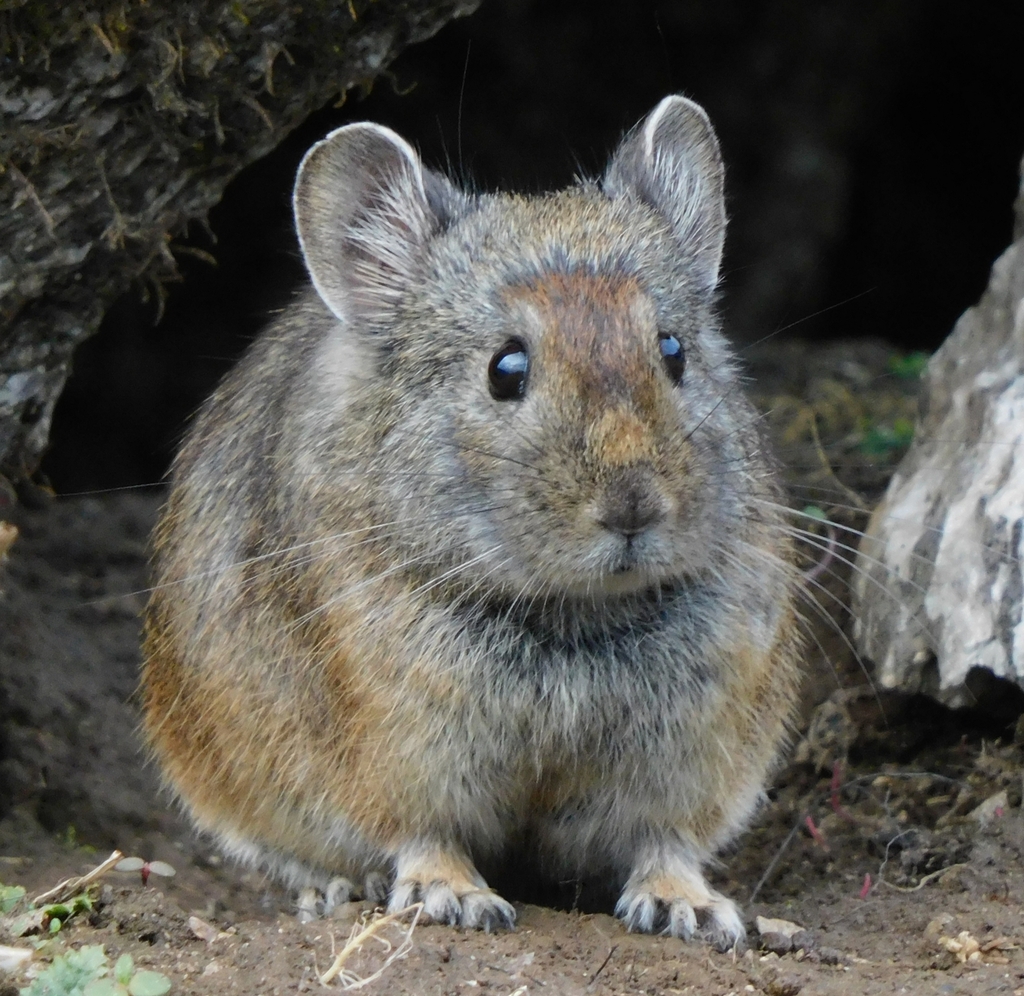
Royle’s Pika
Photo © Jagdish Singh Negi
Photo © Jagdish Singh Negi — CC BY 4.0 — Source: iNaturalist #165894413Identification
Royle's pika is the most common pika species found in the Himalayas. A small lagomorph measuring 17–22 centimeters in length, it is characterized by a slightly arched head, rufous-grey body, and distinctive chestnut-colored head. The species has sparse hair in front of its ears, which can help distinguish it from the sympatric large-eared pika, with which it may be confused in the field.
Range & Habitat
Royle's pika occurs across Bhutan, China, India, Nepal, and Pakistan, with populations concentrated throughout the Himalayan range. The species favors open rocky mountain edges and slopes, as well as areas covered with conifer forests including pine, deodar, and rhododendron. Rather than excavating its own burrows, Royle's pika utilizes existing burrow systems and narrow creeks as shelter, lining them with hay and pine leaves. Rocky mountain areas also provide refuge from predators.
Behaviour & Diet
Royle's pika is a solitary, crepuscular forager, remaining relatively inactive during midday hours to avoid heat stress. Population densities are low across its range, with approximately 12.5 individuals per hectare recorded in the Nepal Himalayas and 16.2 per hectare in the Garhwal Himalayas. Unlike many pika species, Royle's pika does not construct prominent haypiles for food storage. The species is somewhat synanthropic and may be found near human settlements. Foraging activity increases during monsoon season when food availability is greater, and the species produces 2–3 offspring annually.
Best Time & Places to See It
Early morning and late afternoon offer the best opportunities to observe Royle's pika, as the species is most active during crepuscular hours. Visit open rocky slopes and conifer-forest edges in the Himalayan regions of Bhutan, Nepal, India, or Pakistan. The monsoon season brings increased foraging activity and improved chances of sightings, though the species may be found year-round throughout its range. Look carefully among rocky outcrops and along forest margins where the habitat transitions between open and wooded areas.
Photography Tips
Patience and early-morning or late-afternoon visits will maximize your chances of capturing images of this elusive species. Position yourself near rocky mountain edges or conifer-forest boundaries and remain still for extended periods. The species' small size and tendency to remain near cover make a telephoto lens essential. Overcast conditions during monsoon season may provide softer light and increased activity. Given the species' low population density and solitary nature, successful photography requires time spent in suitable habitat and careful, quiet approach.
Langtang National Park
Helambu, Nepal
+364 birds+14 mammals
Where the southern slopes of the Himalayan highlands descend toward the subtropical valleys of central Nepal, Langtang National Park sprawls across one of the subcontinent's most…
VIEW NATIONAL PARKSagarmatha National Park
Khumjung, Nepal
+219 birds+7 mammals
Soaring peaks and deep glacial valleys define this alpine wilderness in northeastern Nepal, where the terrain rises from forested foothills into a realm of high-altitude tundra…
VIEW NATIONAL PARKGiant Panda National Park
Mianyang, China
+447 birds+47 mammals
Where the eastern slopes of China's Sichuan plateau descend into cloud-wrapped valleys, one of Asia's most biodiverse landscapes unfolds across more than 350,000 square kilometres. This…
VIEW NATIONAL PARKNanda Devi National Park
Garpak, India
+218 birds+5 mammals
Where the Himalayas surge into their most dramatic alpine amphitheater, a wilderness of raw geological power unfolds across 624 square kilometers of pristine terrain. Nanda Devi,…
VIEW NATIONAL PARKValley of Flowers National Park
Ghangaria, India
+117 birds+1 mammals
Where alpine meadows explode with color each monsoon season, the Himalayan slopes of Uttarakhand rise to create one of Earth's most extraordinary floral displays. Perched between…
VIEW NATIONAL PARKHemis National Park
Raigahar Dhar, India
+131 birds+13 mammals
Where granite gorges cleave through the Himalayas at dizzying altitudes, a vast wilderness of alpine desert unfolds across the rain shadow of Ladakh. Hemis sprawls across…
VIEW NATIONAL PARKNo community photos yet. Log in to add the first one.
No community observations of this species yet.