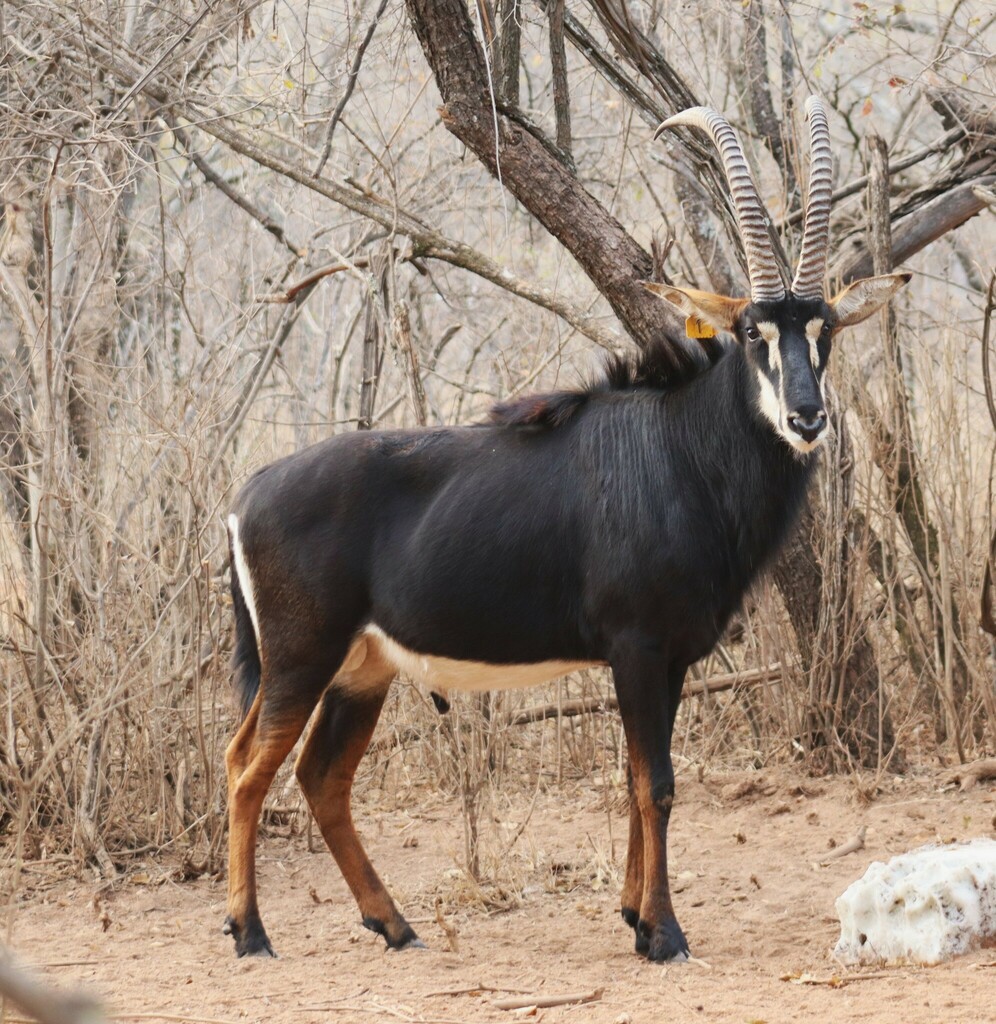
Sable Antelope
Photo © Dave Brown
Photo © Dave Brown — CC0 1.0 — Source: iNaturalist #190513918Identification
The sable antelope is a large, robust antelope with a compact build, thick neck, and striking appearance. Males are notably heavier and about one-fifth taller than females, reaching 117–140 cm at the shoulder. Both sexes possess distinctive long, backward-arching horns—females carry horns of 61–102 cm, while males sport impressive 81–165 cm horns. Sexual dimorphism is pronounced in coloration: females and juveniles are chestnut to dark brown, though southern populations show darker coats, while males darken progressively and turn black after three years. All individuals display contrasting white underparts, cheeks, and chin, with a characteristic wide black stripe across the nose. A well-developed, often upright mane adorns the neck, and calves under two months are light tan with faint markings.
Range & Habitat
Sable antelopes inhabit wooded savanna across East and Southern Africa, from southern Kenya south to South Africa, with a separate population in Angola. Four distinct subspecies occupy different regions: the southern sable antelope occurs south of the Zambezi River in Botswana, Zimbabwe, and South Africa; the Zambian subspecies has the largest range, extending through Zambia, eastern Democratic Republic of the Congo, Malawi, and into southwestern Tanzania; the eastern sable antelope inhabits the coastal hinterlands of southern Kenya and northern Mozambique; and the critically endangered giant sable antelope survives only in a few remaining central Angolan localities.
Behaviour & Diet
Sable antelopes are diurnal grazers and browsers of mid-length grasses and leaves in savanna woodlands and grasslands, particularly during the dry season. They visit salt licks and have been observed chewing bones to obtain essential minerals. Activity levels decrease during the hottest parts of the day. These antelopes form herds of 10 to 30 females and calves, each led by a single dominant bull. Juvenile males are expelled from the herd around age three and form bachelor groups of up to 12 individuals, with the most dominant bachelor typically claiming the next available breeding group. Males establish dominance through intense fights, dropping to their knees and using their powerful horns against rivals.
Best Time & Places to See It
For reliable sable antelope viewing, the Matsetsi Valley of Zimbabwe holds large populations, particularly of the pure southern sable subspecies. South African reserves support significant populations of both pure and crossbred individuals. The Shimba Hills National Reserve in southern Kenya offers opportunities to observe the eastern subspecies. Central Angola remains the only stronghold for the giant sable antelope, though viewing is extremely limited due to its critically endangered status. The dry season is optimal for observing these antelopes in wooded savannas and grasslands.
Photography Tips
Capture the sable's dramatic sexual dimorphism by photographing males and females together when possible—the contrast between black males and chestnut females is striking. The distinctive backward-arching horns and upright neck mane are signature features; position yourself to showcase these characteristics against the savanna background. The sharp facial markings, particularly the black nose stripe and white cheek patches, reward close-range portraiture. Early morning or late afternoon light accentuates the richness of their coats and highlights the white underparts. Herd dynamics, including the dominance displays between males or the protective behavior of the breeding bull, provide compelling behavioral shots.
Addo Elephant National Park
Bwabwata National Park
Chobe National Park
Kafue National Park
Kasanka National Park
Kruger National Park
Marakele National Park
Mokala National Park
Mutinondo Wilderness Area
Nothing matches these filters.
No community photos yet. Log in to add the first one.
No community observations of this species yet.