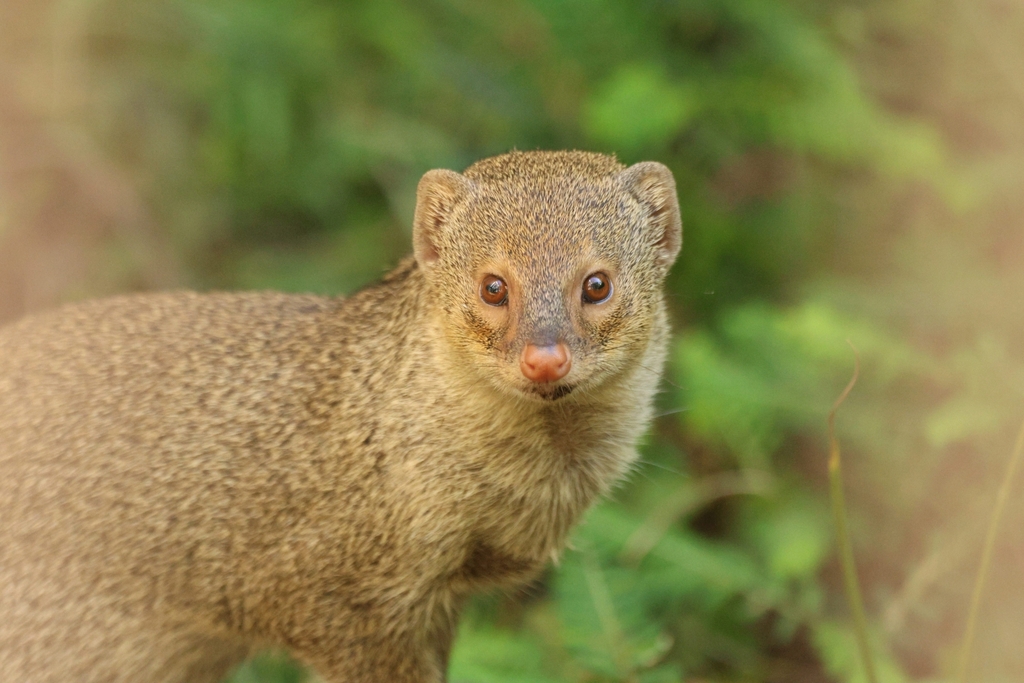
Small Indian Mongoose
Photo © Damien Wallace
Photo © Damien Wallace — CC BY 4.0 — Source: iNaturalist photo #565289286Identification
The small Indian mongoose is a compact carnivore with a slender body and elongated, pointed snout. Adults measure 509–671 mm (20.0–26.4 inches) in head and body length, with short ears and distinctive five-toed feet bearing long claws. Males are noticeably larger than females, with broader heads and more robust bodies—a trait that becomes even more pronounced in introduced island populations. The species can be distinguished from the often-sympatric Indian grey mongoose by its somewhat smaller overall size.
Range & Habitat
The small Indian mongoose is native to Iraq and extends through southeastern Iran, Afghanistan, Pakistan, India, Nepal, Bhutan, Bangladesh, and Myanmar, inhabiting elevations up to 2,100 metres (6,900 feet). In its native range, it favours riverine thickets, crop fields, orchards, marshland, and forested areas. However, this species is also one of the world's most widely introduced carnivores, now established on numerous Caribbean islands, Pacific islands including Hawaii and Fiji, the Japanese island of Okinawa, and various Mediterranean islands including Mljet and other Dalmatian islands off the coast of Croatia.
Behaviour & Diet
The small Indian mongoose is a vocal animal, employing approximately 12 different vocalizations to communicate with conspecifics. In its native Pakistani habitat, it feeds primarily on small vertebrates and invertebrates, though its diet varies by location. The species is diurnal and relatively solitary. In its introduced range, mongooses have proven highly adaptable, consuming rats, mice, insects, ground-nesting birds, reptile eggs, and even turtle hatchlings. This dietary flexibility has made them particularly successful—and problematic—in non-native ecosystems where naive prey species lack evolutionary defences against mammalian predators.
Best Time & Places to See It
In its native range, travellers seeking the small Indian mongoose should focus on protected areas and natural habitats across the Indian subcontinent, such as Panna Tiger Reserve and Gandhi Sagar Sanctuary in India, or Margalla Hills National Park in Pakistan. The species is adaptable to various habitats and elevations, making sightings possible across suitable terrain during daylight hours. However, in introduced populations on Caribbean and Pacific islands, the mongoose has become abundant and is relatively easy to observe in agricultural areas and disturbed habitats.
Photography Tips
Photograph the small Indian mongoose's characteristically slender profile and pointed snout to distinguish it from other mongoose species. The animal's short ears and long-clawed feet are useful identifying features to capture. Since this is a diurnal species, daytime photography is essential. In native habitats where populations are less abundant, patience and early morning or late afternoon forays near riverine areas and crop fields will yield the best opportunities. In introduced Caribbean populations, mongooses are often habituated to human presence in agricultural settings, allowing closer approach for detailed portraits.
Hawaiʻi Volcanoes National Park
Hawaiʻi County, United States
+84 birds+2 mammals
Where volcanic slopes descend toward the Pacific across more than five thousand square kilometers, Hawaiʻi Volcanoes National Park presents one of Earth's most dynamic laboratories of…
VIEW NATIONAL PARKHaleakalā National Park
Maui County, United States
+66 birds+4 mammals
Ascending from sea level to over 10,000 feet across a mere thirty miles, Haleakalā National Park commands one of the Pacific's most dramatic elevation gradients, where…
VIEW NATIONAL PARKVirgin Islands National Park
Cruz Bay, United States
+119 birds+3 mammals
Coral reef and mangrove ecosystems define the tropical maritime landscape of this national park, where St. John's mountainous spine rises sharply from turquoise bays fringed with…
VIEW NATIONAL PARKNo community photos yet. Log in to add the first one.
No community observations of this species yet.