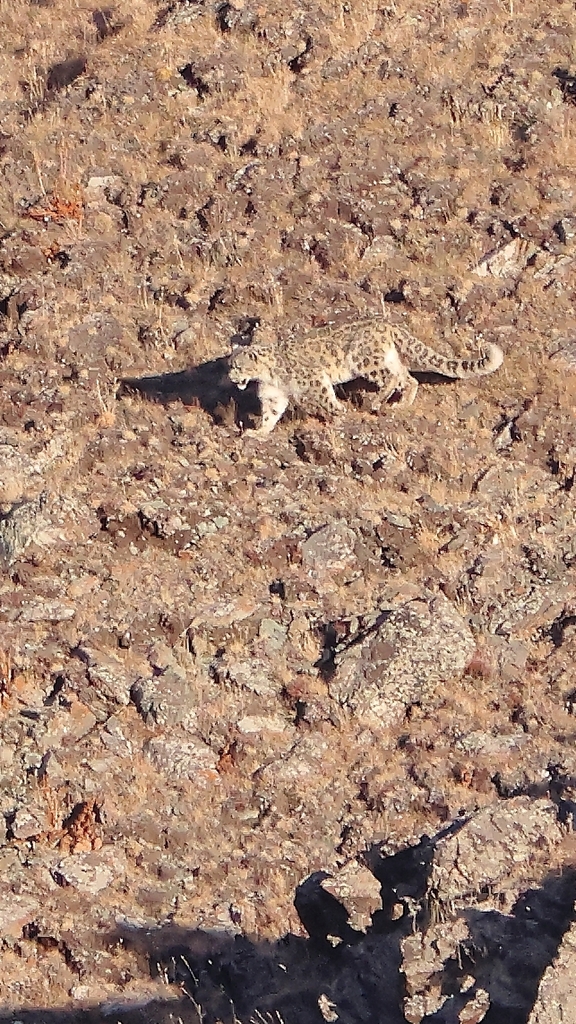
Snow Leopard
Photo © Barry Stewart
Photo © Barry Stewart — CC BY 4.0 — Source: iNaturalist photo #664559942Identification
The snow leopard is a stocky felid with thick whitish to grey fur providing excellent camouflage in its high-altitude habitat. Its most distinctive features are black spots on the head and neck, with larger rosettes adorning the back, flanks, and characteristically bushy tail. Males are noticeably larger than females, and both sexes possess elongated canine teeth. The species shows several striking adaptations to its extreme environment: small, rounded ears that minimize heat loss, broad paws that function like snowshoes for traversing deep snow, and an exceptionally thick tail that provides balance on steep terrain and warmth when curled around the body during rest.
Range & Habitat
Snow leopards are native to the mountain ranges of Central and South Asia, with their range extending from the eastern Hindu Kush through the Himalayas and Tibetan Plateau to southern Siberia, Mongolia, and western China. They are specialists of extreme elevations, inhabiting alpine and subalpine zones typically between 3,000 and 4,500 metres (9,800–14,800 feet), where they favour terrain characterized by steep cliffs and ridges. In the northern portions of their range, they occasionally descend to lower elevations, demonstrating some flexibility in altitude preference while remaining fundamentally adapted to the world's harshest mountain environments.
Behaviour & Diet
Snow leopards are solitary animals with crepuscular activity patterns, being most active during the dawn and twilight hours when prey are similarly active. As obligate carnivores, they actively hunt a variety of ungulates suited to alpine terrain, and also prey on domestic livestock in areas where human settlements encroach on their domain. This dietary flexibility and predatory prowess reflect their role as apex predators in one of Earth's most challenging ecosystems, though their solitary nature and low population density mean encounters between individuals are rare.
Best Time & Places to See It
Snow leopards are notoriously elusive, making them one of the world's most difficult big cats to observe in the wild. The species inhabits remote, inaccessible mountain terrain across multiple countries including Nepal, Bhutan, India, Pakistan, Afghanistan, Tajikistan, Kyrgyzstan, Kazakhstan, Mongolia, Russia, and China. Their cryptic nature, combined with vast home ranges across challenging topography, means that sightings are unpredictable and rare even for experienced guides and researchers. Tourism in snow leopard range requires specialized mountain trekking expertise and realistic expectations about encounter probability.
Photography Tips
Photographing snow leopards presents extraordinary technical and logistical challenges. The species' preference for steep, rocky terrain with excellent visibility, combined with its crepuscular activity patterns, demands high-speed film or sensor capabilities and lenses with substantial reach. Patience is essential—wildlife photographers may spend weeks in prime habitat without a sighting. The animal's cryptic coloration, evolved for camouflage against rock and snow, makes detection difficult even at close range. Photographers should work with experienced local guides familiar with snow leopard behaviour and movement patterns, and be prepared for extreme weather, altitude exposure, and the physical demands of mountain terrain.
No community photos yet. Log in to add the first one.
No community observations of this species yet.