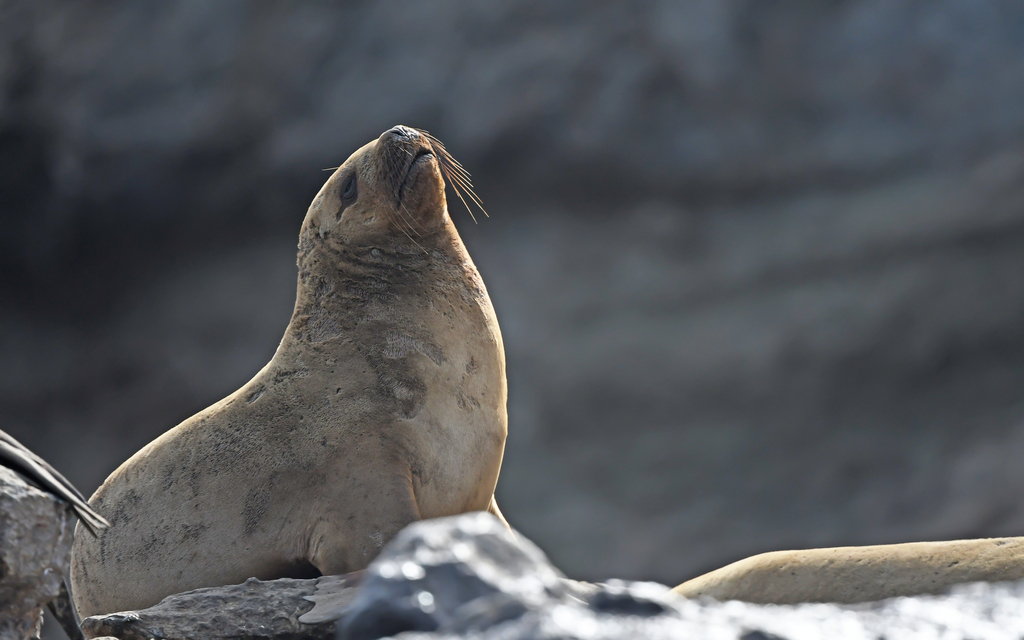
South American Sea Lion
Photo © Christoph Moning
Photo © Christoph Moning — CC BY 4.0 — Source: iNaturalist photo #340277136Identification
The South American sea lion is among the largest and most sexually dimorphic of the eared seals. Males are substantially bigger than females, measuring up to 3 metres in length and weighing up to 350 kg, while females reach around 2 metres and 150 kg. Adult males are immediately recognisable by their large heads, short upturned snouts, and long manes that extend to the shoulders. Males are dark brown in colour, while females are nearly yellowish-brown. Pups are born black but become reddish-brown after their first moult. Even newborn and juvenile sea lions show marked size differences between the sexes.
Range & Habitat
The South American sea lion is found along the coasts and offshore islands of South America, ranging from Peru south to Cape Horn and then north to southern Brazil. Notable breeding colonies occur at locations including Lobos Island in Uruguay, Peninsula Valdes in Argentina, the Beagle Channel, and the Falkland Islands. Some individuals wander as far north as southern Ecuador, though breeding has not been documented there. The species hauls out on beaches composed of sand, gravel, rocks, or pebbles, and can also be seen on flat rocky cliffs with tidepools. Sea lion colonies tend to be small and scattered, particularly on rocky shores.
Behaviour & Diet
South American sea lions primarily feed on fish—including Argentine hake and anchovies—and cephalopods such as shortfin squid, Patagonian squid, and octopus. They also consume crustaceans and other invertebrates depending on local availability, and have been observed preying on penguins, pelicans, and young South American fur seals. They may forage on the ocean floor for slow-moving prey or hunt schooling prey in groups. These sea lions have even been recorded taking advantage of hunting efforts by dusky dolphins.
During the breeding season from December to February, males establish and defend territories. Some males switch to defending individual females rather than territories. Breeding behaviour is highly competitive: dominant males herd females aggressively and typically maintain harems of around three females, though some control as many as 18. Less dominant males, usually subadults, employ alternative strategies such as causing chaotic group raids to disrupt established harems and gain access to breeding females.
Best Time & Places to See It
The breeding season from December to February offers the best opportunity to observe South American sea lions, when large numbers congregate at haul-out sites and breeding colonies are most active. Major breeding locations such as Peninsula Valdes in Argentina, Lobos Island in Uruguay, and the Falkland Islands are prime destinations. The species is relatively easy to locate at these established sites, where colonies—though generally small and scattered—provide excellent viewing opportunities. Warm, sunny weather encourages sea lions to space themselves out within colonies, potentially improving visibility.
Photography Tips
The species' extreme sexual dimorphism makes it rewarding for photographers: the dark-maned males are visually striking and distinctive, while the lighter-coloured females and dark pups offer good contrast. During breeding season, dramatic behavioural interactions—including territorial defence, female herding, and raiding behaviour—provide dynamic subjects. Rocky and sandy beach colonies offer varied compositional opportunities. Early mornings often provide the best light at coastal breeding sites, and patience will be rewarded with action shots during the intense breeding period.
Chile: Fuegian Snipe & Juan Fernandez
Parque Nacional de Galápagos
Santo Tomás, Ecuador
+139 birds+23 mammals
Volcanic peaks and weathered lava fields dominate this remote archipelago in the Pacific, where the interplay of cold ocean currents and tropical latitude creates an ecological…
VIEW ISLAND & ARCHIPELAGOSea Lion Island
Sealion Island Settlement, Falkland Islands
+74 birds+3 mammals
Windswept tussock grasslands roll across volcanic terrain where Southern Ocean swells crash against rocky shores, creating one of the Falkland Islands' most dramatic wildlife theatres. This…
VIEW ISLAND & ARCHIPELAGOCape Dolphin
falskland islands, Falkland Islands
+54 birds+1 mammals
Where windswept grasslands meet dramatic coastal cliffs, the Falkland Islands' northern reaches reveal one of the Southern Hemisphere's most compelling seabird sanctuaries. The terrain here is…
VIEW NATURE RESERVEVolunteer Point
Stanley, Falkland Islands
+70 birds+3 mammals
Windswept grasslands meet volcanic black sand beaches where three penguin species converge in the South Atlantic's most theatrical wildlife theatre. This remote peninsula on East Falkland…
VIEW NATURE RESERVEWest Point Island
West Point, Falkland Islands
+67 birds+3 mammals
Windswept cliffs plunge dramatically into the South Atlantic, their rust-coloured rock faces sculpted by millennia of gales and spray. This northwestern outpost of the Falkland Islands…
VIEW ISLAND & ARCHIPELAGOCabo de Hornos National Park
Cape Horn, Chile
+88 birds+9 mammals
Where the Andes plunge into the Southern Ocean and the Drake Passage churns between two continents, Cabo de Hornos National Park sprawls across one of Earth's…
VIEW NATIONAL PARKPan de Azúcar National Park
Chañaral, Chile
+74 birds+4 mammals
Where the Atacama Desert plunges toward the Pacific, Pan de Azúcar National Park sprawls across 727 square kilometres of one of Earth's most extreme transitions—a landscape…
VIEW NATIONAL PARKMonte León National Park
Argentina
+100 birds+4 mammals
Where the Patagonian steppe meets the Atlantic, Monte León National Park protects a landscape of windswept coastal cliffs, rocky outcrops, and semi-arid grassland spanning over 1,200…
VIEW NATIONAL PARKNo community photos yet. Log in to add the first one.
No community observations of this species yet.