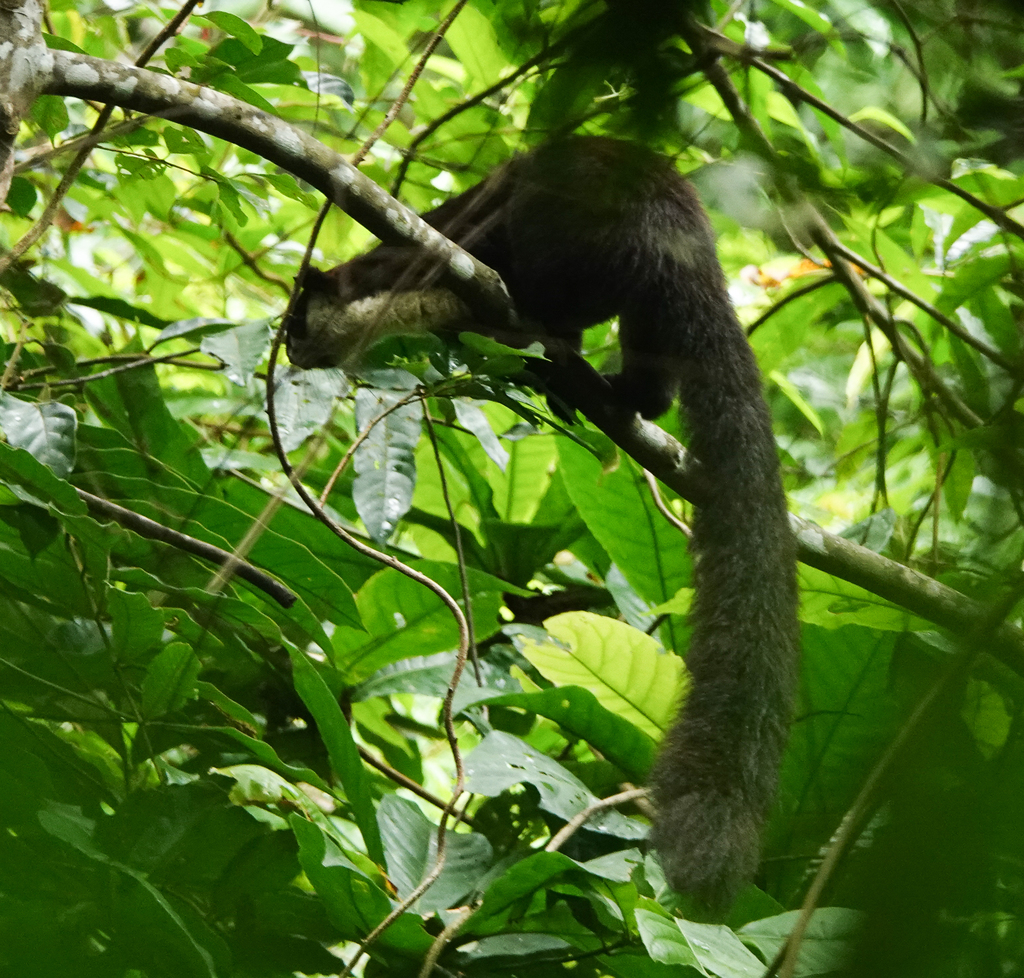
Southern Black Giant Squirrel
Photo © Rejoice Gassah
Photo © Rejoice Gassah — CC BY 4.0 — Source: iNaturalist #69706886Identification
The black giant squirrel is one of the world's largest squirrel species, weighing 1.05–1.25 kg (2.3–2.8 lb) with a head-and-body length of 34–37 cm (13–15 in) and a distinctly bushy tail measuring 41–42 cm (16–17 in). The species is characteristically bicoloured: the back, head, ears, and tail are deep brown to black, while the underparts are light buff. Regional variations occur—populations in Sumatra, Java, and Bali display light-tipped hairs on the back and tail, creating a relatively paler appearance, while individuals from small islands off Myanmar and the Strait of Malacca feature orange to reddish-yellowish underparts.
Range & Habitat
This giant squirrel inhabits forested regions across the Indomalayan zoogeographic zone, from northern Bangladesh, northeast India, eastern Nepal, Bhutan, and southern China, through Myanmar, Laos, and Thailand, to West Malaysia, Cambodia, Vietnam, and western Indonesia including Java, Sumatra, Bali, and nearby islands. It occupies elevations from sea level to at least 2,500 m (8,200 ft). In South Asia, it prefers tropical and subtropical coniferous and broadleaf forests, while in Southeast Asia it favours tropical broadleaf evergreen and semi-evergreen forests. In the rainforests of the Malay Peninsula and Indonesia, populations are less abundant, likely due to competition with primates and other arboreal species for canopy resources. Habitat loss from human settlement, timber harvesting, and agriculture has resulted in approximately 30% population decline in the past decade in some areas.
Behaviour & Diet
The black giant squirrel is diurnal and primarily arboreal, though it occasionally descends to the forest floor to feed. It is solitary by nature and rarely enters plantations or human settlements, preferring pristine forest environments. Its diet comprises seeds, pine cones, fruits, and leaves. Breeding females raise litters of 1–2 young in dreys, typically constructed within hollow tree cavities.
Best Time & Places to See It
The black giant squirrel is best observed during daylight hours in undisturbed forested habitats. Notable locations include Kaziranga National Park in Assam, India, and the lower ranges of Neora Valley National Park near Kalimpong, India, where several populations are established. The species is present across its range from lowland to montane elevations, though habitat degradation continues to threaten its distribution.
Photography Tips
Patience and early morning visits to primary forest areas offer the best photographic opportunities for this canopy-dwelling species. Position yourself with a clear view of tall trees and watch for movement in the upper branches. The striking contrast between dark upperparts and pale underparts creates excellent compositional possibilities. Use a longer telephoto lens to capture detail without disturbing this wary, forest-interior specialist. The bushy tail is a distinctive feature worth emphasizing in your images.
Hat Noppharat Thara-Mu Ko Phi Phi National Park
Ao Nang, Thailand
+253 birds+9 mammals
Where limestone karsts rise dramatically from turquoise waters, Hat Noppharat Thara-Mu Ko Phi Phi National Park unfolds across a mosaic of beach, mangrove forest, and island…
VIEW NATIONAL PARKKhao Yai National Park
Prachantakham District, Thailand
+377 birds+46 mammals
Evergreen dipterocarp forest blankets the rolling terrain of this national park in eastern Thailand, where limestone hills rise abruptly from the forest floor and seasonal streams…
VIEW NATIONAL PARKKaziranga National Park
Kohora, India
+422 birds+26 mammals
Dawn breaks over the floodplains of the Brahmaputra, where tall grasslands stretch endlessly beneath monsoon-heavy skies. This sprawling wilderness of northeastern Assam is a mosaic of…
VIEW NATIONAL PARKTaman Negara National Park
Kampong Samas, Malaysia
+393 birds+48 mammals
Where ancient rainforest meets limestone peaks, one of Southeast Asia's oldest protected wilderness preserves sprawls across 4,343 square kilometers of primordial landscape. Dipterocarp giants tower overhead,…
VIEW NATIONAL PARKTaman Nasional Baluran
Situbondo, Indonesia
+189 birds+9 mammals
Across the northeastern tip of East Java, where monsoon winds sweep down from the Bali Strait, a landscape of contrasts unfolds within 374 square kilometres of…
VIEW NATIONAL PARKKerinci Seblat National Park
Kerinci, Indonesia
+228 birds+16 mammals
Across nearly 67,000 square kilometres of Sumatra's spine, a mountainous realm of equatorial rainforest rises from steaming lowlands to volcanic peaks shrouded in cloud. Kerinci Seblat…
VIEW NATIONAL PARKGaoligong Mountain National Nature Reserve
Nujiang Lisu Autonomous Prefecture, China
+443 birds+13 mammals
VIEW NATURE RESERVENo community photos yet. Log in to add the first one.
No community observations of this species yet.