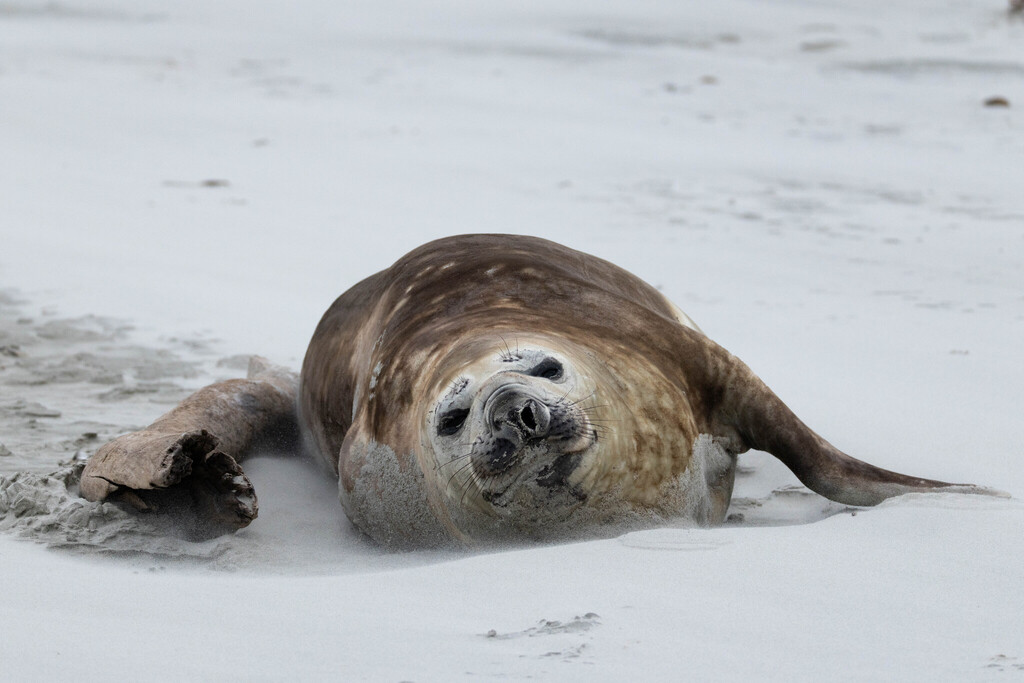
Southern Elephant Seal
Photo © Sebastian Doak
Photo © Sebastian Doak — CC BY 4.0 — Source: iNaturalist photo #630297178Identification
The southern elephant seal is the largest member of the order Carnivora and the largest extant marine mammal that is not a cetacean. Adult males are distinctive for their massive bulk and prominent proboscis—an enlarged snout used to produce extremely loud roars, particularly during breeding season. A bull southern elephant seal is approximately 40% heavier than a male northern elephant seal and nearly twice the weight of a male walrus.
This species exhibits extraordinary sexual dimorphism in terms of mass ratio, among the greatest of any mammal. Adult females typically weigh 350 to 900 kg and measure 2.6 to 3 metres long, while bulls range from 1,500 to 3,700 kg and grow to 4.2 to 5.8 metres in length—making males four to five times heavier than females on average. Southern elephant seals are distinguished from their northern cousins by greater body mass and a shorter proboscis. They possess large, round, black eyes with high concentrations of low-light pigments, reflecting the importance of sight in hunting. Young pups are born completely black with fur unsuited to water but excellent for insulation; after moulting, coats typically turn grey and brown. Older males develop thick, scarred leather-like skin.
Range & Habitat
The southern elephant seal inhabits subantarctic waters across three ocean basins, with a global population estimated between 664,000 and 740,000 individuals. Three distinct geographic subpopulations exist: the largest in the South Atlantic with over 400,000 individuals, including approximately 113,000 breeding females on South Georgia; a second subpopulation of up to 200,000 in the south Indian Ocean, primarily in the Kerguelen Islands; and a third of about 75,000 in the subantarctic Pacific, mainly around Macquarie Island south of Tasmania and New Zealand.
While elephant seals occasionally rest or mate in Antarctica, they gather to breed in subantarctic locations. Their main feeding area is at the edge of the Antarctic continent. Atlantic breeding colonies occur on Gough Island, the Falkland Islands, and Valdes Peninsula in Argentina—the only continental breeding population. The species is currently re-colonizing its former Chilean range, having been sighted at locations such as the Toltén River mouth and Caicura Islets in the 2010s.
Behaviour & Diet
Southern elephant seals are highly adapted marine mammals with specialised hunting abilities. Their large eyes and the high concentration of low-light pigments suggest that vision plays an important role in capturing prey. Their hind limbs are specially adapted for aquatic locomotion, with five long, webbed fingers that propel water with agility, though the pectoral fins are used minimally during swimming.
On land, while their hind limbs are unsuited for conventional locomotion, elephant seals can propel themselves across terrain at speeds up to 8 km/h using their fins as support. They employ this capability for short-distance travel, returning to water, approaching females, or confronting intruders. During breeding season, males produce extremely loud roars from their distinctive proboscis, with southern bulls appearing taller than their northern counterparts when fighting due to their tendency to bend their backs more strongly.
Best Time & Places to See It
The most accessible locations for viewing southern elephant seals are South Georgia in the South Atlantic, which hosts the largest Atlantic subpopulation with approximately 113,000 breeding females, and Macquarie Island in the subantarctic Pacific. The Kerguelen Islands in the Indian Ocean represent another significant viewing destination, hosting three-quarters of that ocean basin's population.
Breeding season represents the most dramatic time to encounter these seals, when males gather to breed in subantarctic colonies and produce their characteristic loud roars. The Falkland Islands and Valdes Peninsula in Argentina also provide opportunities to view this species, with Valdes offering the unique distinction of being the only continental breeding location.
Photography Tips
The extreme size differences between males and females create compelling compositional opportunities. Photograph bulls during breeding season to capture their distinctive proboscis and the dramatic posturing and roaring behaviour. The scarred, thick leather skin of older males provides striking textural detail under direct light.
Young pups, born completely black, offer excellent contrast photography against snow and ice. Their transformation during the first moulting—when coats shift to grey and brown tones—provides a dynamic visual narrative. The large, round black eyes of all seals are particularly expressive; use shallow depth of field to capture these striking features. Since elephant seals can move at up to 8 km/h on land, anticipate their movements and position yourself to capture their propulsion using their fins as support.
Parque Nacional de Galápagos
Santo Tomás, Ecuador
+139 birds+23 mammals
Volcanic peaks and weathered lava fields dominate this remote archipelago in the Pacific, where the interplay of cold ocean currents and tropical latitude creates an ecological…
VIEW ISLAND & ARCHIPELAGOGarden Route National Park
George, South Africa
+353 birds+54 mammals
Sweeping across the Western Cape's coastal and mountainous terrain, this sprawling national park encompasses over five thousand square kilometers of extraordinarily diverse landscape—from coastal limestone cliffs…
VIEW NATIONAL PARKSea Lion Island
Sealion Island Settlement, Falkland Islands
+74 birds+3 mammals
Windswept tussock grasslands roll across volcanic terrain where Southern Ocean swells crash against rocky shores, creating one of the Falkland Islands' most dramatic wildlife theatres. This…
VIEW ISLAND & ARCHIPELAGOCabo de Hornos National Park
Cape Horn, Chile
+88 birds+9 mammals
Where the Andes plunge into the Southern Ocean and the Drake Passage churns between two continents, Cabo de Hornos National Park sprawls across one of Earth's…
VIEW NATIONAL PARKDeception Island
Gabriel de Castilla Base, Antarctica
+26 birds+10 mammals
Steaming geothermal vents pierce a landscape of blackened volcanic sand and ice, where the earth's raw power still trembles beneath your feet. This horseshoe-shaped caldera, flooded…
VIEW ISLAND & ARCHIPELAGOCuverville Island
Cuverville Island, Antarctica
+19 birds+10 mammals
Granite peaks and sculpted ice define this windswept archipelago off the Antarctic Peninsula, where steep rocky shores plunge into waters thick with drifting brash ice. Cuverville…
VIEW ISLAND & ARCHIPELAGONeko Harbour
Neko Harbour, Antarctica
+18 birds+10 mammals
Towering peaks of fractured ice rise abruptly from gunmetal waters, their faces scarred by millennia of glacial advance and retreat. This pocket of the Antarctic Peninsula…
VIEW PROTECTED LANDSCAPEParadise Bay
Brown Station, Antarctica
+18 birds+9 mammals
Where the Antarctic Peninsula's rugged coastline meets the Southern Ocean, Brown Station stands sentinel over Paradise Bay—a protected landscape of ice-carved inlets, towering glacial faces, and…
VIEW PROTECTED LANDSCAPEPort Lockroy
Port Lockroy, Antarctica
+19 birds+9 mammals
Towering peaks of black rock pierce through Antarctic pack ice on the Gerlache Strait, where one of the continent's most accessible harbors cradles a living microcosm…
VIEW PROTECTED LANDSCAPEHalf Moon Island
Cámara Base, Antarctica
+25 birds+8 mammals
Jagged volcanic peaks rise from the cobalt waters of the South Shetland Islands, their slopes carpeted in moss and lichen where hardy vegetation clings to windswept…
VIEW ISLAND & ARCHIPELAGOPetermann Island
Petermann Island, Antarctica
+16 birds+9 mammals
Icebound cliffs rise dramatically from the Bellingshausen Sea, their weathered faces sculpted by millennia of Antarctic wind and tide. This slender wedge of rock and ice,…
VIEW ISLAND & ARCHIPELAGODanco Island
Danco Island, Antarctica
+17 birds+10 mammals
Dramatic black rock pierces the Antarctic Peninsula's icy waters, crowned with permanent snow and ringed by calving glaciers that thunder into the sea. This volcanic outcrop…
VIEW ISLAND & ARCHIPELAGOWilhelmina Bay
Wilhelmina Bay, Antarctica
+20 birds+10 mammals
Sheer cliffs of black volcanic rock plunge into waters so pristine they reflect the Antarctic sky like polished obsidian. This remote western Antarctic inlet, ringed by…
VIEW PROTECTED LANDSCAPELemaire Channel
Orne Harbour, Antarctica
+25 birds+13 mammals
Where granite peaks plunge into steel-grey waters, the Lemaire Channel carves one of Antarctica's most dramatic passages. This narrow strait, squeezed between the Antarctic Peninsula and…
VIEW PROTECTED LANDSCAPESalisbury Plain
South Georgia, South Georgia and the South Sandwich Islands
+33 birds+4 mammals
Where tussock grasses bow to relentless Antarctic winds and glacial meltwater carves braided channels through obsidian volcanic soil, one of Earth's most remote wildlife sanctuaries reveals…
VIEW PROTECTED LANDSCAPESt. Andrews Bay
South Georgia, South Georgia and the South Sandwich Islands
+34 birds+6 mammals
Where windswept tundra dissolves into obsidian beaches, one of the planet's most extraordinary wildlife theaters unfolds across St. Andrews Bay. This remote corner of South Georgia…
VIEW PROTECTED LANDSCAPEFortuna Bay
Stromness, South Georgia and the South Sandwich Islands
+37 birds+5 mammals
Where tussock grasslands sweep down to black-sand beaches and elephant seals haul out in thunderous colonies, the raw sub-Antarctic landscape reveals itself in its most dramatic…
VIEW PROTECTED LANDSCAPEPrion Island
Prince Olav Harbour, South Georgia and the South Sandwich Islands
+36 birds+2 mammals
Windswept tussock grasslands rise sharply from boulder-strewn beaches where the Southern Ocean hurls its grey swells against black volcanic rock. This remote speck in South Georgia's…
VIEW ISLAND & ARCHIPELAGOCooper Bay
Cooper Bay, South Georgia and the South Sandwich Islands
+28 birds+5 mammals
Where black-sand beaches meet towering cliffs striped with cascading meltwater, one of the Southern Ocean's most dramatic amphitheaters reveals itself. Cooper Bay cuts a deep indent…
VIEW PROTECTED LANDSCAPEElsehul Bay
Bird Island Station, South Georgia and the South Sandwich Islands
+33 birds+4 mammals
Granite peaks rise sheer from the Southern Ocean, their weathered faces streaked with cascading meltwater and cloaked in tussock grass that bends beneath relentless winds. This…
VIEW PROTECTED LANDSCAPEDorob National Park
Henties Bay, Namibia
+230 birds+13 mammals
Where the Skeleton Coast meets the Namib Desert's inland reaches, Dorob National Park sprawls across 34,021 square kilometres of one of southern Africa's most austere and…
VIEW NATIONAL PARKGreat Otway National Park
Australia
+255 birds+42 mammals
Temperate rainforest and wet eucalyptus woodland cloak the ridges and gullies of Victoria's Great Otway National Park, where persistent moisture and mild year-round temperatures sustain a…
VIEW NATIONAL PARKTasman National Park
White Beach, Australia
+53 birds+3 mammals
Where the Tasman Peninsula's windswept coastline meets temperate rainforest, White Beach unfolds as one of Tasmania's most dramatic meeting points between land and sea. The park's…
VIEW NATIONAL PARKNo community photos yet. Log in to add the first one.
No community observations of this species yet.