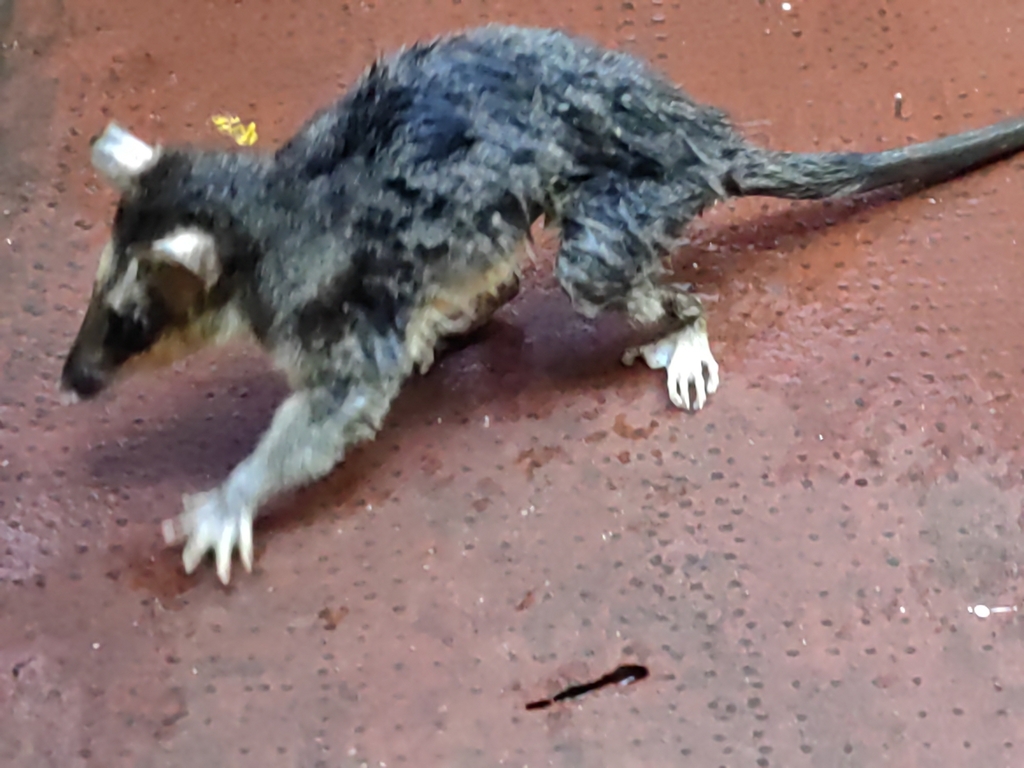
Southern Four-eyed Opossum
Photo © Anabela Plos
Photo © Anabela Plos — CC BY 4.0 — Source: iNaturalist photo #301803871The southern four-eyed opossum (Philander quica) is a species of opossum from South America. == Taxonomy == This species was described in 1824 by Coenraad Jacob Temminck in his 1824 work Monographies de Mammalogie. Similar to many early marsupials, this species was originally described in the genus Didelphis. This species was considered a valid species until 1935, when the Brazilian zoologist Alípio de Miranda-Ribeiro would consider it a subspecies of the gray four-eyed opossum. The Atlantic Forest populations of Philander were considered to be Philander frenatus by James L. Patton & Maria Nazareth Ferreira da Silva in 1997, but the holotype of P. frenatus was collected in eastern Brazil near the city of Belém, well outside the range of this species. P. frenatus was collected by Friedrich Wilhelm Sieber, who never collected from near the Atlantic Forest. In 2018, P. frenatus was synonymized with Philander opossum, leaving "Philander quica" as the oldest valid name for this species. Analysis of the cytochrome b and nucDNA of most members of the genus Philander has shown P. quica to be the sister taxon to all other Philander species. This species is recognized by the American Society of Mammalogists, but not by the IUCN.…
Serra dos Órgãos National Park
Brazil
+446 birds+13 mammals
Granite peaks thrust skyward through the Atlantic Forest canopy in the mountains immediately north of Rio de Janeiro, their bare rock faces rising above a landscape…
VIEW NATIONAL PARKIguazú National Park
Puerto Iguazú, Argentina
+346 birds+15 mammals
Where the Paraná Plateau plunges toward the Atlantic watershed, nearly 800 square kilometers of subtropical rainforest drape across Misiones Province in a landscape carved by millennia…
VIEW NATIONAL PARKNo community photos yet. Log in to add the first one.
No community observations of this species yet.