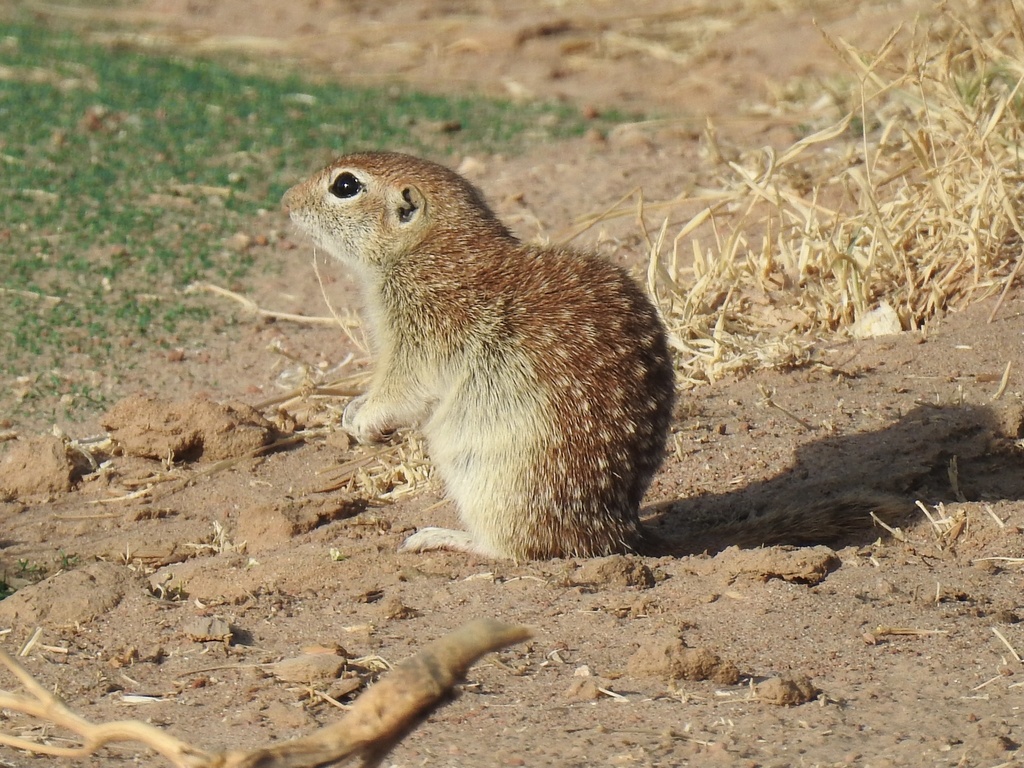
Spotted Ground Squirrel
Photo © CK2AZ
Photo © CK2AZ — CC BY 4.0 — Source: iNaturalist photo #100943909Identification
The spotted ground squirrel is one of the smallest squirrels in the northern hemisphere, easily recognized by its distinctive white linear spots covering the dorsal surface and white underbelly. Body coloration varies considerably, ranging through shades of brown, black, gray, and white depending on environmental influences—populations in darker soils tend to be darker than their grassland counterparts. Juveniles typically display darker pelages than adults. The species molts twice yearly, with adults emerging from hibernation in thicker coats that are shed by spring.
The skull structure resembles that of the thirteen-lined ground squirrel but is slightly broader in the interorbital and rostral regions, with notably enlarged auditory bullae—a distinctive feature of this species.
Range & Habitat
Spotted ground squirrels inhabit a range extending from south-central South Dakota through Nebraska's sand hills, eastern Colorado, northwestern Oklahoma, western Texas, eastern Arizona, western Kansas, most of New Mexico, and southeastern Utah. In Mexico, their distribution is limited to south and central regions. They prefer arid, dry landscapes with deep sand soils and sparse vegetation, making sand hills, dunes, and short-grass mesas their ideal homes.
As burrowing specialists, they create their own tunnels in lighter, loose soils and sometimes occupy abandoned prairie dog burrows. Burrows are typically found on short-grass mesas or along riverbanks in areas where soil composition favors excavation.
Behaviour & Diet
These ground squirrels are primarily herbivorous, feeding on seeds and green plant parts throughout the growing season. Green grass shoots are consumed in spring, followed by flowers and seeds in summer. In late summer, they occasionally display insectivorous behavior, feeding on grasshopper larvae. Most above-ground activity centers on foraging and feeding, with additional time spent on alert calls, maintenance behaviors such as resting, sunbathing, and grooming, and during mating season, active sexual displays.
Males exhibit a distinctive frenzy-like courting behavior during mating season, repeatedly entering and exiting burrows. The species employs seven different alert postures to warn colony members of predators or assert territorial claims. Hibernation typically lasts from late July through April or May, with active seasons lasting 115–135 days for males and 95–125 days for females.
Best Time & Places to See It
The spotted ground squirrel is most active and visible from April or May through July or August, during their above-ground seasonal activity period. The best viewing opportunities occur in their preferred habitat: arid regions with sparse vegetation and sandy soils, particularly sand hills, dunes, and short-grass mesas. Look for them in areas across their range in the American Southwest and central Mexico, especially in New Mexico, western Texas, and eastern Arizona.
Early morning hours often provide the best sightings, as the squirrels forage actively during cooler parts of the day. Scanning open, sandy terrain for movement and listening for their distinctive alert calls can help locate them.
Photography Tips
The spotted ground squirrel's small size and preference for open sandy habitats make it challenging but rewarding to photograph. Use a telephoto lens (at least 200–300mm) to maintain distance without disturbing the animal, as they are alert and quick to retreat underground. The contrasting white spots against darker pelage photograph well in strong daylight, but shooting during early morning or late afternoon provides softer, more flattering light.
Patience is essential—position yourself downwind and remain still near active burrows or foraging areas. Be prepared for rapid movement, as these squirrels spend minimal time above ground. The open, sparse landscape they inhabit offers clean backgrounds that help isolate your subject. Respect their wariness and never block burrow entrances, as escape routes are vital to their survival.
Big Bend National Park
Bitter Lake National Wildlife Refuge
Cave Creek Canyon
Chiricahua Mountains
Lower Rio Grande Valley National Wildlife Refuge
Petrified Forest National Park
White Sands National Park
Nothing matches these filters.
No community photos yet. Log in to add the first one.
No community observations of this species yet.