Identification
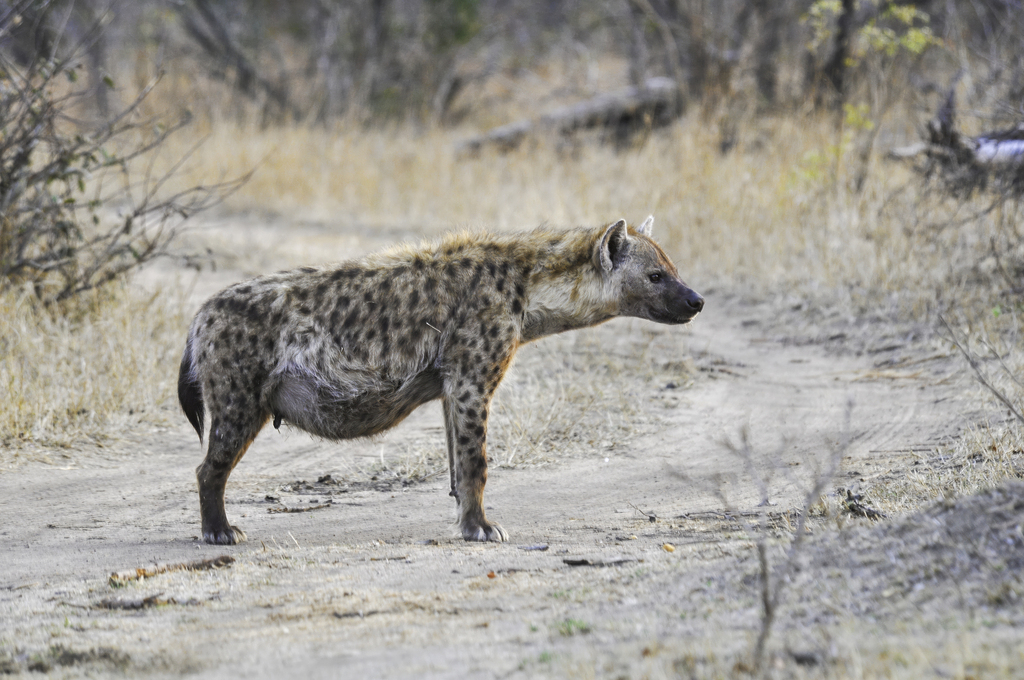
The spotted hyena is the largest living member of the Hyaenidae family, distinguished by its robust, bear-like build and rounded ears. Its most recognizable feature is its spotted pelt, which sets it apart from other hyena species. The animal also displays a less prominent mane than its relatives, and possesses dual-purposed dentition capable of crushing bone and skin alike. Females are notably larger than males, reflecting the species' matriarchal social structure. Most remarkably, spotted hyenas are the only placental mammals where females possess a pseudo-penis and lack an external vaginal opening—a unique anatomical trait among mammals.
Range & Habitat
The spotted hyena is native to sub-Saharan Africa, where it remains the most common large carnivore across the continent. The species maintains a widespread distribution and population estimated between 27,000 and 47,000 individuals, earning it a classification of least concern by the IUCN. However, populations are experiencing declines outside of protected areas due to habitat loss and poaching, making conservation areas increasingly important for the species' long-term survival.
Behaviour & Diet
Spotted hyenas are the most social members of the Carnivora order, exhibiting complex social behaviours and the largest group sizes of any carnivore. Their clan structure resembles that of primates more closely than other carnivores, featuring hierarchical organization and frequent social interaction among both related and unrelated members. Spotted hyena society is matriarchal, with females dominating males. The social system is openly competitive, with access to food, mating, and dispersal opportunities determined by dominance and alliance networks. Remarkably, despite this competition, clan members cooperate extensively in hunting, eating, resting, and defending against threats.
As highly adaptable and opportunistic feeders, spotted hyenas are primarily hunters but also scavenge effectively. They display greater hunting flexibility than other African carnivores, hunting alone, in small parties of 2–5 individuals, or in large coordinated groups. During hunts, they run through ungulate herds to select prey, then pursue their target over distances of several kilometres at speeds reaching 60 kilometres per hour. Their digestive capacity is exceptional—they can consume and process skin, bone, and other animal waste—making them the most efficient users of animal matter among African carnivores.
Best Time & Places to See It
Spotted hyenas are found throughout sub-Saharan Africa, with populations concentrated in protected areas where habitat loss and poaching are minimized. Their widespread range and large numbers make them relatively accessible to wildlife travellers across the continent, though sightings are most reliable in established national parks and reserves where populations remain robust.
Photography Tips
The spotted hyena's robust build, rounded ears, and distinctive spotted coat make compelling photographic subjects. Capture the animal's powerful frame and characteristic bear-like posture during daylight hours when detail is clear. Group dynamics offer excellent opportunities—photograph clan interactions, hierarchical displays, and cooperative behaviours. Early morning or late afternoon light will enhance the visibility of the spotted pelt pattern. Be prepared for extended observation periods, as hyenas are active both day and night; patience often rewards photographers with intimate clan behaviour and social interactions.