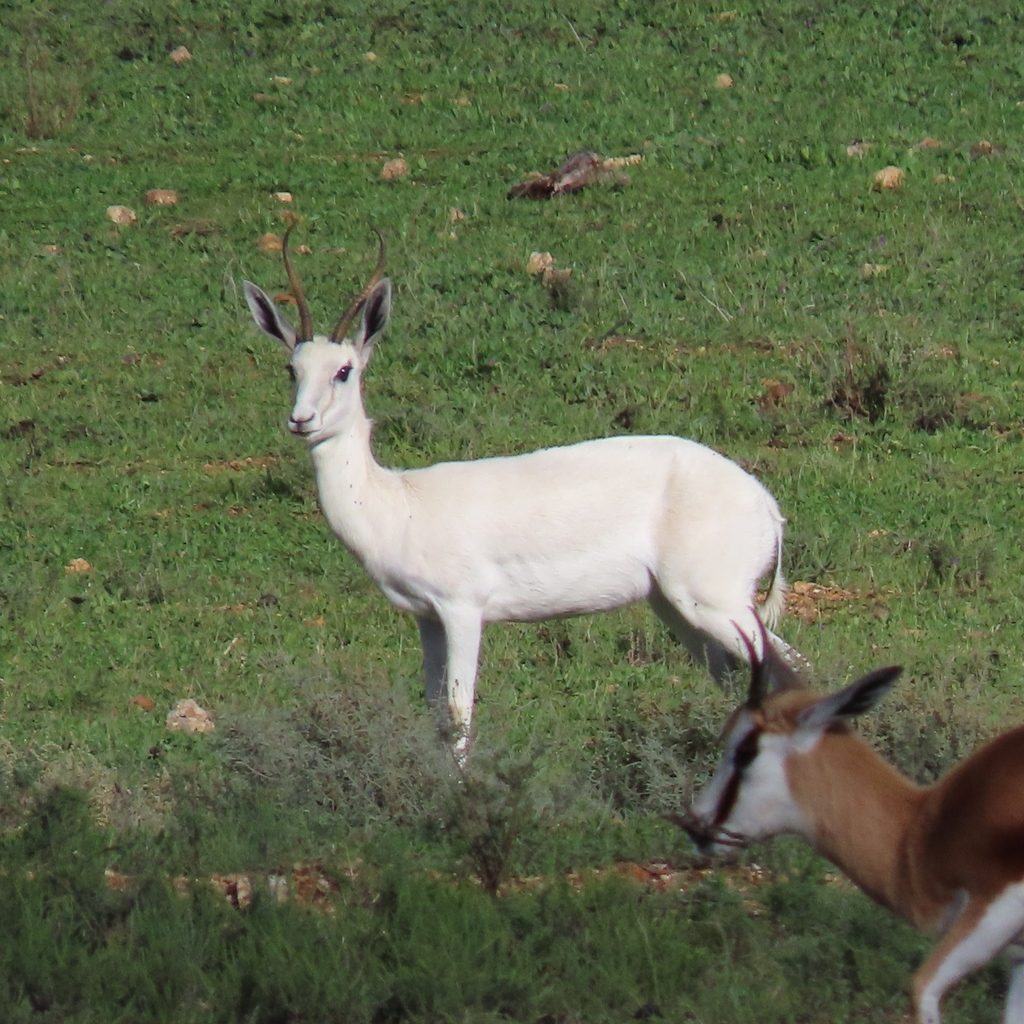
Springbok
Photo © Liezl van der Merwe
Photo © Liezl van der Merwe — CC BY 4.0 — Source: iNaturalist #157165548Identification
The springbok is a slender, long-legged antelope that reaches 71 to 86 cm at the shoulder and weighs between 27 and 42 kg. Both males and females possess a distinctive pair of black horns, 35 to 50 cm long, that curve backwards. The species is easily recognised by its white face marked with a dark stripe running from the eyes to the mouth, a light brown coat featuring a reddish-brown stripe that runs across the flanks from the upper foreleg to the buttocks, and a characteristic white rump flap. The tail, 14 to 28 cm long, ends in a short black tuft.
Range & Habitat
The springbok is found mainly in south and southwestern Africa, inhabiting the dry areas of the region. Three subspecies are recognised, with distributions ranging from southwestern Angola through Namibia and Botswana, and across the arid regions south of the Orange River extending into the Free State and Kimberley. The springbok is the national mammal of South Africa and remains one of the few antelope species with an expanding population, classified by conservation authorities as a least concern species with no major threats to its long-term survival.
Behaviour & Diet
Active mainly at dawn and dusk, springbok form mixed-sex herds known as harems. The species is famous for pronking—a distinctive behaviour in which the antelope performs multiple stiff-legged leaps up to 2 metres above the ground with its back bowed and white rump flap lifted. Historically, springbok of the Kalahari Desert and Karoo migrated in large numbers across the countryside in a practice known as trekbokking.
Primarily a browser, the springbok feeds on shrubs and succulents and has a remarkable adaptation: it can live without drinking water for years, obtaining its moisture requirements from succulent vegetation. Breeding occurs year-round with peaks during the rainy season when forage is most abundant. A single calf is born after a five- to six-month pregnancy, weans at nearly six months, and leaves its mother a few months later.
Best Time & Places to See It
Springbok are most active during dawn and dusk, making these the optimal times for wildlife observation and photography. They are widely distributed across south and southwestern Africa in suitable dry habitats, with populations throughout South Africa, Namibia, and Botswana where they remain relatively common and accessible to travellers.
Photography Tips
The springbok's striking markings—the white face with dark facial stripes, reddish-brown flank stripe, and contrasting white rump—make it a photogenic subject. The most memorable images capture the species' iconic pronking behaviour, when the animal leaps into the air in a stiff-legged posture with its white flap lifted. Photograph during dawn and dusk when the animals are most active, and be patient; pronking is often triggered by alarm or excitement, providing dynamic action shots that showcase this unique behaviour.
Nxai Pan National Park
Botswana
+226 birds+16 mammals
Across the northwestern reaches of Botswana stretches a landscape of profound seasonal transformation—a sprawling pan system where shallow depressions fill and empty with the rains, creating…
VIEW NATIONAL PARKGarden Route National Park
George, South Africa
+353 birds+54 mammals
Sweeping across the Western Cape's coastal and mountainous terrain, this sprawling national park encompasses over five thousand square kilometers of extraordinarily diverse landscape—from coastal limestone cliffs…
VIEW NATIONAL PARKPilanesberg National Park
Moses Kotane Local Municipality, South Africa
+364 birds+49 mammals
Granite peaks and volcanic ridges rise unexpectedly from the savanna floor across this 734-square-kilometre expanse in the North West province, creating a landscape of profound ecological…
VIEW NATIONAL PARKMokala National Park
Siyancuma Local Municipality, South Africa
+246 birds+35 mammals
Across the semi-arid savanna of the Northern Cape, where red earth meets sparse acacia woodland and open grassland punctuated by rocky outcrops, lies a landscape shaped…
VIEW NATIONAL PARKTankwa-Karoo National Park
Hantam Local Municipality, South Africa
+201 birds+20 mammals
Across the semi-arid heartland of the Northern Cape, where winter rains carve ephemeral watercourses through endless ochre plains, Tankwa-Karoo National Park sprawls across more than 3,100…
VIEW NATIONAL PARKMountain Zebra National Park
Inxuba Yethemba Local Municipality, South Africa
+265 birds+35 mammals
Across the windswept plateaus and deeply incised valleys of the Eastern Cape's interior, Mountain Zebra National Park unfolds as a landscape of geological drama and ecological…
VIEW NATIONAL PARKAugrabies Falls National Park
Kai !Garib Local Municipality, South Africa
+176 birds+20 mammals
Where the Orange River cuts a dramatic scar through the Northern Cape's arid interior, Augrabies Falls National Park sprawls across nearly 1,200 square kilometers of raw,…
VIEW NATIONAL PARKAddo Elephant National Park
Sundays River Valley Local Municipality, South Africa
+388 birds+55 mammals
Where the Eastern Cape's semi-arid scrublands meet transitional woodland, Addo sprawls across 13,478 square kilometres of one of southern Africa's most biodiverse landscapes. The terrain rises…
VIEW NATIONAL PARKCamdeboo National Park
Camdeboo Local Municipality, South Africa
+272 birds+24 mammals
Granite ridges and weathered sandstone cliffs rise across a semi-arid landscape where the Karoo transitions into the eastern escarpment of South Africa, creating Camdeboo National Park's…
VIEW NATIONAL PARKNamib-Naukluft National Park
Namibia
+217 birds+33 mammals
Across nearly 94,000 square kilometers of southwestern Namibia, a landscape of extremes unfolds where towering sand dunes meet rugged mountain ranges, and ancient riverbeds carve through…
VIEW NATIONAL PARKEtosha National Park
Namibia
+356 birds+58 mammals
Across northern Namibia's stark semi-arid plateau, a vast shallow depression transforms seasonally into one of Africa's most dramatic wildlife theaters. Etosha National Park, encompassing more than…
VIEW NATIONAL PARKNamibRand Nature Reserve
Hammerstein, Namibia
+107 birds+12 mammals
Where rust-coloured dunes surrender to sculpted granite outcrops and vast plains stretch toward an endless horizon, one of southern Africa's most pristine wilderness areas unfolds. The…
VIEW NATURE RESERVEMakgadikgadi Pans National Park
Gucta, Botswana
+272 birds+27 mammals
Where salt-crusted flatlands stretch endlessly toward a shimmering horizon, one of Africa's most extraordinary ecosystems awakens with the rains. The Makgadikgadi Pans comprise vast mineral-rich basins…
VIEW NATIONAL PARKNo community photos yet. Log in to add the first one.
No community observations of this species yet.