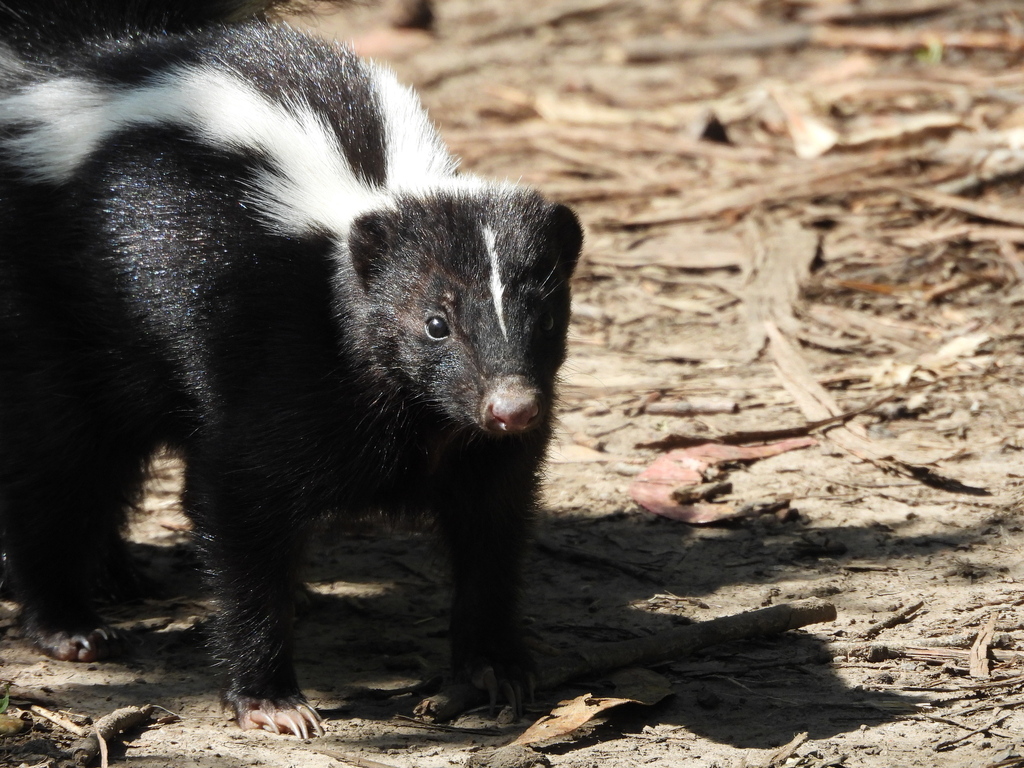
Striped Skunk
Photo © P Holroyd
Photo © P Holroyd — CC BY 4.0 — Source: iNaturalist photo #484497004Identification
The striped skunk is one of North America's most recognizable animals, easily identified by its distinctive black fur with white stripes. The characteristic pattern consists of a white stripe extending from the head that divides along the shoulders, continuing along the flanks to the rump and tail. Some individuals display a white patch on the chest or white stripes on the front limbs, while brown or cream-colored mutations occasionally occur. The animal is stoutly built with short legs, a small conical head, and a long, heavily furred tail.
Striped skunks are medium-sized mustelids, measuring 52–77 centimetres (20–30 inches) in total body length and weighing 1.8–4.5 kg (4.0–9.9 pounds), with some individuals reaching 5.5 kg (12 pounds). Adult males are about 10% larger than females. The forefeet are armed with five long, curved claws adapted for digging, while hind foot claws are shorter and straighter. Most distinctive are the two highly developed musk glands, one on each side of the anus, containing approximately 15 millilitres of pungent yellow musk each—their primary defense mechanism.
Range & Habitat
The striped skunk occurs across much of North America, including southern Canada, the United States, and northern Mexico. The species has a long evolutionary history on the continent, with fossil evidence indicating it has inhabited North America since the early Pleistocene. Following the retreat of glaciers during the Holocene period, striped skunks expanded northwards and westwards from their historical southern ranges, eventually colonizing most of their current territory.
The striped skunk's broad distribution and conservation status as "least concern" reflect its remarkable ability to adapt to human-modified environments. This adaptability has allowed the species to thrive across diverse landscapes and urban settings throughout its extensive range.
Behaviour & Diet
Striped skunks are mostly nocturnal animals, becoming active during darkness when they forage for food. They are omnivores with polygamous mating systems and few natural predators, save for birds of prey. The breeding season typically occurs between mid-February and mid-April, though timing is delayed at higher latitudes. Males during the mating period are highly mobile, sometimes covering 4 kilometres (2.5 miles) per night in search of females. A single male may establish a harem of several females, which he mates with and defends against rival males for approximately 35 days.
The striped skunk's most famous defensive feature is its ability to spray musk—a potent mixture of sulfur-containing compounds that can reach several metres in distance. The odor is extraordinarily powerful and, if sprayed into the eyes, causes temporary burning. This chemical defense is highly effective, explaining why these animals have so few natural predators despite their relatively slow movement.
Best Time & Places to See It
Striped skunks are primarily nocturnal, so viewing opportunities are best during evening and night hours. Early morning may also yield sightings as they return to their dens. The mating season from February to April is an active period when males are particularly mobile and searching for mates, potentially increasing encounter rates during this time. However, their wide distribution across southern Canada, the United States, and northern Mexico means they can be found throughout their range in suitable habitats during most of the year.
Photography Tips
Photographing striped skunks requires patience and respect for their powerful defensive capabilities. Maintain a safe distance and never corner or threaten an individual, as they will spray without hesitation. Night photography techniques are essential, as these are nocturnal animals. Use a headlamp or red light to avoid startling them, and be prepared with appropriate camera settings for low-light conditions. Early morning hours may offer better natural light while still capturing these animals during their active period.
The striped skunk's bold black-and-white coloration makes for striking photographs and provides excellent contrast. Capture images that emphasize their distinctive stripe pattern and stocky build. Remember that skunks are iconic wildlife subjects and popular in nature photography, but always prioritize safety and ethical wildlife observation practices when pursuing images of these remarkable animals.
Jasper National Park
Improvement District No. 12, Canada
+235 birds+34 mammals
Where the Canadian Rockies rise in dramatic succession across western Alberta, Jasper National Park spans over 11,000 square kilometres of subalpine and alpine terrain, glaciated valleys,…
VIEW NATIONAL PARKNew River Gorge National Park
Fayette County, United States
+183 birds+13 mammals
Where the New River carves its ancient path through the Appalachian plateau, a landscape of towering sandstone cliffs and dense deciduous forest creates one of the…
VIEW NATIONAL PARKBig Bend National Park
Brewster County, United States
+345 birds+34 mammals
Where the Chisos Mountains rise abruptly from the Sonoran Desert floor, Big Bend National Park spans over 7,300 square kilometers of one of North America's most…
VIEW NATIONAL PARKSaguaro National Park
Rincon Valley, United States
+354 birds+40 mammals
Where the Sonoran Desert meets sky-island mountains, two geographically separated districts of Saguaro National Park sprawl across nearly two thousand square kilometers of Arizona's most iconic…
VIEW NATIONAL PARKPinnacles National Park
San Benito County, United States
+197 birds+33 mammals
Jagged volcanic spires thrust from chaparral-covered ridges across 222 square kilometers of central California's inner Coast Ranges, their pale stone crowns catching the afternoon light like…
VIEW NATIONAL PARKGreat Basin National Park
White Pine County, United States
+170 birds+19 mammals
Where the Great Basin's high desert plateaus rise above 10,000 feet, ancient bristlecone pines endure on moonscape ridges of limestone and quartzite, creating one of North…
VIEW NATIONAL PARKZion National Park
Washington County, United States
+244 birds+30 mammals
Towering sandstone cliffs in shades of crimson, rust, and cream rise abruptly from the Virgin River's winding canyon floor, their sculpted faces bearing witness to millions…
VIEW NATIONAL PARKCapitol Reef National Park
Garfield County, United States
+196 birds+22 mammals
Wrinkled ridges of crimson and gold sandstone rise from the floor of south-central Utah, their weathered faces carved by the Fremont River into one of the…
VIEW NATIONAL PARKGreat Smoky Mountains National Park
Sevier County, United States
+244 birds+40 mammals
Where the southern Appalachian ridgeline reaches its most densely forested expression, over 4,200 square kilometres of temperate woodland rise and fall across Tennessee and North Carolina,…
VIEW NATIONAL PARKGrand Teton National Park
Teton County, United States
+247 birds+38 mammals
Where the Teton Range tears skyward in a dramatic escarpment above the Snake River valley, nearly 2,550 square kilometers of montane wilderness unfolds across Teton County,…
VIEW NATIONAL PARKYellowstone National Park
Park County, United States
+253 birds+43 mammals
Across nearly 11,400 square kilometres of the Rocky Mountain plateau, geothermal fury and pristine wilderness converge in one of Earth's most dynamic landscapes. Hot springs, geysers…
VIEW NATIONAL PARKRedwood National Park
Humboldt County, United States
+343 birds+43 mammals
Where the Pacific fog rolls deep into northern California's coastal valleys, some of the tallest trees on Earth rise from a landscape shaped by tectonic forces…
VIEW NATIONAL PARKFundy National Park of Canada
Alma Parish, Canada
+217 birds+24 mammals
Where the Bay of Fundy's tidal rhythms sculpt a landscape of dramatic cliffs, forested valleys, and boulder-strewn shorelines, Fundy National Park rises across approximately 345 square…
VIEW NATIONAL PARKKouchibouguac National Park of Canada
Carleton Parish, Canada
+207 birds+14 mammals
Where the Maritime provinces meet the Atlantic, 591 square kilometres of coastal forest and wetland unfold across New Brunswick's eastern shoulder, a mosaic of boreal woodland,…
VIEW NATIONAL PARKTutuaca
Tosanachi, Mexico
+147 birds+13 mammals
Where copper canyons plunge deeper than the Grand Canyon itself, Mexico's remote Sierra Madre Occidental unfolds in dramatic vertical relief. Tutuaca anchors this wilderness realm, a…
VIEW PROTECTED LANDSCAPECuyahoga Valley National Park
Brecksville, United States
+255 birds+27 mammals
Where the Cuyahoga River carves through a glaciated landscape of Ohio, the valley reveals a temperate deciduous forest ecosystem shaped by four distinct seasons and reliable…
VIEW NATIONAL PARKGlacier National Park
United States
+246 birds+39 mammals
Where jagged peaks pierce a subarctic sky and glacial valleys carve through ancient rock, Glacier National Park spans the spine of the Northern Rockies along Montana's…
VIEW NATIONAL PARKGuadalupe Mountains National Park
Culberson County, United States
+262 birds+14 mammals
Where fossil-laden limestone ridges thrust skyward above the Chihuahuan Desert floor, Guadalupe Mountains National Park reveals a landscape sculpted by ancient seas and relentless aridity. These…
VIEW NATIONAL PARKShenandoah National Park
Page County, United States
+243 birds+31 mammals
Ridges of ancient quartzite rise above the Shenandoah Valley floor, their slopes dressed in a mosaic of oak and hickory forest that yields to cove hardwoods…
VIEW NATIONAL PARKBosque del Apache National Wildlife Refuge
Socorro County, United States
+345 birds+17 mammals
Where the Rio Grande emerges from its desert canyon in central New Mexico, a narrow ribbon of riparian woodland defies the arid landscape that surrounds it.…
VIEW WILDLIFE SANCTUARYWichita Mountains National Wildlife Refuge
Medicine Park, United States
+256 birds+17 mammals
Granite peaks rise abruptly from rolling prairie in southwestern Oklahoma, where the Wichita Mountains National Wildlife Refuge protects a rare collision of ecosystems. This sanctuary encompasses…
VIEW WILDLIFE SANCTUARYLaguna Atascosa National Wildlife Refuge
Cameron County, United States
+365 birds+19 mammals
Where coastal prairie meets shallow lagoon along the southernmost tip of Texas, Laguna Atascosa National Wildlife Sanctuary sprawls across a landscape sculpted by salt spray and…
VIEW WILDLIFE SANCTUARYLower Rio Grande Valley National Wildlife Refuge
Starbase, United States
+311 birds+11 mammals
Where the Rio Grande delta spreads across the coastal plain of South Texas, a sanctuary of subtropical wetlands and riparian corridors creates a landscape that pulses…
VIEW WILDLIFE SANCTUARYHavasu National Wildlife Refuge
Lake Havasu City, United States
+291 birds+8 mammals
Where the Colorado River widens into a vast reservoir in the Sonoran Desert, Havasu National Wildlife Sanctuary protects one of the most critical wetland ecosystems in…
VIEW WILDLIFE SANCTUARYSacramento National Wildlife Refuge
Glenn County, United States
+247 birds+13 mammals
Across the flat expanse of Glenn County's Sacramento Valley, shallow pools and seasonal marshes create one of California's most vital wetland sanctuaries—a landscape shaped by water…
VIEW WILDLIFE SANCTUARYSan Luis National Wildlife Refuge
Merced County, United States
+219 birds+14 mammals
Across the floor of California's San Joaquin Valley, where semi-arid grasslands meet shallow seasonal wetlands, San Luis National Wildlife Sanctuary preserves a critical mosaic of habitats…
VIEW WILDLIFE SANCTUARYDon Edwards San Francisco Bay National Wildlife Refuge
Fremont, United States
+286 birds+20 mammals
Where the San Francisco Bay's shallow margins dissolve into tidal salt marshes and mudflats, this wildlife sanctuary preserves one of California's most ecologically vital estuarine systems.…
VIEW WILDLIFE SANCTUARYBear River Migratory Bird Refuge
Box Elder County, United States
+254 birds+9 mammals
Where the Bear River winds through the semi-arid basin country of northwestern Utah, a sprawling wildlife sanctuary transforms the high desert into a haven for migratory…
VIEW WILDLIFE SANCTUARYNational Elk Refuge
Jackson, United States
+230 birds+27 mammals
Where the sagebrush flats of northwestern Wyoming rise toward the Gros Ventre Mountains, winter transforms the landscape into a realm of survival and spectacle. The National…
VIEW WILDLIFE SANCTUARYNo community photos yet. Log in to add the first one.
No community observations of this species yet.