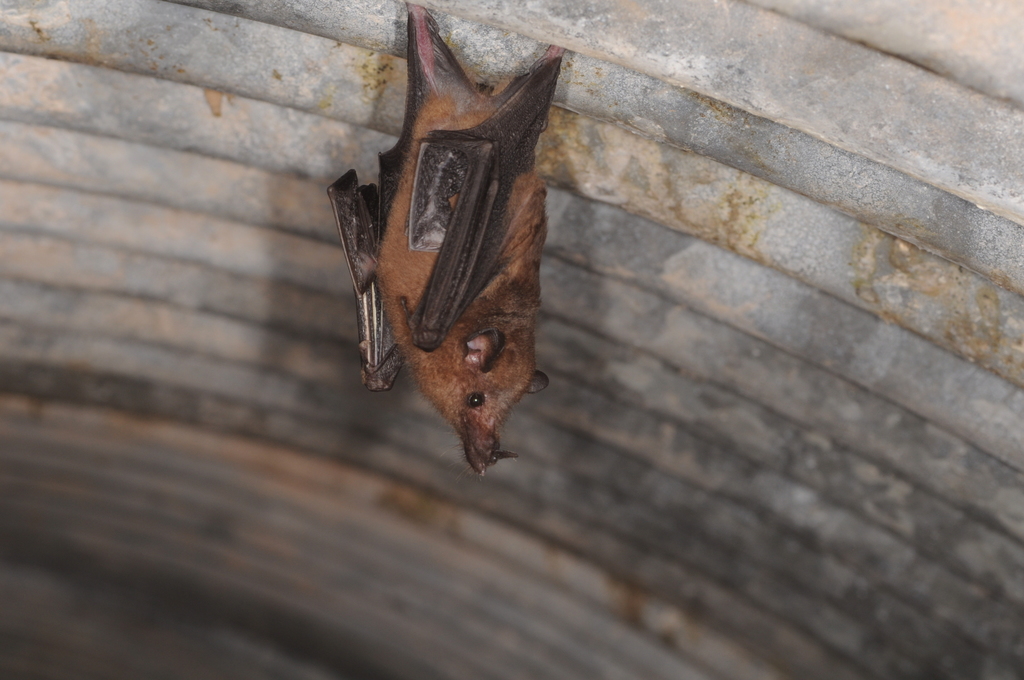
The tailed tailless bat (Anoura caudifer) is a species of leaf-nosed bat from South America. == Taxonomy == The scientific name of this species is variously given as either A. caudifer or A. caudifera, with scientists having argued for both names on the basis of Latin grammar and of the ICZN rules on the naming of species. When Étienne Geoffroy Saint-Hilaire first described the bat in 1818, he used the species name "caudifer", and this is the name currently preferred by such influential sources as the International Union for Conservation of Nature and Mammal Species of the World. The common name of the bat is typically given as the "tailed tailless bat". This is because the species belongs to the genus Anoura, commonly called the "tailless bats", yet it possesses a tail. However, the name is arguably somewhat misleading, since only three of the other seven species of "tailless bats" genuinely lack a tail. Of the remaining four, however, three have tails that are significantly shorter even than that of A. caudifer, and the fourth, the equatorial tailless bat, was only distinguished from A. caudifer in 2006. == Description == The tailed tailless bat is one of the smaller bat…
Natural Serranía de los Yariguíes National Park
El Carmen de Chucurí, Colombia
+320 birds+3 mammals
Where the northern cordilleras of Colombia rise toward cloud forest, the Serranía de los Yariguíes unfolds across nearly 1,820 square kilometers of some of the most…
VIEW NATIONAL PARKNatural Farallones de Cali National Park
Buenaventura, Colombia
+733 birds+27 mammals
Where the Pacific coastal plain meets the western slopes of the Andes, Farallones de Cali National Park sprawls across nearly 3,500 square kilometers of dramatic topography…
VIEW NATIONAL PARKSão Joaquim National Park
Brazil
+222 birds+9 mammals
Where the southern Brazilian highlands rise above the Atlantic Forest, São Joaquim National Park protects nearly 1,000 square kilometers of montane terrain that shifts between temperate…
VIEW NATIONAL PARKNo community photos yet. Log in to add the first one.
No community observations of this species yet.