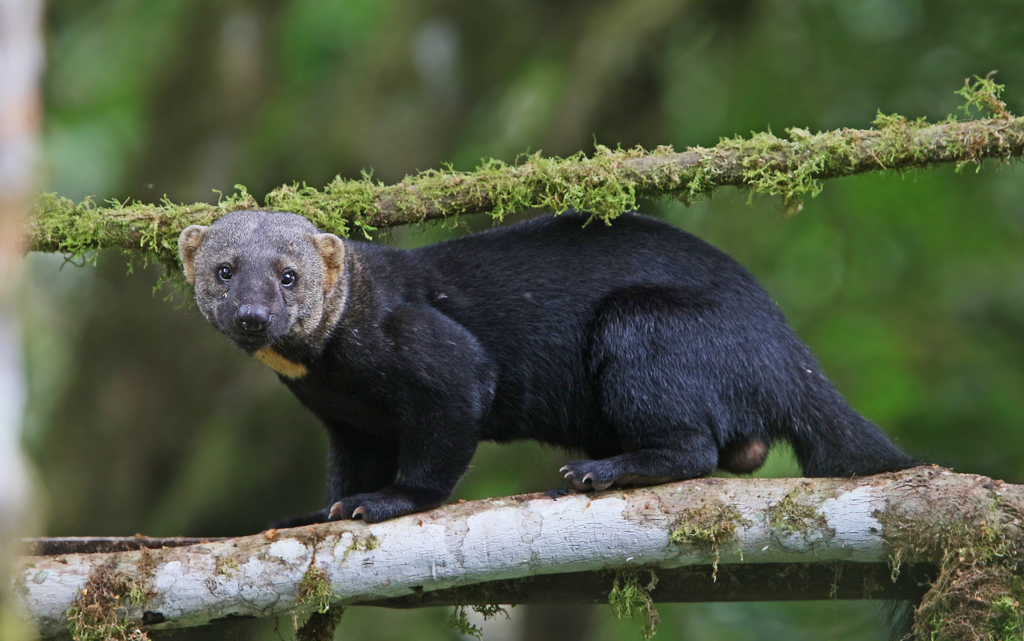
Tayra
Photo © Christoph Moning
Photo © Christoph Moning — CC BY 4.0 — Source: iNaturalist photo #60541018Identification
The tayra is a long, agile mustelid resembling a large fisher or marten, though with a sleeker, more compact build than a wolverine. Adults range from 56 to 71 cm in length with a notably bushy tail of 37 to 46 cm, and weigh between 2.7 and 7.0 kg, with males noticeably larger and more muscular than females. Their most distinctive feature is a yellowish or orange "heart"-shaped patch on the chest—unique to each individual in color, shape, and size, making it useful for field identification.
Tayras have short, dark brown to black fur that is relatively uniform across the body and limbs, contrasting with lighter tan or greyish fur on the head and neck. Their small, rounded ears, long sensory whiskers, and black eyes with a striking blue-green shine are characteristic of the species. Genetic color morphs including albino, white, or beige-yellow individuals occur more frequently in tayras than in other mustelids. Their feet possess short, curved claws adapted for climbing and running rather than digging, with hairless pads surrounded by sensory hairs.
Range & Habitat
Tayras are found across most of South America, Central America, and the island of Trinidad, with their northernmost range extending to Tamaulipas and Veracruz on Mexico's east coast, and south Sinaloa and Nayarit on the west coast. Seven regional subspecies are currently recognized across their range. Notable absences include Chile, Uruguay, most of Argentina, and parts of Brazil's east coast.
The species is strongly associated with tropical and subtropical forests, though they may traverse grasslands and other open habitats at night while traveling between forest patches. They are also encountered in cultivated areas, tree plantations, and farmlands, demonstrating some habitat flexibility despite their forest preference.
Behaviour & Diet
Tayras are primarily diurnal, though occasionally active in evening or night hours. Though presumed solitary, they have been observed in larger groups, likely comprising mothers and older offspring. As opportunistic omnivores, they hunt rodents and other small mammals, birds, lizards, reptiles, and invertebrates, while also climbing trees to access fruit and honey. They locate prey primarily by scent—their eyesight being relatively poor—and actively pursue prey rather than using stalking or ambush tactics.
Expert climbers using their long tails for balance, tayras move in a bounding gallop at speed and can leap between treetops when pursued. They typically avoid water but are capable swimmers. They shelter in hollow trees or ground burrows and maintain large home ranges up to 24 km², traveling at least 6 km in a single night. A fascinating behavior involves caching unripe green plantains to ripen over several days before consumption. Young tayras begin hunting as early as three months, fully grow by six months, and establish independent territories by ten months.
Best Time & Places to See It
Tayras are diurnal animals, making daytime forest walks the most productive viewing period, though occasional evening or night activity is possible. They can be encountered across tropical and subtropical forests throughout Central America, South America, and Trinidad. Forest edges, cultivated areas, and tree plantations also offer opportunities, particularly where forest patches are accessible.
The species' preference for movement across their large home ranges means sightings are never guaranteed, but patient observation in suitable forest habitat—especially near fruiting trees or areas with small mammal activity—offers the best chances. Early morning and late afternoon periods may be particularly productive during daytime observation.
Photography Tips
The tayra's compact size, agility, and arboreal habits make photography challenging but rewarding. Focus on capturing the distinctive chest patch, as its unique characteristics are key identification features. The animal's ability to move rapidly both on the ground and through trees means anticipating movement and maintaining readiness is essential for successful shots.
The striking blue-green shine in the tayra's black eyes and the contrast between the dark body fur and lighter head coloring offer compelling compositional opportunities. Since tayras are primarily active during daylight hours, natural forest lighting should be adequate, though the dappled light beneath forest canopy may require careful exposure management. Their climbing behavior and use of branches for balance provide dynamic compositional possibilities for capturing their characteristic agility.
Corcovado National Park
Puerto Jiménez, Costa Rica
+444 birds+48 mammals
Where the Osa Peninsula juts into the Pacific, rainforest descends almost to the tide line, and Corcovado National Park protects one of Central America's most intact…
VIEW NATIONAL PARKArenal Volcano National Park
Peñas Blancas, Costa Rica
+551 birds+21 mammals
Straddling the border between Alajuela and Guanacaste in northwestern Costa Rica, this national park rises dramatically around one of Central America's most active volcanic systems. The…
VIEW NATIONAL PARKTortuguero National Park
Roxana, Costa Rica
+420 birds+23 mammals
Canals and lagoons thread through a labyrinth of lowland rainforest where the Caribbean coast of Costa Rica meets the wetland frontier. This is terrain shaped by…
VIEW NATIONAL PARKPiedras Blancas National Park
Golfito, Costa Rica
+386 birds+24 mammals
Where the Golfo Dulce meets the southwestern Pacific coast of Costa Rica, Piedras Blancas National Park protects a dramatic transition zone where lowland rainforest descends toward…
VIEW NATIONAL PARKSanta Rosa National Park
Santa Elena, Costa Rica
+359 birds+30 mammals
Where Pacific-facing slopes descend from volcanic uplands toward the Guanacaste lowlands, Santa Rosa National Park unfolds across a mosaic of tropical dry forest, gallery woodland, and…
VIEW NATIONAL PARKYasuní National Park
Aguarico, Ecuador
+601 birds+43 mammals
Where the western Amazon basin converges with Ecuador's Orellana Province, lowland rainforest reaches toward the horizon in an unbroken canopy of staggering botanical density. Yasuní National…
VIEW NATIONAL PARKSangay National Park
Cebadas, Ecuador
+320 birds+10 mammals
High in Ecuador's Andean spine, where the Western Cordillera rises to touch perpetual snow, a landscape of volcanic drama and ecological intensity unfolds across Sangay National…
VIEW NATIONAL PARKAntisana National Park
Quijos, Ecuador
+432 birds+21 mammals
Where the eastern Andean slopes descend into the Amazon basin, Antisana National Park sprawls across roughly 2,500 square kilometers of some of South America's most dramatic…
VIEW NATIONAL PARKItatiaia National Park
Brazil
+519 birds+12 mammals
Where granite peaks pierce the Atlantic rainforest canopy in southeastern Brazil, Itatiaia National Park rises as one of the country's oldest and most ecologically vital protected…
VIEW NATIONAL PARKSerra dos Órgãos National Park
Brazil
+446 birds+13 mammals
Granite peaks thrust skyward through the Atlantic Forest canopy in the mountains immediately north of Rio de Janeiro, their bare rock faces rising above a landscape…
VIEW NATIONAL PARKSoberanía National Park
Cristóbal, Panama
+495 birds+34 mammals
Rainforest and riverine woodland blanket the rolling terrain of this 714-square-kilometre national park in Colón Province, where the Caribbean watershed feeds a maze of streams and…
VIEW NATIONAL PARKParque Internacional la Amistad
Teribe, Panama
+325 birds+11 mammals
Where the continental divide rises between the Caribbean and Pacific watersheds, a wilderness of extraordinary biological richness unfolds across the Talamanca Range and into lowland rainforest—a…
VIEW NATIONAL PARKIguazú National Park
Puerto Iguazú, Argentina
+346 birds+15 mammals
Where the Paraná Plateau plunges toward the Atlantic watershed, nearly 800 square kilometers of subtropical rainforest drape across Misiones Province in a landscape carved by millennia…
VIEW NATIONAL PARKParque Provincial Pampa del Indio
Laguna Limpia, Argentina
+231 birds+4 mammals
Across the flat horizons of Chaco Province, where the Paraná River system spills into vast wetlands and grasslands, Parque Provincial Pampa del Indio protects one of…
VIEW NATURE RESERVEMontes Azules
Candelaria, Mexico
+395 birds+47 mammals
Where jungle-clad limestone plateaus plunge into canyon systems carved by the Usumacinta River, Mexico's most pristine rainforest reserve unfolds across the Lacandón region of Chiapas. Montes…
VIEW BIOSPHERE RESERVELaguna del Tigre National Park
Petén, Guatemala
+399 birds+29 mammals
Where the Petén lowlands dissolve into wetland and forest, Laguna del Tigre National Park protects one of Guatemala's most ecologically vital landscapes. This sprawling reserve encompasses…
VIEW NATIONAL PARKSierra del Lacandón National Park
Petén, Guatemala
+348 birds+7 mammals
Where the Petén rainforest rises into limestone ridges and deep ravines, Sierra del Lacandón National Park protects one of Central America's most intact tropical wilderness zones.…
VIEW NATIONAL PARKCarara National Park
Tárcoles, Costa Rica
+397 birds+19 mammals
Where the Pacific coastal plain meets transitional forest, Carara National Park straddles one of Central America's most dynamic ecological boundaries. The park's landscape encompasses lowland deciduous…
VIEW NATIONAL PARKCahuita National Park
Talamanca, Costa Rica
+359 birds+15 mammals
Where the Caribbean shoreline dissolves into mangrove creeks and coral gardens, Cahuita's mosaic of habitats unfolds across the Limón coast. The park's signature feature—a living coral…
VIEW NATIONAL PARKRincón de la Vieja National Park
Liberia, Costa Rica
+451 birds+30 mammals
Where volcanic slopes rise abruptly from the Guanacaste lowlands, Rincón de la Vieja National Park sprawls across a landscape shaped by geothermal drama and seasonal extremes.…
VIEW NATIONAL PARKGandoca-Manzanillo National Wildlife Refuge
Manzanillo, Costa Rica
+394 birds+18 mammals
Where the Caribbean coastal plain surrenders to water-logged forest and mangrove tangles, Gandoca-Manzanillo Wildlife Sanctuary shelters one of Costa Rica's most biodiverse lowland wetland ecosystems. The…
VIEW WILDLIFE SANCTUARYBarra del Colorado National Wildlife Refuge
Tortuguero, Costa Rica
+462 birds+36 mammals
Where the Caribbean's restless waters meet the Limón Province coastline, Barra del Colorado National Wildlife Sanctuary unfolds across a landscape of extraordinary ecological complexity. This equatorial…
VIEW WILDLIFE SANCTUARYNo community photos yet. Log in to add the first one.
No community observations of this species yet.