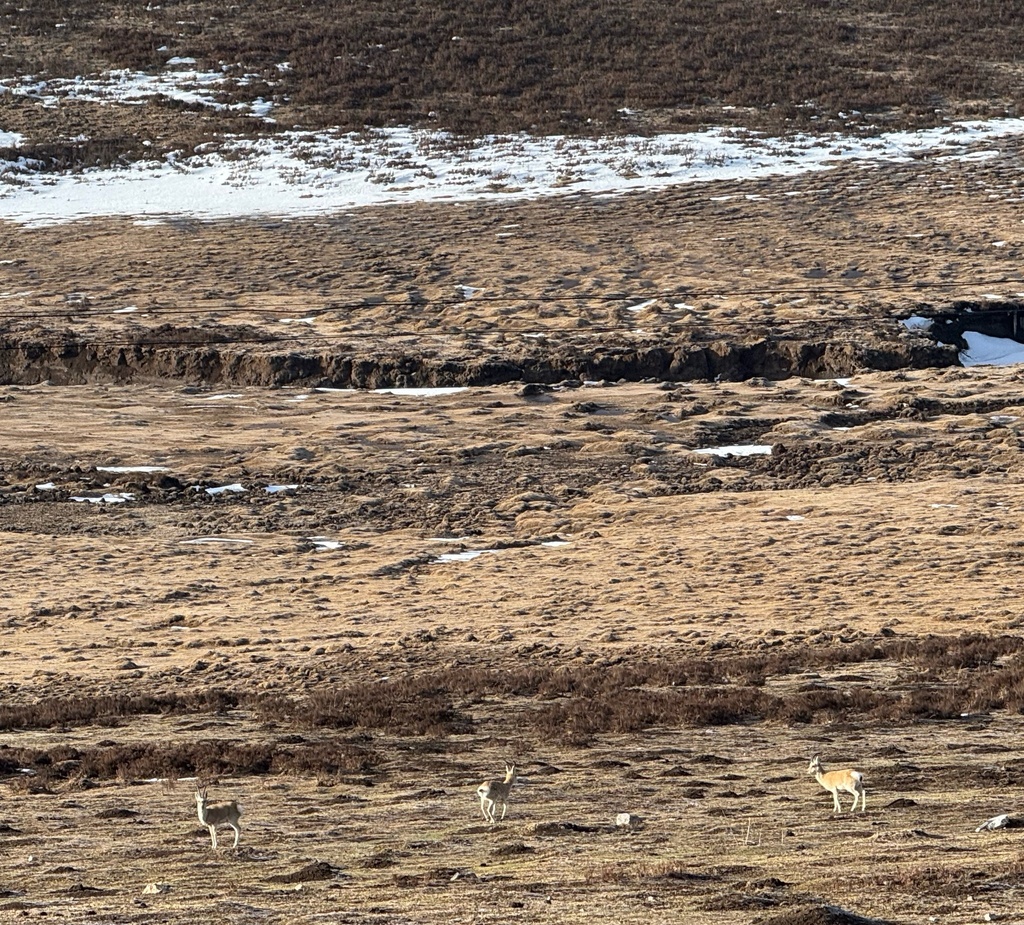
Tibetan Gazelle
Photo © chrisdt
Photo © chrisdt — CC BY 4.0 — Source: iNaturalist #347205519The goa (Procapra picticaudata), also known as the Tibetan gazelle, is a species of antelope that inhabits the Tibetan Plateau. == Description == The goa is a relatively small antelope, with slender and graceful bodies. Both males and females stand 54 to 65 centimetres (21 to 26 in) tall at the shoulder, measure 91 to 105 cm (36 to 41 in) in head-body length and weigh 13 to 16 kg (29 to 35 lb). Males have long, tapering, ridged horns, reaching lengths of 26 to 32 cm (10 to 13 in). The horns are positioned close together on the forehead, and rise more or less vertically until they suddenly diverge towards the tips. Females have no horns, and neither sex has distinct facial markings. The goa is grayish brown over most of its body, with its summer coat being noticeably greyer in colour than its winter one. It has a short, black-tipped tail in the center of its heart-shaped white rump patches. Its fur lacks an undercoat, consisting of long guard hairs only, and is notably thicker in winter. It appears to have excellent senses, including keen eyesight and hearing. Its thin and long legs enhance its running skills, which…
Sanjiangyuan National Park
Nagqu, China
+187 birds+25 mammals
Where the headwaters of three great Asian rivers emerge from a high alpine plateau, the landscape unfolds in tundra and dwarf shrubland—a world of austere beauty…
VIEW NATIONAL PARKQiangtang National Nature Reserve
Ngari Prefecture, China
+34 birds+5 mammals
Across the high Tibetan plateau north of Nagqu sprawls one of Earth's most extreme alpine tundra ecosystems, where vast expanses of sparse grassland and barren terrain…
VIEW NATURE RESERVEQinghai Lake National Nature Reserve
Hainan Tibetan Autonomous Prefecture, China
+243 birds+11 mammals
At 3,200 metres above sea level on the Tibetan plateau, where winter temperatures plunge far below freezing and snow blankets the landscape for half the year,…
VIEW NATURE RESERVENo community photos yet. Log in to add the first one.
No community observations of this species yet.