Tsessebe
Photo © Diogo Luiz
Photo © Diogo Luiz — CC BY 4.0 — Source: iNaturalist photo #62633159Identification
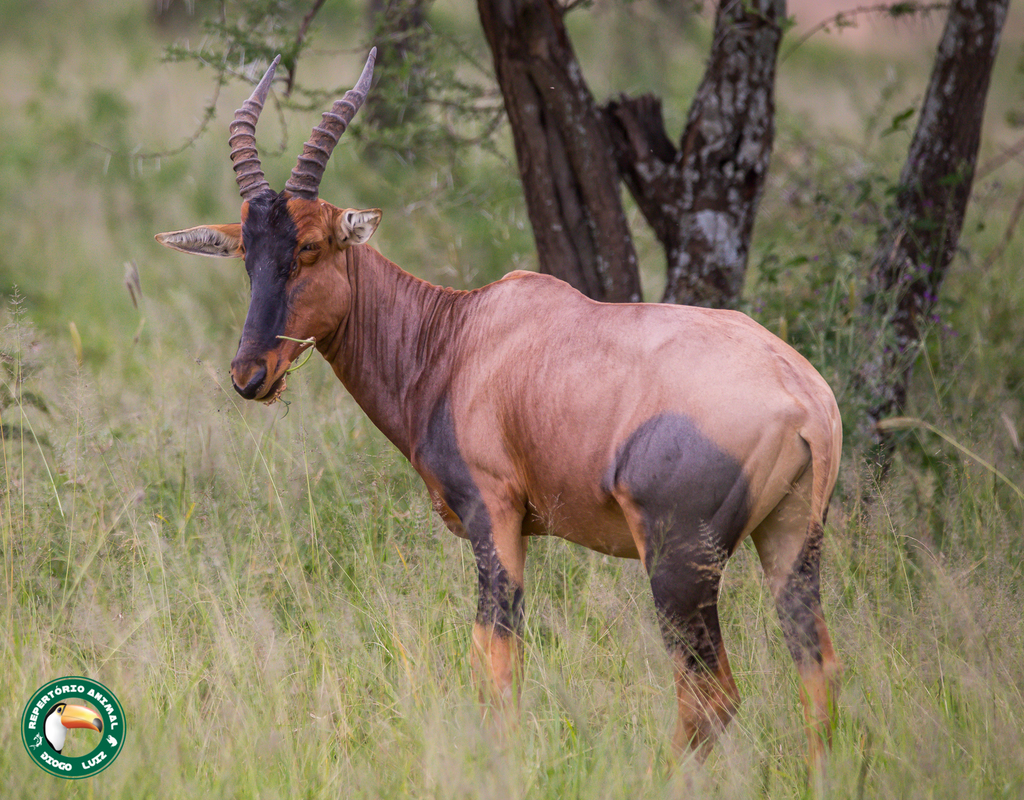
The tsessebe is a large, robust antelope with a distinctly dark appearance. Adults measure 150–230 cm in length and stand 100–130 cm at the shoulder, with males averaging 137 kg and females 120 kg. Their most striking features include a chestnut to reddish-brown coat, a prominent dark mask-like facial pattern, and a characteristic hump at the base of the neck. Both sexes carry lyrate-shaped, ringed horns (37–40 cm long), which play an important role in male territory defence and mate attraction.
The upper forelimbs and thighs display distinctive greyish, dark purple, or bluish-black patches, while the hindlimbs are brownish-yellow to yellow and the belly is white. The tail has a black tuft. Their short, shiny coat and elongated head shape distinguish them from similar species like hartebeest, which they resemble but with darker colouration and less sharply angled horns. Tsessebe possess preorbital glands that secrete clear oil and hoof glands on their front legs.
Range & Habitat
Tsessebe occur across sub-Saharan Africa with several recognised geographic subspecies. The subspecies Damaliscus lunatus jimela, commonly called 'topi', is found north of Lake Bangweulu in Zambia, across the border and beyond the rift valley, and above the north shore of Lake Rukwa in Tanzania. The species historically ranged across diverse habitats suitable for large antelope populations, though current distributions reflect both historic and contemporary patterns.
Behaviour & Diet
Tsessebe are social antelopes that inhabit open grasslands and savanna environments. Males use their horns as tools for territorial defence and to attract mates, though horn size is not positively correlated with territorial success or mate selection. The species is notably vocal, producing characteristic groaning sounds.
Best Time & Places to See It
Tsessebe are best observed in open grassland and savanna habitats across their range in southern and East Africa. The subspecies jimela inhabits the regions around Lake Bangweulu in Zambia and Lake Rukwa in Tanzania, making these areas prime locations for viewing. In the wild, tsessebe typically live a maximum of 15 years.
Photography Tips
Photograph tsessebe in open grassland habitats where their distinctive dark facial mask and body colouration are clearly visible. Early morning and late afternoon light will enhance the rich chestnut and reddish-brown tones of their coat and highlight the contrasting dark patches on the upper legs. Their characteristic neck hump and lyrate horns are key features to capture. The animals' preference for open terrain makes them relatively accessible subjects, though patience and a good telephoto lens are recommended for detailed shots of facial features and horn structure.
Serengeti National Park
Tanzania
+558 birds+57 mammals
Across Tanzania's northern plateau, where volcanic soils meet acacia woodland and open grassland, unfolds one of Earth's most dynamic ecosystems. The Serengeti National Park sprawls across…
VIEW NATIONAL PARKChobe National Park
Botswana
+446 birds+45 mammals
Where the Chobe River cuts a sinuous path through northern Botswana, the landscape transforms into one of Africa's most dynamic wetland-savanna mosaics. This national park encompasses…
VIEW NATIONAL PARKBwindi Impenetrable National Park
Kanyashogi, Uganda
+603 birds+26 mammals
Steep ridges cloaked in montane forest rise from Uganda's southwestern borderlands, where the landscape grows so dense and tangled that early explorers named it impenetrable. At…
VIEW NATIONAL PARKLake Mburo National Park
Uganda
+505 birds+24 mammals
Rolling acacia woodland and scattered lakes define this intimate savanna preserve in southwestern Uganda, where the rift valley's geological drama shapes every water source and grassland.…
VIEW NATIONAL PARKNgorongoro Conservation Area
Tanzania
+626 birds+55 mammals
Volcanic calderas and open grassland dominate this high plateau in northern Tanzania, where the landscape rises above 2,000 metres and ancient geological forces have shaped both…
VIEW WILDLIFE MANAGEMENT AREAQueen Elizabeth National Park
Uganda
+672 birds+30 mammals
Across the southwestern escarpment of Uganda, where the Western Rift Valley descends through ancient volcanic terrain, Queen Elizabeth National Park sprawls across more than 8,300 square…
VIEW NATIONAL PARKPilanesberg National Park
Moses Kotane Local Municipality, South Africa
+364 birds+49 mammals
Granite peaks and volcanic ridges rise unexpectedly from the savanna floor across this 734-square-kilometre expanse in the North West province, creating a landscape of profound ecological…
VIEW NATIONAL PARKMokala National Park
Siyancuma Local Municipality, South Africa
+246 birds+35 mammals
Across the semi-arid savanna of the Northern Cape, where red earth meets sparse acacia woodland and open grassland punctuated by rocky outcrops, lies a landscape shaped…
VIEW NATIONAL PARKIthala Game Reserve
uPhongolo Local Municipality, South Africa
+328 birds+26 mammals
Rolling thornbush savanna and acacia woodland dominate the landscape of this 494-square-kilometre national park in KwaZulu-Natal's uPhongolo Local Municipality, where granite outcrops punctuate grassland plateaus and…
VIEW NATIONAL PARKMarakele National Park
Modimolle Local Municipality, South Africa
+341 birds+36 mammals
Granite ridges and sprawling grasslands dominate this 1,176-square-kilometre reserve in Limpopo's heartland, where bushveld transitions between rocky outcrops and open savanna. The park's rugged topography creates…
VIEW NATIONAL PARKBwabwata National Park
Namibia
+377 birds+35 mammals
Where the Kavango River winds through northeastern Namibia, vast floodplains and dense riparian woodland create one of southern Africa's most ecologically dynamic protected landscapes. Spanning 14,249…
VIEW NATIONAL PARKEtosha National Park
Namibia
+356 birds+58 mammals
Across northern Namibia's stark semi-arid plateau, a vast shallow depression transforms seasonally into one of Africa's most dramatic wildlife theaters. Etosha National Park, encompassing more than…
VIEW NATIONAL PARKOmo National Park
Ethiopia
+61 birds+4 mammals
Where the Omo River carves through southwestern Ethiopia, a landscape of riverine woodland, acacia savanna, and scattered grassland unfolds across one of East Africa's most remote…
VIEW NATIONAL PARKNairobi National Park
Nairobi, Kenya
+515 birds+35 mammals
Just minutes from Kenya's capital, where the Nairobi River winds through acacia woodland and open grassland, lies one of Africa's most paradoxical wildlife sanctuaries. The park's…
VIEW NATIONAL PARKRuma National Park
Suba, Kenya
+250 birds+8 mammals
Where the Winam Gulf narrows toward the Kenyan mainland, Ruma National Park rises as a sanctuary of evergreen woodland set within the humid tropics of Homa…
VIEW NATIONAL PARKNo community photos yet. Log in to add the first one.