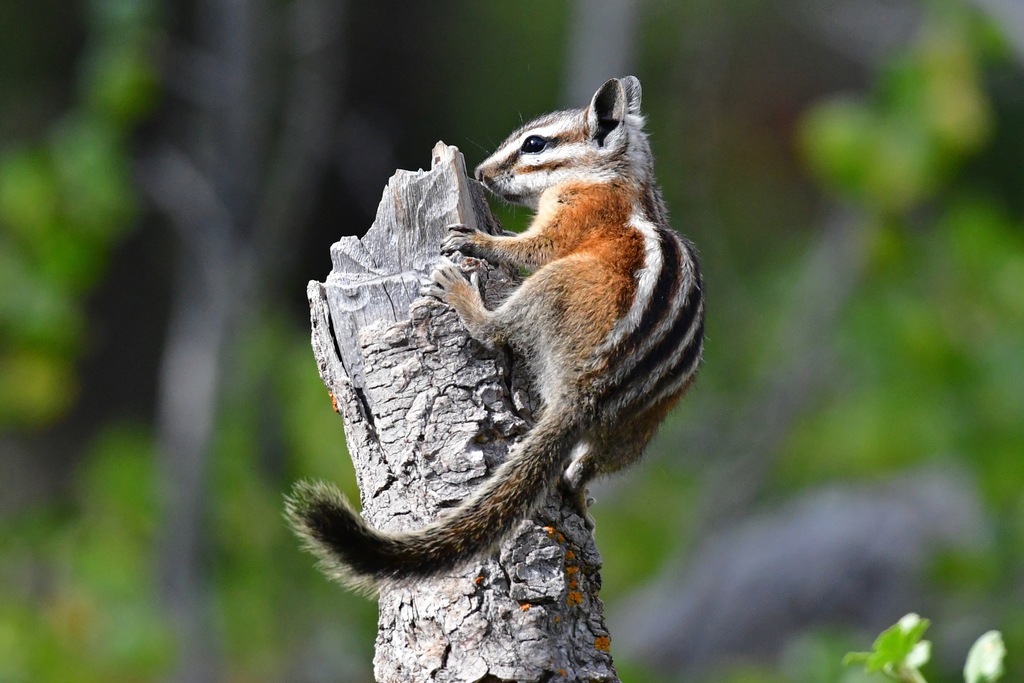
Uinta Chipmunk
Photo © Tom Kennedy
Photo © Tom Kennedy — CC BY 4.0 — Source: iNaturalist photo #178317091Identification
The Uinta chipmunk is a medium-sized chipmunk, measuring 20 to 24 cm in total length with a tail of 7 to 11 cm, and weighing around 67 g on average. The most distinctive feature is its striking striped pattern: three wide, dark blackish-brown stripes run down the back, separated and bordered by four paler stripes of pale grey to white fur. The face also displays three dark and three pale stripes on each side. In summer, the predominant coat color ranges from yellowish brown-grey to dark brown, often with a reddish tinge, while the ears are black and the underparts very pale grey. The tail is particularly striking, featuring orange and black fur with a paler fringe on the underside.
In winter, the Uinta chipmunk's appearance changes noticeably: the coat becomes duller and more greyish, and the distinctive stripes become less pronounced. This seasonal variation is due to two molts per year, with the first occurring between May and August (winter to summer fur) and the second from September to November (summer to winter pelage).
Range & Habitat
The Uinta chipmunk is endemic to the United States and inhabits montane and subalpine forests of the western United States at elevations between 1,400 and 3,650 m. The species is most commonly found at the margins of pine and fir forests, in clearings, and often near rocky terrain or steep slopes. The range is not continuous but consists of disjunct populations, likely reflecting changes in forest cover during the Pleistocene era. Seven subspecies are currently recognized, distributed across southern Utah and northern Arizona, central Nevada and eastern California, western Wyoming, western Colorado, southern Nevada, southeastern Utah, and northern Utah.
In areas where their ranges overlap, Uinta chipmunks frequently share habitat with other chipmunk species, including the cliff chipmunk, Colorado chipmunk, and least chipmunk. In northeastern Colorado, Uinta chipmunks are found at higher elevations, with a boundary occurring at approximately 2,100 m where they replace Colorado chipmunks.
Behaviour & Diet
Uinta chipmunks are solitary, diurnal animals that are highly territorial, with each individual defending a territory of 2 to 5 hectares. They are herbivorous, with a primary diet consisting of seeds from coniferous trees such as Douglas fir, ponderosa pine, juniper, and spruce. They supplement this with fruit from local shrubs including wild roses, raspberries, and chokecherries, along with grass, fungi, and occasionally small quantities of insects or carrion.
These chipmunks establish dens in burrows beneath rocks and shrubs or in natural rock crevices and hollow logs, spending much of winter in these shelters. Otherwise, they are highly arboreal, climbing trees to forage and escape predators. Uinta chipmunks are vocal animals, producing sharp "chip" sounds in bursts lasting up to 15 minutes from exposed locations like rock outcrops or high branches. They also make lower-pitched "chuck" sounds, often interspersed with chips while fleeing from predators, as well as trills and squeals. Chucks are predominantly heard at feeding sites.
Best Time & Places to See It
The breeding season occurs in spring, roughly from late April to early June, with timing dependent on local climate and latitude. Young chipmunks begin leaving burrows shortly after weaning around 25 days of age, making late spring and summer excellent periods for observation. However, survival rates are low, with only 27.5% of individuals surviving through winter, and maximum life expectancy believed to be around two years.
To observe Uinta chipmunks, visit montane and subalpine forests in the western United States, particularly at forest margins, clearings, and rocky terrain within their elevation range. Look for them in areas with pine and fir forest cover across their disjunct range in Utah, Colorado, Wyoming, Nevada, and California. Early morning hours when they are most active will increase your chances of sightings.
Photography Tips
The Uinta chipmunk's striking striped pattern and seasonal color variations make it an attractive photography subject. In summer, photograph the vibrant yellowish-brown to dark brown coat with its distinct blackish stripes and pale facial markings. Return in winter to capture the subtler greyish tones and less-distinct stripe pattern. The distinctive orange-and-black tail with its pale underside fringe is a photographic highlight worth pursuing.
Position yourself near rock outcrops and high branches where chipmunks make their characteristic vocalizations—these exposed locations offer excellent photography opportunities. Early morning light will best illuminate their facial stripes and coat colors. Since they are aggressive and territorial, individual chipmunks may return repeatedly to the same feeding sites and burrow entrances, allowing patient photographers to anticipate and capture compelling behavior shots.
Great Basin National Park
White Pine County, United States
+170 birds+19 mammals
Where the Great Basin's high desert plateaus rise above 10,000 feet, ancient bristlecone pines endure on moonscape ridges of limestone and quartzite, creating one of North…
VIEW NATIONAL PARKZion National Park
Washington County, United States
+244 birds+30 mammals
Towering sandstone cliffs in shades of crimson, rust, and cream rise abruptly from the Virgin River's winding canyon floor, their sculpted faces bearing witness to millions…
VIEW NATIONAL PARKGrand Teton National Park
Teton County, United States
+247 birds+38 mammals
Where the Teton Range tears skyward in a dramatic escarpment above the Snake River valley, nearly 2,550 square kilometers of montane wilderness unfolds across Teton County,…
VIEW NATIONAL PARKYellowstone National Park
Park County, United States
+253 birds+43 mammals
Across nearly 11,400 square kilometres of the Rocky Mountain plateau, geothermal fury and pristine wilderness converge in one of Earth's most dynamic landscapes. Hot springs, geysers…
VIEW NATIONAL PARKRocky Mountain National Park
Larimer County, United States
+259 birds+33 mammals
Where granite peaks rise above 12,000 feet and alpine tundra gives way to subalpine forest, Rocky Mountain National Park spans the Continental Divide across nearly 1,600…
VIEW NATIONAL PARKBryce Canyon National Park
Tropic, United States
+202 birds+20 mammals
Hoodoos rise like a forest of stone pillars from an amphitheater carved into Utah's high plateau, where the Paunsaugunt elevates the landscape to over 9,000 feet…
VIEW NATIONAL PARKGrand Canyon National Park
United States
+277 birds+35 mammals
A mile-deep chasm of rust-red rock and purple shadow cuts through the high desert plateau of northern Arizona, revealing nearly two billion years of geological history…
VIEW NATIONAL PARKNo community photos yet. Log in to add the first one.
No community observations of this species yet.