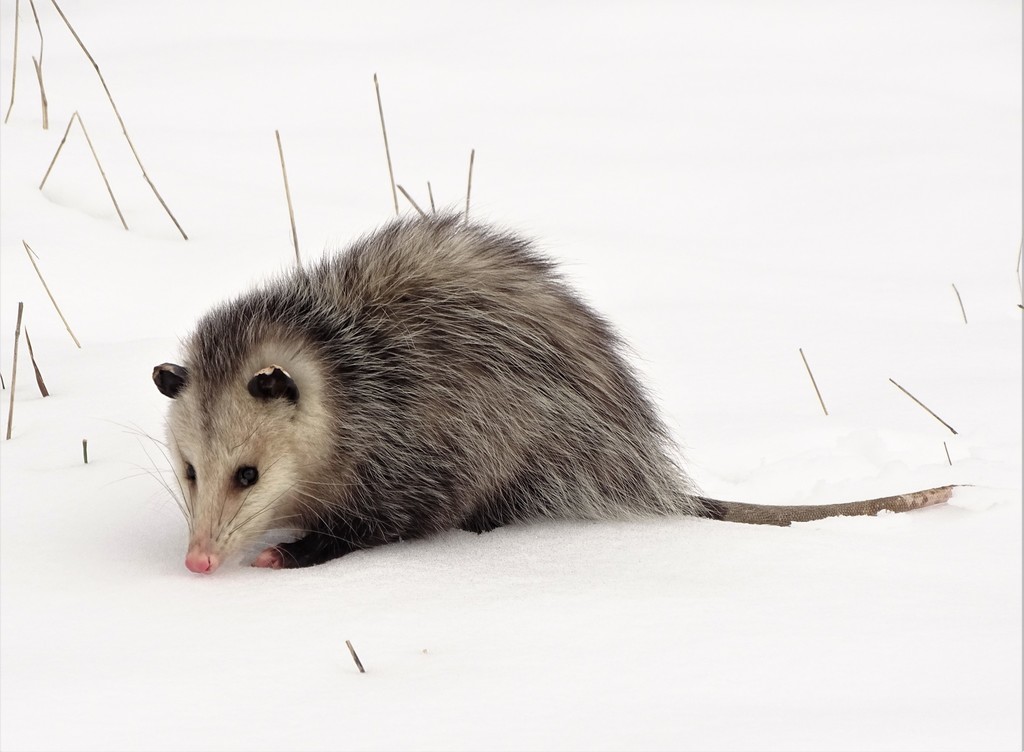
Virginia Opossum
Photo © Shirley Zundell
Photo © Shirley Zundell — CC BY 4.0 — Source: iNaturalist photo #64550660Identification
The Virginia opossum is a solitary nocturnal animal about the size of a domestic cat. Adults measure 33–55 cm (13–22 in) from snout to tail base, with tails adding another 25–54 cm (9.8–21.3 in). Males average 40.8 cm body length and weigh 2.1–2.8 kg (4.6–6.2 lb); females are slightly smaller at 40.6 cm and 1.9–2.1 kg (4.2–4.6 lb). Their distinctive appearance features a dull grayish-brown coat contrasting sharply with a white face, long hairless prehensile tail, hairless ears, and an elongated flat nose. Look for their characteristic opposable, clawless thumbs on the hind limbs. With 50 teeth—more than any other North American land mammal—and 13 nipples arranged in a circle with one central nipple, opossums are unmistakably unique marsupials. Their distinctive tracks show five finger-like toes with the hind thumb printing at an extreme angle (90° or greater) to the other digits.
Larger specimens occur in northern populations, while tropical individuals are noticeably smaller. Opossums have 10 upper incisors—far more than the maximum 6 found in other North American mammals. Their prehensile tails can grasp branches and carry small objects, a valuable adaptation for their arboreal tendencies.
Range & Habitat
Once found only as far north as Maryland and the Ohio Valley, Virginia opossums now range from southern Ontario and Maine south through Central America to Costa Rica, making them the world's northernmost marsupials. Their ancestors evolved in South America but entered North America approximately 0.8 million years ago following the formation of the Isthmus of Panama. Since 1900, they have dramatically expanded northeastward, northwestward, and northward, now occupying most of New England, the Great Lakes region, and spreading into British Columbia. Clearing of dense forests by European settlers and elimination of their main predators facilitated this expansion.
Opossums thrive in settled areas near human food sources—trash cans, pet food, compost piles, and gardens. They frequently inhabit the Pacific coast, where they were intentionally introduced during the Great Depression. Small populations also occur in parts of Arizona and New Mexico. As opossums are not adapted to heavy snow or extremely cold winters, population viability in northern regions depends on winter severity.
Behaviour & Diet
Virginia opossums are successful opportunists and solitary nocturnal feeders. Their slow, deliberate movements and attraction to roadside carrion make them more prone to becoming roadkill than other animals in their range. They are frequent visitors to human settlements, where they scavenge available food sources including garbage, pet food, compost, and garden produce. This opportunistic feeding strategy and their nocturnal habits make them well-suited to coexisting with humans.
Best Time & Places to See It
Look for opossums after dark, particularly in suburban and settled areas with accessible food sources. Search near trash cans, pet food stations, compost piles, and gardens. Spring and summer months offer the best viewing opportunities in northern parts of their expanded range. Areas such as southern Ontario, New England, and the Great Lakes region have seen regular opossum populations in recent decades. Check roadsides and areas with brush cover at night using a headlamp or flashlight.
Photography Tips
Photograph opossums at night using available light or a headlamp to avoid startling them. Their distinctive white face and prehensile tail make compelling subjects. Focus on capturing their characteristic track patterns in soft substrates like mud—the unusual 90° angle of the hind thumb print creates a distinctive identifier. Patience is essential; allow opossums to continue their natural feeding behavior. Wide-angle shots showing them in their urban habitat context can illustrate their successful adaptation to human environments. The contrast between their white face and grayish-brown body provides natural compositional interest.
New River Gorge National Park
Fayette County, United States
+183 birds+13 mammals
Where the New River carves its ancient path through the Appalachian plateau, a landscape of towering sandstone cliffs and dense deciduous forest creates one of the…
VIEW NATIONAL PARKSaguaro National Park
Rincon Valley, United States
+354 birds+40 mammals
Where the Sonoran Desert meets sky-island mountains, two geographically separated districts of Saguaro National Park sprawl across nearly two thousand square kilometers of Arizona's most iconic…
VIEW NATIONAL PARKIndiana Dunes National Park
Porter, United States
+304 birds+15 mammals
Along the southern shore of Lake Michigan, where glacial geology meets temperate woodland and open water, sprawls a landscape of extraordinary ecological complexity. The dunes themselves—massive…
VIEW NATIONAL PARKEverglades National Park
Monroe County, United States
+345 birds+22 mammals
Where freshwater marsh meets subtropical sky, the Everglades sprawls across southwestern Florida as one of North America's most expansive wetland ecosystems. Spanning over 13,000 square kilometers,…
VIEW NATIONAL PARKGreat Smoky Mountains National Park
Sevier County, United States
+244 birds+40 mammals
Where the southern Appalachian ridgeline reaches its most densely forested expression, over 4,200 square kilometres of temperate woodland rise and fall across Tennessee and North Carolina,…
VIEW NATIONAL PARKRedwood National Park
Humboldt County, United States
+343 birds+43 mammals
Where the Pacific fog rolls deep into northern California's coastal valleys, some of the tallest trees on Earth rise from a landscape shaped by tectonic forces…
VIEW NATIONAL PARKPoint Pelee National Park
Leamington, Canada
+296 birds+14 mammals
Where Lake Erie's shallow waters meet the Ontario shoreline, a slender sandy peninsula juts into the Great Lakes like a natural funnel for migrating wildlife. This…
VIEW NATIONAL PARKSierra de Tamaulipas
El Porvenir, Mexico
+98 birds+19 mammals
Where limestone peaks thrust skyward through dense subtropical forest, Mexico's northeastern frontier reveals one of the continent's most biodiverse mountain ranges. Canyons carved by perennial rivers…
VIEW NATURE RESERVEParque Nacional Grutas de Cacahuamilpa
Pilcaya, Mexico
+97 birds+12 mammals
Where limestone ridges rise abruptly from the tropical deciduous forests of central Guerrero, the Grutas de Cacahuamilpa National Park shelters one of Mexico's most extensive cave…
VIEW NATIONAL PARKBiscayne National Park
Miami-Dade County, United States
+263 birds+7 mammals
Coral reefs and mangrove shallows dominate this marine sanctuary where the Florida Keys meet the Atlantic, creating a mosaic of shallow seagrass meadows, patch reefs, and…
VIEW NATIONAL PARKCongaree National Park
Richland County, United States
+205 birds+12 mammals
Where the Congaree River winds through the lowlands of South Carolina, an old-growth bottomland forest of extraordinary character rises from a landscape shaped by seasonal floods…
VIEW NATIONAL PARKCuyahoga Valley National Park
Brecksville, United States
+255 birds+27 mammals
Where the Cuyahoga River carves through a glaciated landscape of Ohio, the valley reveals a temperate deciduous forest ecosystem shaped by four distinct seasons and reliable…
VIEW NATIONAL PARKShenandoah National Park
Page County, United States
+243 birds+31 mammals
Ridges of ancient quartzite rise above the Shenandoah Valley floor, their slopes dressed in a mosaic of oak and hickory forest that yields to cove hardwoods…
VIEW NATIONAL PARKMerritt Island National Wildlife Refuge
Brevard County, United States
+341 birds+19 mammals
Brackish marshes and palmetto scrub define this wildlife sanctuary spanning the coastal lowlands of central Florida, where the Atlantic tide meets freshwater systems in a dynamic…
VIEW WILDLIFE SANCTUARYOkefenokee National Wildlife Refuge
Charlton County, United States
+206 birds+14 mammals
Vast wetlands of cypress and blackwater creeks define this wildlife sanctuary straddling the Georgia–Florida border, where the landscape shifts between open marsh, dense swamp forest, and…
VIEW WILDLIFE SANCTUARYChincoteague National Wildlife Refuge
Chincoteague, United States
+362 birds+16 mammals
Across the barrier islands and salt marshes of Virginia's Eastern Shore, where Atlantic tides sculpt an intricate mosaic of sandy spits and tidal flats, lies one…
VIEW WILDLIFE SANCTUARYWichita Mountains National Wildlife Refuge
Medicine Park, United States
+256 birds+17 mammals
Granite peaks rise abruptly from rolling prairie in southwestern Oklahoma, where the Wichita Mountains National Wildlife Refuge protects a rare collision of ecosystems. This sanctuary encompasses…
VIEW WILDLIFE SANCTUARYLaguna Atascosa National Wildlife Refuge
Cameron County, United States
+365 birds+19 mammals
Where coastal prairie meets shallow lagoon along the southernmost tip of Texas, Laguna Atascosa National Wildlife Sanctuary sprawls across a landscape sculpted by salt spray and…
VIEW WILDLIFE SANCTUARYSanta Ana National Wildlife Refuge
Hidalgo County, United States
+349 birds+12 mammals
Where the Rio Grande delta meets the semi-arid scrublands of South Texas, Santa Ana National Wildlife Sanctuary preserves a rare mosaic of wetland and thornforest habitat…
VIEW WILDLIFE SANCTUARYSacramento National Wildlife Refuge
Glenn County, United States
+247 birds+13 mammals
Across the flat expanse of Glenn County's Sacramento Valley, shallow pools and seasonal marshes create one of California's most vital wetland sanctuaries—a landscape shaped by water…
VIEW WILDLIFE SANCTUARYDon Edwards San Francisco Bay National Wildlife Refuge
Fremont, United States
+286 birds+20 mammals
Where the San Francisco Bay's shallow margins dissolve into tidal salt marshes and mudflats, this wildlife sanctuary preserves one of California's most ecologically vital estuarine systems.…
VIEW WILDLIFE SANCTUARYWheeler National Wildlife Refuge
Triana, United States
+268 birds+10 mammals
Shallow impoundments and meandering channels spread across northern Alabama's humid subtropical landscape, where Wheeler National Wildlife Sanctuary anchors a critical junction of wetland and woodland habitat.…
VIEW WILDLIFE SANCTUARYBombay Hook National Wildlife Refuge
Kent County, United States
+323 birds+15 mammals
Tidal marshes and brackish shallows define this sanctuary on Delaware's Atlantic coast, where the meeting of freshwater and salt creates some of the Mid-Atlantic's most dynamic…
VIEW WILDLIFE SANCTUARYBlackwater National Wildlife Refuge
Fishing Creek, United States
+293 birds+15 mammals
Tidal marshes and brackish waterways define this wildlife sanctuary where the Chesapeake Bay's influence reshapes the landscape with every rise and fall of the water. Shallow…
VIEW WILDLIFE SANCTUARYAlligator River National Wildlife Refuge
Dare County, United States
+288 birds+17 mammals
Where the coastal plain of North Carolina meets the Albemarle Peninsula, a sprawling mosaic of freshwater marshes, pocosins, and swamp forest creates one of the Atlantic…
VIEW WILDLIFE SANCTUARYPea Island National Wildlife Refuge
Dare County, United States
+356 birds+15 mammals
Where the Outer Banks taper toward the Atlantic, a sliver of barrier island creates a microcosm of coastal ecology. Pea Island National Wildlife Sanctuary spans over…
VIEW WILDLIFE SANCTUARYSt. Marks National Wildlife Refuge
Saint Marks, United States
+324 birds+16 mammals
Where the Apalachee Bay begins to define the Florida coastline, salt marshes and freshwater impoundments merge into one of the southeastern United States' most productive wildlife…
VIEW WILDLIFE SANCTUARYChassahowitzka National Wildlife Refuge
Homosassa, United States
+299 birds+14 mammals
Where the Gulf of Mexico's coastal marshes dissolve into brackish tidal flats and mangrove thickets, the Chassahowitzka National Wildlife Sanctuary near Homosassa represents one of Florida's…
VIEW WILDLIFE SANCTUARYNo community photos yet. Log in to add the first one.
No community observations of this species yet.