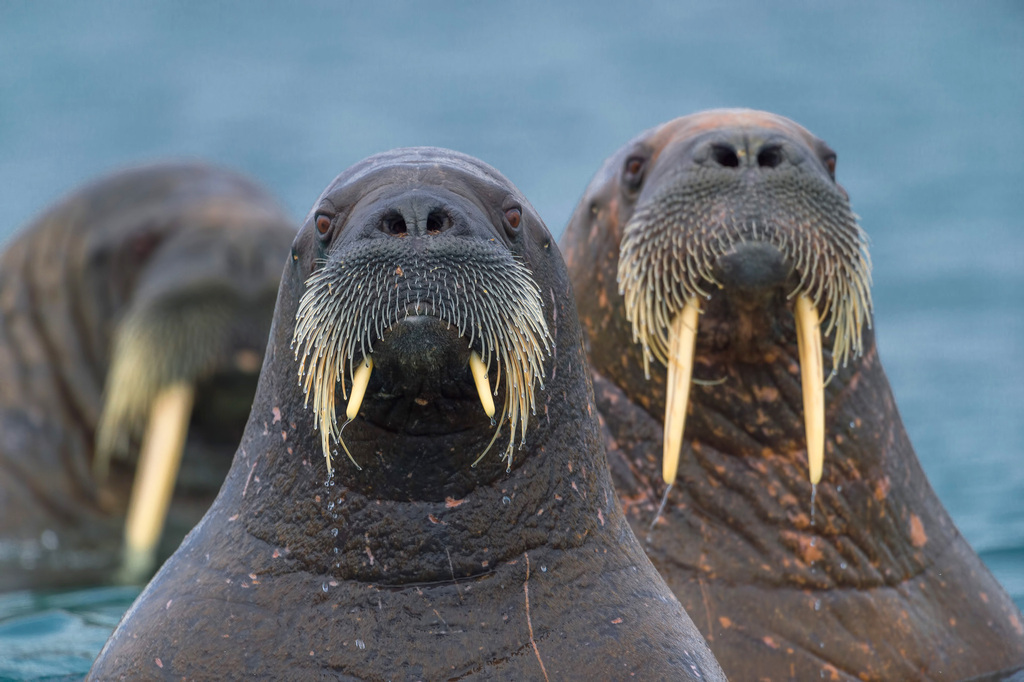
Walrus
Photo © Morten Ross
Photo © Morten Ross — CC BY 4.0 — Source: iNaturalist #180695142Identification
The walrus is unmistakable among Arctic marine mammals. Adults are characterised by prominent tusks and distinctive whiskers, combined with considerable bulk that makes them among the largest pinnipeds in the world. Adult males in the Pacific can weigh more than 2,000 kilograms, exceeded in size only by the two species of elephant seals. The walrus is the only extant species in the family Odobenidae, making it a truly unique marine mammal with no close living relatives.
Range & Habitat
Walruses have a discontinuous distribution about the North Pole, inhabiting the Arctic Ocean and subarctic seas of the Northern Hemisphere. Two subspecies are recognised: the Atlantic walrus, which lives in the Atlantic Ocean, and the Pacific walrus, which inhabits the Pacific Ocean. These populations remain largely separate, with fixed genetic differences indicating very restricted gene flow between them.
Walruses live mostly in shallow waters above continental shelves, where they spend significant amounts of their lives on sea ice. Historically, walruses ranged more widely—fossil evidence and archaeological remains indicate they once lived as far south as the southern North Sea and the Atlantic coast of North America. Today, populations of Atlantic and Laptev walruses remain fragmented and at low levels compared with pre-industrial times.
Behaviour & Diet
Walruses are relatively long-lived, social and intelligent animals. They spend considerable time hauled out on sea ice, where they forage in the benthic environment below. Their diet consists primarily of benthic bivalve molluscs, which they locate and extract from the seafloor in the shallow continental shelf waters where they prefer to live. Their remarkable tusks serve a practical purpose: the scientific name Odobenus derives from Greek words meaning 'teeth' and 'walk', referring to walruses' observed behaviour of using their tusks to pull themselves out of the water.
Walruses are considered a keystone species of the Arctic marine region, playing an important ecological role in their environment. The species has held profound cultural significance for indigenous Arctic peoples across millennia, who have traditionally hunted walruses for meat, fat, skin, tusks, and bone.
Best Time & Places to See It
Walruses are found throughout the Arctic, though specific locations depend on which subspecies you wish to encounter. The Atlantic walrus inhabits waters around Greenland, the Canadian Arctic, and northeastern North America, while the Pacific walrus is found in the Bering Sea and other Pacific Arctic waters. Your best opportunities lie in expedition-style Arctic travel, typically during summer months when sea ice recedes and access to walrus haul-out sites becomes feasible. Local guides in Arctic communities are essential for responsible and successful walrus encounters.
Photography Tips
Photographing walruses requires patience, respect for distance, and appropriate Arctic travel logistics. These are large, powerful animals that should be observed from a safe distance. Use a telephoto lens to capture close-up details of their distinctive tusks and whiskers without disturbing the animals. The Arctic's extended daylight during summer months provides excellent lighting conditions. Remember that walruses are often found in groups hauled out on ice floes, which can provide dramatic compositional opportunities when photographed with the Arctic landscape.
Arctic Ecology and Ecosystem Conservation Tour
South Spitsbergen National Park
Norway
+41 birds+15 mammals
Glaciers and tundra meet in Norway's high Arctic, where South Spitsbergen National Park sprawls across the southernmost reaches of the Svalbard archipelago. Here, massive valley glaciers…
VIEW NATIONAL PARKNorthwest Spitsbergen National Park
Norway
+58 birds+17 mammals
Where the High Arctic converges with the Norwegian mainland, Northwest Spitsbergen National Park sprawls across one of Earth's most extreme and pristine wildernesses. Crowned by jagged…
VIEW NATIONAL PARKNorthern Isfjorden National Park
Norway
+40 birds+12 mammals
Where the Arctic fjord system cuts deep into Svalbard's northwestern coast, Northern Isfjorden National Park protects a landscape of stark geological drama—towering cliff faces, tidewater glaciers,…
VIEW NATIONAL PARKLower Saxon Wadden Sea National Park
Norderney, Germany
+193 birds+12 mammals
Where the North Sea meets the German coast, a vast expanse of tidal mudflats, salt marshes, and shallow waters creates one of Europe's most dynamic estuarine…
VIEW NATIONAL PARKSchleswig-Holsteinisches Wattenmeer National Park
Germany
+378 birds+49 mammals
Where the North Sea ebbs and flows across a vast expanse of exposed mud and sand, the Schleswig-Holsteinisches Wattenmeer National Park reveals one of Europe's most…
VIEW NATIONAL PARKPembrokeshire Coast National Park
Pembrokeshire, United Kingdom
+250 birds+41 mammals
Where the Cambrian coastline meets the Celtic Sea, cliff-top moorland and hidden coves define a landscape carved by 300 million years of geological drama. Pembrokeshire Coast…
VIEW NATIONAL PARKNorth York Moors National Park
North Yorkshire, United Kingdom
+234 birds+32 mammals
Across the high moorlands of North Yorkshire, where heather and bilberry sprawl beneath vast skies, the landscape rises and falls in gentle undulation—a patchwork of open…
VIEW NATIONAL PARKForlandet National Park
Vera, Norway
+38 birds+12 mammals
Windswept Arctic tundra meets jagged coastal cliffs where the Barents Sea crashes against Norway's northernmost wilderness. This sliver of protected terrain on the Nordkapp Peninsula comprises…
VIEW NATIONAL PARKWrangel Island Nature Reserve
Wrangel Island, Russia
+25 birds+11 mammals
Where the Chukchi Sea fractures Arctic ice beneath an unforgiving sky, a lonely island holds one of Earth's most pristine ecosystems. Wrangel Island spans tundra so…
VIEW NATURE RESERVENortheast Greenland National Park
Northeast Greenland National Park, Greenland
+34 birds+10 mammals
Where granite peaks plunge into the Arctic Ocean and pack ice dominates a landscape of incomparable vastness, one of Earth's most remote wildernesses reveals itself. Spanning…
VIEW NATIONAL PARKRussian Arctic National Park
Russia
+23 birds+3 mammals
Across the stark tundra of Russia's northwestern Arctic, where permafrost defines the land and sunlight dictates the rhythm of life, lies a landscape sculpted by ice…
VIEW NATIONAL PARKAlaska Maritime National Wildlife Refuge
Alaska, United States
+391 birds+58 mammals
Where the North Pacific collides with Alaska's rugged coastline, a sprawling archipelago of islands, rocky outcrops, and coastal headlands forms one of North America's most remote…
VIEW WILDLIFE SANCTUARYNo community photos yet. Log in to add the first one.
No community observations of this species yet.