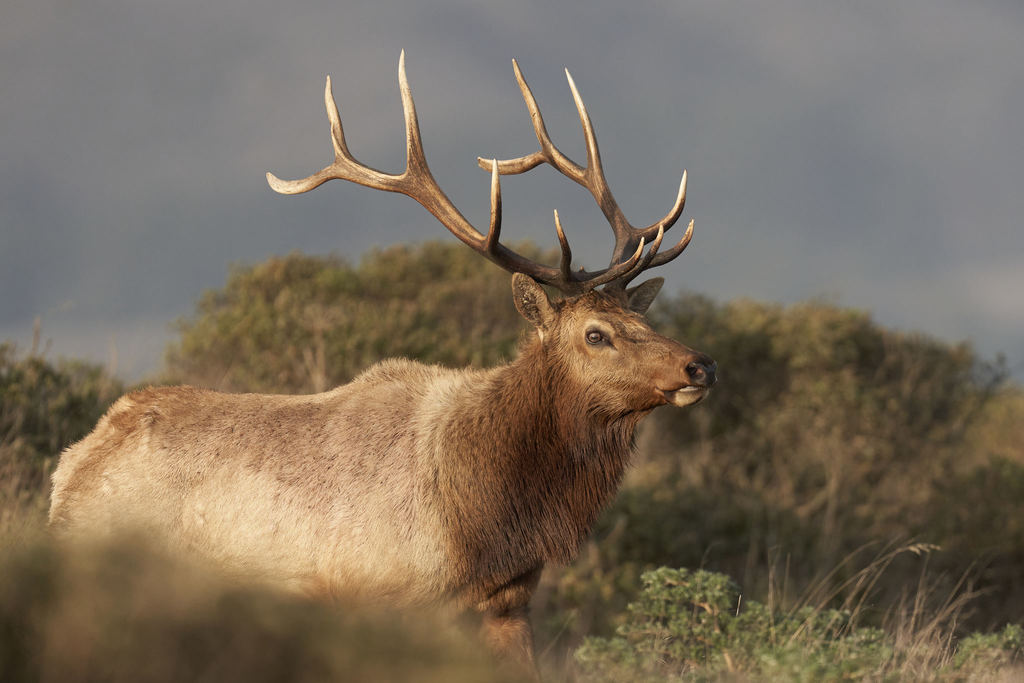
Wapiti
Photo © benjchristensen
Photo © benjchristensen — CC BY 4.0 — Source: iNaturalist photo #97584339Identification
The wapiti, also known as elk, is the second largest species within the deer family and one of the largest terrestrial mammals in its native range. The most distinctive feature is the characteristic light fur around the tail region—the animal's name derives from Shawnee and Cree words meaning "white rump." When alarmed or distressed, wapiti fluff up or raise this pale patch to signal to one another. Male wapiti possess large, blood- and nerve-filled antlers that shed annually as the weather warms. Their wider rump-patch and paler-hued antlers distinguish them from the European red deer, to which they were once thought to be closely related.
Range & Habitat
Wapiti are native to North America and Central and East Asia. Historically, their range was far more extensive—prehistoric populations inhabited Eurasia and Western Europe during the Late Pleistocene, surviving into the early Holocene in Southern Sweden and the Alps. An extinct North American subspecies once ranged south into Mexico. Today, these adaptable animals dwell in open forests and forest-edge habitats, and have successfully colonized introduced ranges including Argentina and New Zealand, though their success in these non-native regions has raised conservation concerns for local ecosystems.
Behaviour & Diet
Wapiti are grazers and browsers, feeding on grasses, sedges, leaves, twigs, and bark. During the mating season, male wapiti engage in ritualized and dramatic displays of dominance and courtship. These include posturing to attract females, antler-wrestling or sparring with rival males, and bugling—a loud series of throaty whistles, bellows, screams, and other vocalizations that establish dominance and aim to attract mates.
Best Time & Places to See It
Wapiti are found throughout their native ranges in North America and Asia in open forests and forest edges. The mating season offers the best opportunity to observe and hear these magnificent animals, as males are most vocal and active during this time. Their bugling calls are particularly distinctive and can be heard across considerable distances during the rut.
Photography Tips
The wapiti's large size and striking appearance make them rewarding photographic subjects. Their pale rump patch is a key identifying feature to capture, particularly when the animal raises it in alarm. During the mating season, male wapiti displaying their antlers, posturing, or engaged in sparring provide dramatic opportunities. The bugling season also offers chances to photograph animals in active, behavioural moments rather than simply at rest.
Baikal National Park
Banff National Park
Big Bend National Park
Bosque del Apache National Wildlife Refuge
Bryce Canyon National Park
Capitol Reef National Park
Carlsbad Caverns National Park
Crater Lake National Park
Giant Panda National Park
Nothing matches these filters.
No community photos yet. Log in to add the first one.
No community observations of this species yet.