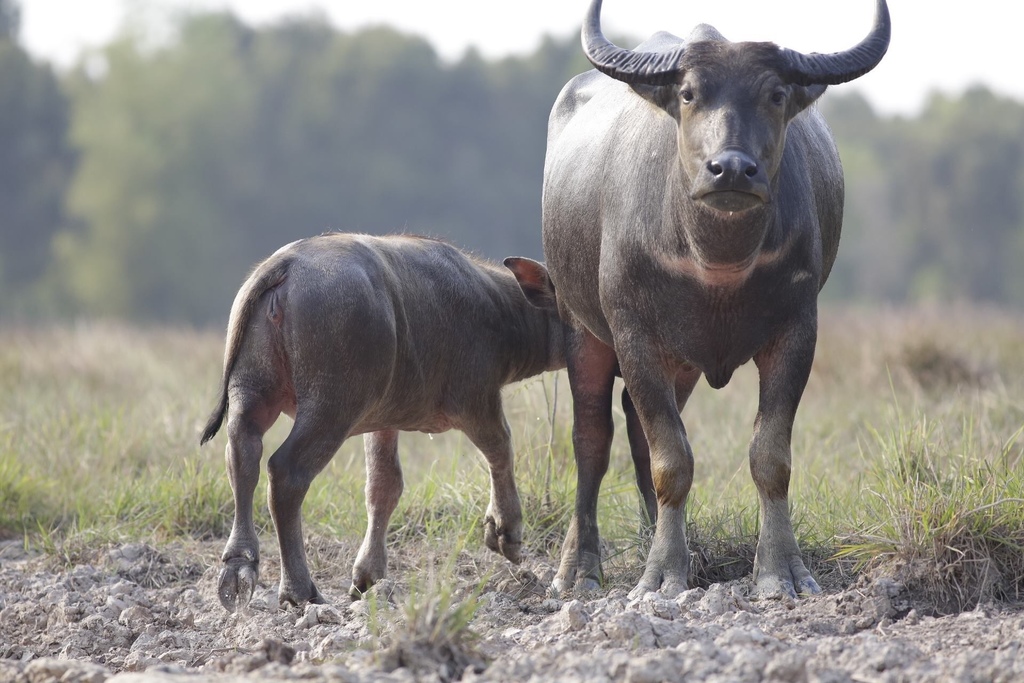
Water Buffalo
Photo © Nguyễn Văn Hùng
Photo © Nguyễn Văn Hùng — CC BY 4.0 — Source: iNaturalist photo #54130920Identification
The water buffalo is a large domesticated bovine with two distinctly different types. River buffaloes have black or dark slate-coloured skin, longer faces, smaller girths, and bigger limbs than their swamp cousins. Their horns grow downward and backward before curving upward in a spiral. Swamp buffaloes are heavier and more stockily built, with grey skin at birth that becomes slate blue, a flat forehead, prominent eyes, short face, and wide muzzle. Their horns grow outward in a semicircle, remaining roughly on the plane of the forehead. Both types have a short tail reaching only to the hocks.
Water buffaloes are impressive in size, standing 129–133 cm at the withers for bulls and 120–127 cm for cows, though large individuals may reach 160 cm. Head-rump length typically ranges from 240–300 cm, with weights between 300–550 kg, and occasionally exceeding 1,000 kg. The two types have different chromosome numbers and do not readily interbreed, though fertile offspring can occasionally occur.
Range & Habitat
The water buffalo originates from the Indian subcontinent and Southeast Asia, where the river type was domesticated around 6,300 years ago in western India, and the swamp type independently domesticated 3,000 to 7,000 years ago in Mainland Southeast Asia. Today, domestic and feral populations are found across a vast range: river buffaloes extend from the Indian subcontinent west to Egypt, the Balkans, and Italy, while swamp buffaloes inhabit the rest of Southeast Asia and reach as far as the Yangtze Valley in China. They have also been introduced to Australia, the Americas, and parts of Africa.
These animals thrive in hot and humid climates with temperatures ranging from 0°C in winter to 30°C or higher in summer. Water availability is critical for thermoregulation; they require access to wallows, rivers, or splashing water. Some breeds have adapted to saline seaside shores and sandy terrain, demonstrating their ecological flexibility across diverse landscapes.
Behaviour & Diet
River buffaloes prefer deep water, while swamp buffaloes favour mudholes, which they excavate with their horns. During wallowing, they acquire a thick mud coating that helps protect them from heat and insects. Both types are exceptionally well-adapted to hot, humid climates and depend on water access for thermoregulation. The water buffalo's unique rumen differs significantly from other ruminants, containing a larger population of cellulolytic bacteria, lower protozoa, and higher fungi zoospores, with elevated ammonia nitrogen and pH levels compared to cattle.
Water buffaloes are herbivorous, feeding on green fodders including alfalfa, banana plants, cassava, maize, oats, and sorghum. Interestingly, during floods they can graze underwater, consuming aquatic plants such as reeds and sedges. This dietary adaptability and ability to feed in challenging conditions reflects their remarkable evolution as agricultural animals.
Best Time & Places to See It
Water buffaloes are found throughout their range year-round, but your viewing opportunities depend on location and climate. In tropical and subtropical regions—including Southeast Asia, the Indian subcontinent, and parts of Australia—these animals are active throughout the year. The hot season may be optimal for observing their wallowing behaviour, as they will frequent water sources more regularly during peak temperatures.
Seek them in rice-growing regions of Asia, where they remain integral to agricultural practices, or in grasslands and wetland areas where both domestic herds and feral populations congregate. Regions with accessible rivers, lakes, and muddy terrain offer the best viewing opportunities, particularly early morning or late afternoon when animals are most active.
Photography Tips
Capture the water buffalo's impressive bulk and distinctive horns by photographing them during wallowing sessions, when their mud-covered forms create striking textures and contrasts. The two different types—river and swamp—offer distinct photographic subjects; focus on the river buffalo's sleeker frame and spiralling horns, or the swamp buffalo's stockier build and semicircular horns. Backlighting during the golden hour enhances the texture of dried mud on their hides.
Water scenes provide excellent compositional opportunities: photograph buffaloes in their element—partially submerged in rivers or lakes, or emerging from water with water droplets glistening on their dark hides. Close-up shots of their impressive horns, prominent eyes, and facial features reveal their character. Wide-angle shots showing herds in their natural habitat provide context for their agricultural and ecological importance.
4-Day Short Vacation to Uganda – Gorilla Trekking Bwindi
S’Albufera Natural Park
Platja de Muro, Spain
+253 birds+6 mammals
Where Mediterranean lagoons meet the Balearic coast, S'Albufera stretches across nearly 1,600 hectares of wetland and dune systems that rank among Europe's most ecologically vital shallow-water…
VIEW NATURAL PARKLunugamvehera National Park
Sri Lanka
+204 birds+14 mammals
Dry scrubland and shallow wetlands converge in Sri Lanka's southeastern lowlands, where Lunugamvehera National Park anchors one of the island's most ecologically vital landscapes. The park's…
VIEW NATIONAL PARKMinneriya National Park
Sri Lanka
+158 birds+9 mammals
Across the dry zone of Sri Lanka's North Central Province spreads a landscape of shallow tanks, grassland margins, and scattered dry forest—a mosaic of water and…
VIEW NATIONAL PARKWasgamuwa National Park
Sri Lanka
+156 birds+8 mammals
Dry deciduous forest and open grassland sweep across the North Central lowlands where Wasgamuwa National Park protects one of Sri Lanka's largest remaining tracts of this…
VIEW NATIONAL PARKSchleswig-Holsteinisches Wattenmeer National Park
Germany
+378 birds+49 mammals
Where the North Sea ebbs and flows across a vast expanse of exposed mud and sand, the Schleswig-Holsteinisches Wattenmeer National Park reveals one of Europe's most…
VIEW NATIONAL PARKRanthambhore National Park
Sawai Madhopur, India
+294 birds+20 mammals
Granite ridges and ravines carved through the Aravalli Range frame this protected landscape in eastern Rajasthan, where deciduous forest mingles with open scrubland and seasonal water…
VIEW NATIONAL PARKKhao Yai National Park
Prachantakham District, Thailand
+377 birds+46 mammals
Evergreen dipterocarp forest blankets the rolling terrain of this national park in eastern Thailand, where limestone hills rise abruptly from the forest floor and seasonal streams…
VIEW NATIONAL PARKHortobágy National Park
Hortobágy, Hungary
+260 birds+17 mammals
Across the North Great Plain of Hungary stretches one of Europe's most expansive semi-natural grassland systems, where horizon-wide vistas of steppe and wetland create a landscape…
VIEW NATIONAL PARKKakadu National Park
Kakadu, Australia
+273 birds+46 mammals
Kakadu National Park is Australia’s largest national park and one of the world’s most remarkable protected areas, covering nearly 20,000 square kilometres in the tropical north…
VIEW NATIONAL PARKKaziranga National Park
Kohora, India
+422 birds+26 mammals
Dawn breaks over the floodplains of the Brahmaputra, where tall grasslands stretch endlessly beneath monsoon-heavy skies. This sprawling wilderness of northeastern Assam is a mosaic of…
VIEW NATIONAL PARKTaman Negara National Park
Kampong Samas, Malaysia
+393 birds+48 mammals
Where ancient rainforest meets limestone peaks, one of Southeast Asia's oldest protected wilderness preserves sprawls across 4,343 square kilometers of primordial landscape. Dipterocarp giants tower overhead,…
VIEW NATIONAL PARKTaman Nasional Baluran
Situbondo, Indonesia
+189 birds+9 mammals
Across the northeastern tip of East Java, where monsoon winds sweep down from the Bali Strait, a landscape of contrasts unfolds within 374 square kilometres of…
VIEW NATIONAL PARKKomodo National Park
Komodo, Indonesia
+155 birds+14 mammals
Where volcanic peaks rise dramatically from turquoise waters, a primordial landscape unfolds across three main islands and countless smaller ones scattered throughout the Lesser Sunda archipelago.…
VIEW NATIONAL PARKKerkini Lake National Park
Serres, Greece
+291 birds+18 mammals
Where the Strymon River widens into a sprawling freshwater lake hemmed by the Rhodope Mountains, Kerkini National Park unfolds across northern Greece as one of southeastern…
VIEW NATIONAL PARKLitchfield National Park
Australia
+175 birds+15 mammals
Where weathered sandstone plateaus rise above the savanna woodlands of Australia's Top End, Litchfield National Park unfolds as a landscape of dramatic contrasts shaped by a…
VIEW NATIONAL PARKNitmiluk National Park
Australia
+186 birds+27 mammals
Dramatic sandstone gorges carved by the Katherine River slice through the tropical savanna of Australia's Top End, creating a landscape where escarpments tower above crystalline pools…
VIEW NATIONAL PARKNo community photos yet. Log in to add the first one.
No community observations of this species yet.