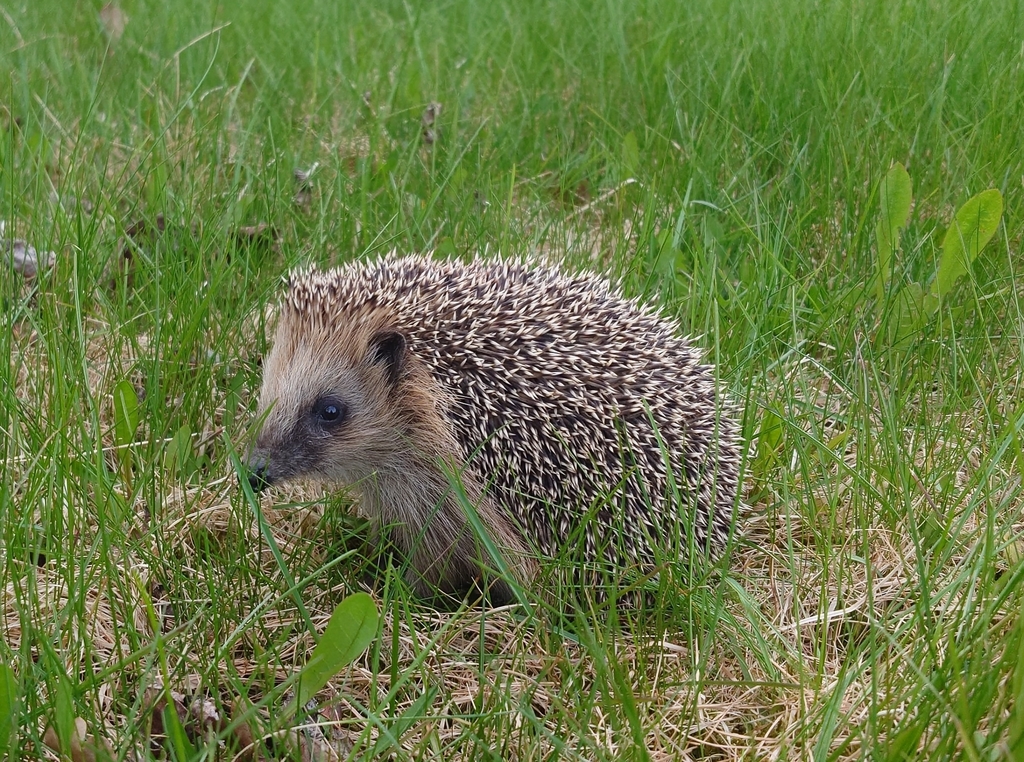
West European Hedgehog
Photo © Linda Lötjönen
Photo © Linda Lötjönen — CC BY 4.0 — Source: iNaturalist photo #656714041Identification
The West European hedgehog is a stocky, distinctive mammal covered in up to 6,000 brown and white spines. Adults typically measure 260 mm or more in body length, with an extremely short tail of only 20–30 mm. Weight varies considerably with season, averaging around 800 g in summer but often exceeding 1,100 g by autumn; large specimens may reach up to 2,000 g. This is likely the largest hedgehog species. Where it overlaps with the northern white-breasted hedgehog, look for the absence of a white chest spot on the West European species. Rare 'blonde' or leucistic individuals with creamy-coloured spines occur throughout most of the range but are extremely common on North Ronaldsay and the Channel Island of Alderney.
Range & Habitat
Native to Europe from Iberia and Italy northwards into Scandinavia and westwards into Ireland, the West European hedgehog is generally common and widely distributed. It survives across a remarkably wide range of habitat types, making it highly adaptable. Though populations remain stable across much of its range, the species is declining severely in Great Britain, where it is now Red Listed as at risk of local extinction. Beyond its native range, it was introduced to New Zealand during the late nineteenth and early twentieth centuries.
Behaviour & Diet
The West European hedgehog is largely nocturnal, moving with a hesitant gait and frequently pausing to smell the air. Unlike smaller, warmer-climate hedgehog species, it may hibernate during winter, though most individuals wake periodically to relocate their nests. As an insectivore, its diet consists primarily of earthworms, supplemented by snails, slugs, beetles, ants, bees, wasps, earwigs, cockroaches, crickets, grasshoppers, butterflies, moths, and insect larvae. It also takes eggs of ground-nesting birds and forages on carrion, and may consume lizards, snakes, frogs, and small rodents. Plant matter contributes negligibly to its diet.
Best Time & Places to See It
The breeding season commences after hibernation, with pregnancies peaking between May and July. Females raise litters of typically four to six young, born blind with small spines; the outer coat develops within 36 hours, and weaning occurs at around six weeks. Young animals are often visible in late summer and early autumn. European hedgehogs are nocturnal, so evening and night hours offer the best viewing opportunities. European gardens remain particularly good locations, where they forage for pests. Though average life expectancy is three years, individuals may live over ten years in the wild.
Photography Tips
Photograph hedgehogs during twilight hours or at night using a headlamp or infrared setup to capture their natural nocturnal behaviour. Focus on their characteristic curled posture and detailed spine patterns, which are striking under controlled lighting. Patient observation near gardens, compost heaps, and log piles during warmer months yields the best encounters. Capture the hesitant gait and frequent pausing behaviour that characterises their movement. If an individual curls into a ball—its defensive posture—allow it space and wait for it to unfurl. Rare blonde individuals, if encountered in populations like those on Alderney, offer exceptional photographic opportunities.
Abruzzo, Lazio and Molise National Park
Alpilles Regional Nature Park
Alta Murgia National Park
Aoraki / Mount Cook National Park
Arthur’s Pass National Park
Asinara National Park
Avesnois Regional Nature Park
Bannau Brycheiniog National Park
Bavarian Forest National Park
Nothing matches these filters.
No community photos yet. Log in to add the first one.
No community observations of this species yet.