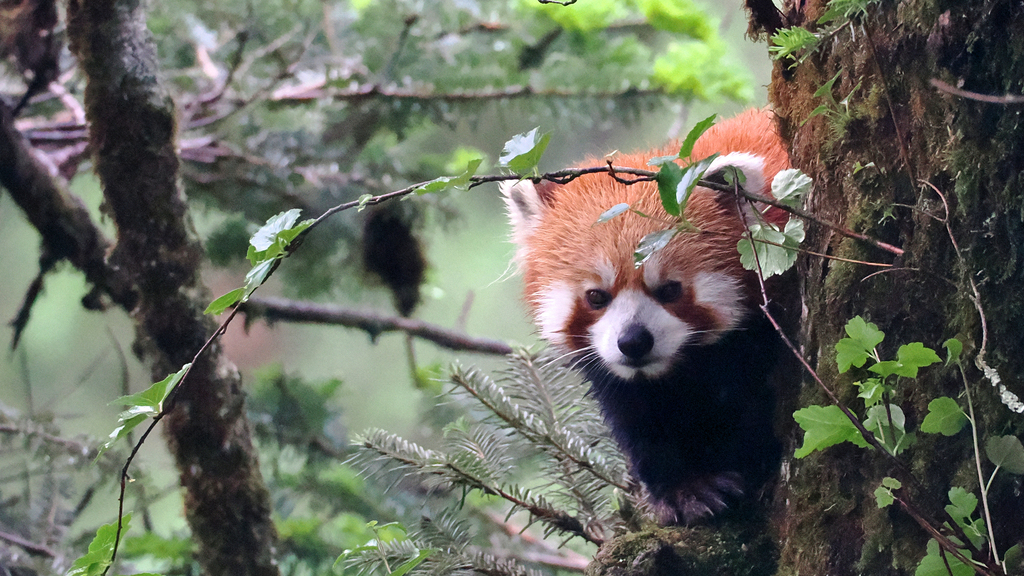
Western Red Panda
Photo © steve b
Photo © steve b — CC0 1.0 — Source: iNaturalist photo #523440542Identification
The western red panda is a small mammal instantly recognizable by its distinctive reddish-brown fur contrasted with a black belly and legs. Its most charming features include white-lined ears, a mostly white muzzle, and a boldly ringed tail that aids balance in its arboreal habitat. Head-to-body length ranges from 51–63.5 cm with a tail of 28–48.5 cm, and the species weighs between 3.2 and 15 kg, making it genuinely diminutive. Its evolutionary relatives include raccoons, weasels, and skunks rather than the giant panda—despite both sharing elongated wrist bones or "false thumbs" used for grasping bamboo. Well-adapted for climbing, the red panda possesses flexible joints and curved semi-retractile claws that provide exceptional grip on steep forest terrain.
Range & Habitat
Native to the eastern Himalayas and southwestern China, the red panda inhabits coniferous forests as well as temperate broadleaf and mixed forests. It shows a strong preference for steep slopes with dense bamboo cover located close to water sources. Two recognized subspecies—the Himalayan and Chinese red panda—diverged genetically approximately 250,000 years ago, with populations separated by geographic features such as the Siang River and glaciated regions of the southern Tibetan Plateau. The species is solitary and largely arboreal, spending most of its time in the trees.
Behaviour & Diet
Red pandas are primarily bamboo feeders, consuming bamboo shoots and leaves as their staple diet, supplemented by fruits and blossoms. Mating occurs in early spring, with females giving birth to litters of up to four cubs during summer months. Habitat destruction and fragmentation through deforestation, combined with poaching pressure, have severely threatened red panda populations, leading to its listing as Endangered on the IUCN Red List since 2015. The species benefits from protection in all range countries.
Best Time & Places to See It
Community-based conservation programmes operate in Nepal, Bhutan, and northeastern India, offering opportunities for dedicated wildlife travelers to encounter this elusive species in protected areas. China maintains nature conservation projects benefiting red pandas across their range. Regional captive breeding programmes established in zoos worldwide provide alternative viewing opportunities and contribute to species preservation efforts.
Photography Tips
Photographing red pandas requires patience and early morning or late afternoon positioning to capture their arboreal behavior in soft, natural light. Their distinctive white facial markings and ringed tails provide excellent contrast for compelling images. Since they are largely arboreal and solitary, positioning yourself along steep forest slopes near bamboo thickets increases your chances of encountering them against natural backdrops. The species' small size and preference for dense forest cover demand telephoto lenses and high shutter speeds to freeze movement through the canopy.
Gaoligong Mountain National Nature Reserve
Giant Panda National Park
Langtang National Park
Wolong National Nature Reserve
Nothing matches these filters.
No community photos yet. Log in to add the first one.
No community observations of this species yet.