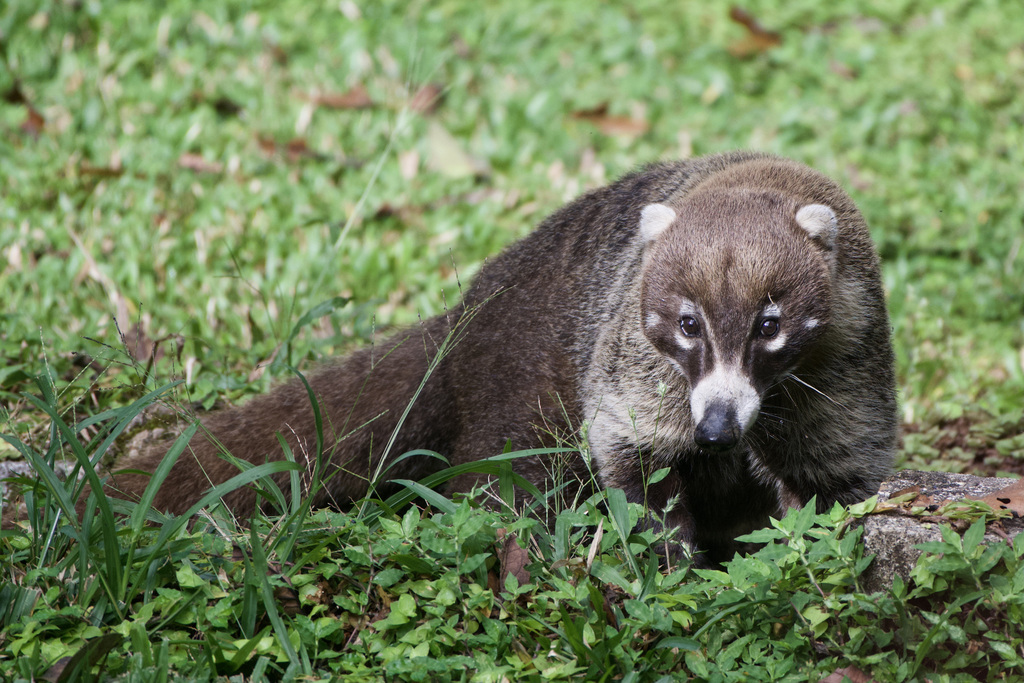
White-nosed Coati
Photo © Dario Taraborelli
Photo © Dario Taraborelli — CC0 1.0 — Source: iNaturalist photo #174901321Identification
The white-nosed coati is a member of the raccoon family, recognizable by its distinctive long, flexible snout and elongated body. It weighs between 4–6 kg (8.8–13.2 lb) on average, though small females may weigh as little as 3.1 kg (6.8 lb) and large males up to 9 kg (20 lb). The species measures approximately 110 cm (3.6 ft) from nose to tail tip, with the tail comprising about half of this length.
The white nose that gives this species its common name is a key identifying feature. Coatis are agile climbers that use their tails for balance when moving through trees and on branches.
Range & Habitat
The white-nosed coati ranges from Flagstaff, Arizona and New Mexico southward through Mexico, Central America, and into the northwestern region of Colombia near the Panamanian border. It inhabits wooded areas across tropical and subtropical dry and moist broadleaf forests, thriving at elevations from sea level up to 3,000 m (9,800 ft). A subspecies occurs on Cozumel Island, where individuals are notably smaller than mainland populations.
The species has also established populations in Florida, with records dating back to at least 1928 from escaped captives. Early sightings in Texas extend back to 1877, with scattered records through the twentieth century, though these northern occurrences remain rare.
Behaviour & Diet
Unlike many of their procyonid relatives, white-nosed coatis are diurnal, conducting most of their foraging during daylight hours. Adult males live solitary lives except during breeding season, while females form social groups called bands with their offspring, including young males under two years old. Coatis are omnivorous foragers that hunt on the ground for small vertebrates, snakes, eggs, insects, and carrion, while also consuming fruits. They are capable climbers and use their tails for balance in trees.
White-nosed coatis play an important ecological role as pollinators of the balsa tree, particularly in Central America. Studies in Costa Rica have documented coatis inserting their snouts into balsa flowers to feed on nectar; pollen adheres to their faces and is dispersed throughout the forest. Gestation lasts 10–11 weeks, with litters of 2–7 young weaned at four months and reaching adult size at 15 months. In the wild, coatis live up to seven years; in captivity, they average 14 years, with some reaching their late teens.
Best Time & Places to See It
White-nosed coatis are most actively visible during daylight hours, making them excellent subjects for daytime wildlife observation. They are most readily encountered in wooded habitats throughout Central America, Mexico, and southern Arizona, particularly in protected areas and national parks within their range. Costa Rica, Belize, and Guatemala are reliable destinations for viewing this species in its natural habitat.
Your best chances of encountering coatis are in tropical and subtropical forests during the early morning and late afternoon hours when foraging activity peaks. Look for them on the ground near fallen fruits or along forest edges.
Photography Tips
The white-nosed coati's distinctive nose and energetic ground-foraging behaviour make it a rewarding photographic subject. Use a telephoto lens to maintain a respectful distance while capturing detailed shots of the characteristic white nose and expressive face. Since coatis are diurnal and often active on open ground, natural daylight photography is straightforward.
Focus on capturing the coati's tail, which is often held upright and is a distinctive feature—try to include this in your composition. When coatis climb trees, their tail becomes a striking balancing tool; this dynamic behaviour offers excellent action photography opportunities. Patience during early morning or late afternoon light will yield the best results.
Costa Rica Sampler
Nothing matches these filters.
Nothing matches these filters.
Arenal Volcano National Park
Arrecifes de Cozumel National Park
Barra del Colorado National Wildlife Refuge
Baru Volcano National Park
Braulio Carrillo National Park
Cahuita National Park
Caño Negro National Wildlife Refuge
Carara National Park
Chagres National Park
Nothing matches these filters.
No community photos yet. Log in to add the first one.
No community observations of this species yet.