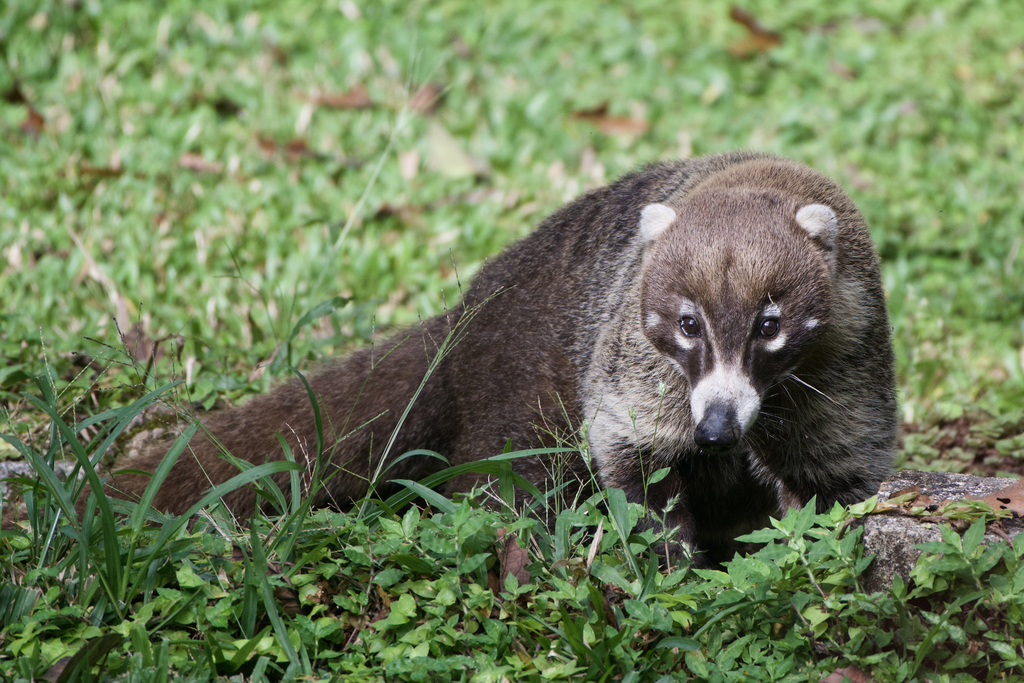
Coatí
Photo © Dario Taraborelli
Photo © Dario Taraborelli — CC0 1.0 — Source: iNaturalist photo #174901321El coatí de nariz blanca (Nasua narica), también conocido como pizote, antón o tejón americano, es un mamífero carnívoro de la familia de los prociónidos que habita en el sector meridional de Norteamérica, Centroamérica y el extremo noroeste de Colombia. Suelen habitar en las zonas boscosas (bosque seco y húmedo) de América en cualquier altitud, desde el nivel del mar hasta 3500 m s. n. m., desde el sureste de Arizona y Nuevo México hasta Ecuador. En México se les ha observado en prácticamente todo el territorio en especial en Aguascalientes dónde abundan en gran manera, excepto en Baja California Sur y Tlaxcala. Son omnívoros, prefiriendo pequeños vertebrados, y se alimentan también con frutos, carroña, insectos y huevos. Pueden subir los árboles con facilidad, utilizando la cola para equilibrarse, pero es más frecuente que busquen alimento en el suelo. Sus depredadores incluyen boas, aves rapaces, félidos, y tayras.
Se adaptan fácilmente a la presencia humana y a menudo se los observa incursionando los campamentos y saqueando los recipientes de basura. Pueden ser domesticados con relativa facilidad. Son principalmente diurnos, retirándose por la noche en un árbol específico, para iniciar su labor diaria de búsqueda de alimento desde la madrugada. Sin embargo, sus hábitos son ajustables, y se vuelven más nocturnos en las zonas donde son cazados por los seres humanos, o cuando saquean los asentamientos humanos para su propia alimentación. Los machos adultos son solitarios, pero las hembras y los machos sexualmente inmaduros forman grupos sociales. Usan señales vocales para comunicarse. Durante la búsqueda de alimento, el cuidado de las crías queda a cargo de un par de niñeras, como también lo hacen las suricatas. La época de reproducción es en febrero o marzo. Después de aproximadamente 77 días de gestación, una hembra da entre dos y siete crías. Las crías son inicialmente ciegas y cubiertas de pelusa gris oscuro. Se destetan a los cuatro meses, y alcanzan la madurez sexual en aproximadamente dos años. En este punto, los machos son expulsados del grupo. Pueden alcanzar una edad de 17 años.
Corcovado National Park
Puerto Jiménez, Costa Rica
+132 aves+30 mamíferos
Rain hammers the canopy as moisture-laden clouds collide with the Osa Peninsula’s mountainous spine, birthing one of the planet’s most […]
VER PARQUE NACIONALManuel Antonio National Park
Quepos, Costa Rica
+125 aves+30 mamíferos
White sand beaches curve between steep jungle walls where the Pacific laps against Costa Rica’s most biodiverse coastal sanctuary. Rainforest […]
VER PARQUE NACIONALArenal Volcano National Park
Peñas Blancas, Costa Rica
+131 aves+30 mamíferos
Where a perfect cone of dark basalt rises 1,633 metres above rainforest canopy, Costa Rica’s most iconic volcano commands a […]
VER PARQUE NACIONALTortuguero National Park
Roxana, Costa Rica
+124 aves+30 mamíferos
Where emerald waterways thread through impenetrable rainforest and pristine Caribbean beaches merge with lagoons, one of Costa Rica’s most biodiverse […]
VER PARQUE NACIONALChirripó National Park
Rivas, Costa Rica
+132 aves+30 mamíferos
Where the Central American spine rises above the clouds, granite peaks puncture a realm of perpetual mist and montane forest. […]
VER PARQUE NACIONALBraulio Carrillo National Park
Las Horquetas, Costa Rica
+132 aves+30 mamíferos
Steep volcanic slopes plunge into misty valleys where primary tropical rainforest cloaks the landscape in unrelenting green. Rising from 2,000 […]
VER PARQUE NACIONALPiedras Blancas National Park
Golfito, Costa Rica
+132 aves+30 mamíferos
Where misty lowland rainforest plunges toward the Pacific through a labyrinth of river valleys, one of Costa Rica’s most pristine […]
VER PARQUE NACIONALSanta Rosa National Park
Santa Elena, Costa Rica
+129 aves+30 mamíferos
Dawn breaks over a mosaic of dry forest and humid woodland where Costa Rica’s northwestern peninsula juts into the Pacific. […]
VER PARQUE NACIONALGuanacaste National Park
Santa Elena, Costa Rica
+132 aves+30 mamíferos
Where Pacific dry forest meets cloud-shrouded volcanic peaks, one of Costa Rica’s most biodiverse conservation areas unfolds across northwestern Guanacaste […]
VER PARQUE NACIONALVolcán Poás National Park
Toro Amarillo, Costa Rica
+132 aves+30 mamíferos
Where volcanic peaks pierce the Costa Rican highlands, a landscape of primordial drama unfolds. The Poás volcano dominates this 6,506-hectare […]
VER PARQUE NACIONALSaguaro National Park
Tucson, Estados Unidos
+126 aves+28 mamíferos
Towering sentinels of the Sonoran Desert rise across nearly two thousand square kilometers of Arizona’s most iconic terrain. These magnificent […]
VER PARQUE NACIONALSaguaro National Park – Rincon Mountain District
Pima County, Estados Unidos
+131 aves+28 mamíferos
Dawn breaks over slopes where towering saguaro cacti puncture the Sonoran Desert sky like sentinels guarding an ancient realm. This […]
VER PARQUE NACIONALNatural Utría National Park
Alto Baudó (Pie de Pató), Colombia
+144 aves+15 mamíferos
Where the Chocó rainforest plunges headlong into the Pacific, a pristine coastal wilderness unfolds across 1,287 square kilometers of Colombia’s […]
VER PARQUE NACIONALBaru Volcano National Park
Cerro Punta, Panamá
+146 aves+16 mamíferos
Where mist clings to volcanic slopes and cloud forest canopy rises above 3,500 metres, Panama’s highest peak dominates a landscape […]
VER PARQUE NACIONALSoberanía National Park
Cristóbal, Panamá
+132 aves+30 mamíferos
Where the Chagres River cuts through lowland tropical forest mere kilometres from Panama City’s skyline, one of Central America’s most […]
VER PARQUE NACIONALChagres National Park
Caimitillo, Panamá
+131 aves+30 mamíferos
Where rainforest canopy meets mountain spine, the Chagres River carves through some of Central America’s most pristine tropical wilderness. Spanning […]
VER PARQUE NACIONALDarién National Park
Tucutí, Panamá
+132 aves+30 mamíferos
Where rainforest swallows the horizon and rivers carve through primordial wilderness, one of Central America’s last great untamed frontiers unfolds […]
VER PARQUE NACIONALPortobelo National Park
Portobelo, Panamá
+115 aves+16 mamíferos
Where Caribbean waters dissolve into rainforest, a protected realm of pristine coastal wilderness unfolds across 570 square kilometers of northern […]
VER PARQUE NACIONALMarino Golfo de Chiriquí National Park
Boca Chica, Panamá
+94 aves+8 mamíferos
Where mangrove-fringed islands emerge from turquoise shallows and volcanic peaks anchor the horizon, Panama’s Gulf of Chiriquí reveals one of […]
VER PARQUE NACIONALDzibilchantún National Park
Barcelona, México
+97 aves+5 mamíferos
Cenotes puncture the limestone plateau of Mexico’s Yucatan Peninsula like sapphire eyes, and this compact 8-square-kilometre park shelters some of […]
VER PARQUE NACIONALLagunas de Montebello National Park
Laguna de Montebello, México
+126 aves+3 mamíferos
Crystalline waters pierce through limestone plateaus in the borderlands of Chiapas, where over fifty interconnected lakes create a landscape of […]
VER PARQUE NACIONALArrecifes de Cozumel National Park
San Miguel de Cozumel, México
+134 aves+21 mamíferos
Crystalline waters lap against the world’s second-longest coral barrier reef, where vibrant walls of living limestone plunge into the abyss. […]
VER PARQUE NACIONALSierra de Tamaulipas
El Porvenir, México
+91 aves+20 mamíferos
Where limestone peaks thrust skyward through dense subtropical forest, Mexico’s northeastern frontier reveals one of the continent’s most biodiverse mountain […]
VER RESERVA NATURALParque Nacional Benito Juárez
San Andrés Huayápam, México
+129 aves+30 mamíferos
Towering pine and fir forests blanket the high plateaus of Oaxaca’s Sierra Madre Oriental, where elevation exceeds 3,600 meters and […]
VER PARQUE NACIONALParque Nacional Grutas de Cacahuamilpa
Pilcaya, México
+141 aves+19 mamíferos
Where limestone cliffs plunge into shadowed canyons, the Río Río Grande carves its ancient passage through one of Mexico’s most […]
VER PARQUE NACIONALTutuaca
Tosanachi, México
+122 aves+22 mamíferos
Where copper canyons plunge deeper than the Grand Canyon itself, Mexico’s remote Sierra Madre Occidental unfolds in dramatic vertical relief. […]
VER PAISAJE PROTEGIDOAún no hay fotos de la comunidad. Inicia sesión para añadir la primera.
Aún no hay observaciones de la comunidad de esta especie.