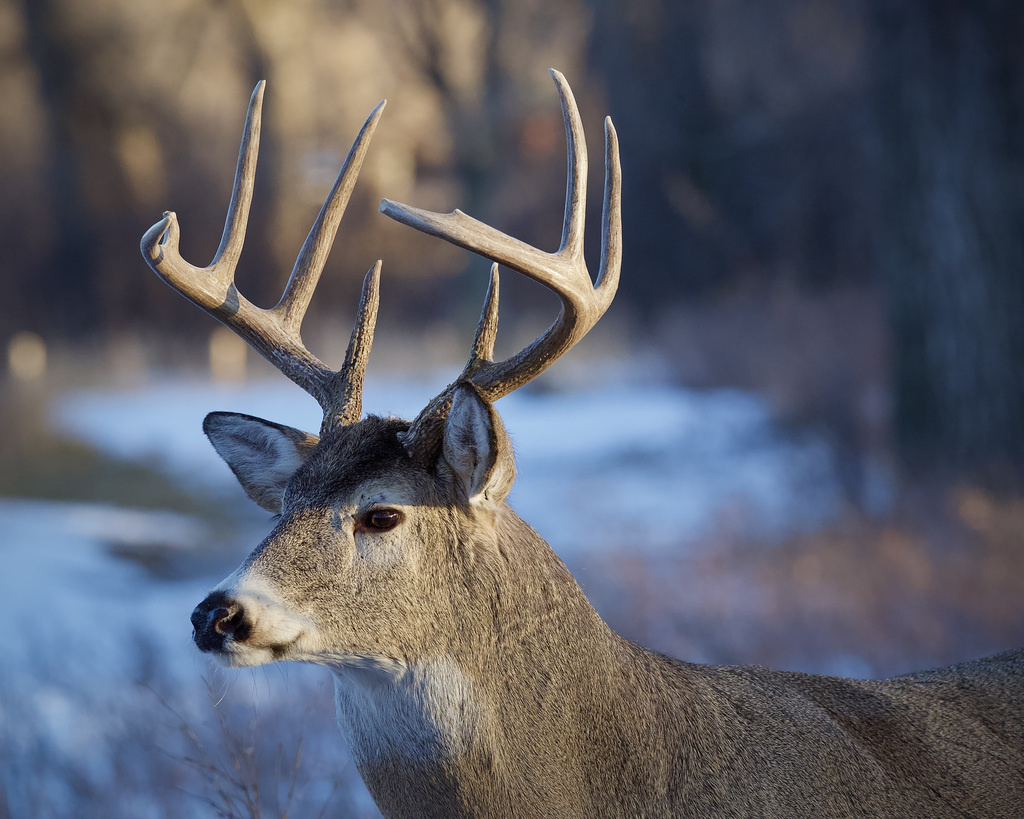
White-tailed Deer
Photo © John Krampl
Photo © John Krampl — CC BY 4.0 — Source: iNaturalist photo #106015318Identification
The white-tailed deer is a medium-sized ungulate herbivore native to the Americas. The species is highly recognizable by its distinctive white tail, which it displays prominently when alarmed. Various subspecies exist across its range, with morphological differences that have led taxonomists to describe between 30 and 40 subspecies historically, though genetic studies suggest fewer distinct populations. The Northern white-tailed deer (O. v. borealis) represents the largest and darkest subspecies, while smaller and lighter-colored forms exist in southern and arid regions.
Range & Habitat
The white-tailed deer is the most widely distributed mainland ungulate herbivore in the Americas. In North America, it is very common east and south of the Rocky Mountains, including southwestern Arizona. High populations exist on the Edwards Plateau of Central Texas—which holds an estimated 5.3 million individual white-tailed deer—as well as in Illinois, Indiana, Iowa, Maryland, Michigan, Minnesota, Mississippi, Missouri, New Jersey, New York, North Dakota, Ohio, Pennsylvania, and Wisconsin. The Columbian white-tailed deer population, once widespread along the Willamette and Cowlitz River valleys of western Oregon and southwestern Washington, is now considerably reduced and classified as near-threatened.
Highly adaptable, white-tailed deer inhabit diverse ecosystems ranging from arid grasslands to tropical basins, including the Amazon and Orinoco regions, the Llanos, and high-elevation Andean terrain. Throughout Central and South America, subspecies are distributed from Guatemala to Peru. The species has also been introduced to New Zealand, parts of Canada, the Caribbean, and several European countries including the Czech Republic, Finland, France, Germany, Romania, and Serbia.
Behaviour & Diet
White-tailed deer are crepuscular, meaning they are most active at dawn and dusk, with sporadic rest periods throughout the day and night. As herbivores, they feed on vegetation appropriate to their habitat. The species is highly adaptable across its range, allowing it to thrive in vastly different environments. In some areas, populations have become so abundant they are considered a nuisance.
Best Time & Places to See It
For the best viewing opportunities, visit during dawn or dusk when white-tailed deer are most active. Texas offers exceptional numbers, particularly on the Edwards Plateau of Central Texas. Other reliable locations include the Great Lakes region and the northeastern United States. For those seeking rarer subspecies, the Florida Keys host the endangered Key deer, while the Columbian white-tailed deer can be found in limited numbers in the river valleys of Oregon and Washington, though sightings are increasingly difficult due to population decline.
Photography Tips
Plan your shoots around the crepuscular activity patterns—early morning and late evening light will reward patient photographers. In areas of high population density such as Texas, scouting during daylight hours can help identify feeding areas and movement corridors. Use the white tail as a compositional element, as it is the species' most distinctive field mark. For endangered subspecies like the Columbian white-tailed deer, work with local wildlife authorities and protected area managers to access habitat responsibly and legally.
Acadia National Park
Algonquin Provincial Park
Alligator River National Wildlife Refuge
Antisana National Park
Badlands National Park
Banff National Park
Barra del Colorado National Wildlife Refuge
Bic National Park
Big Bend National Park
Nothing matches these filters.
No community photos yet. Log in to add the first one.
No community observations of this species yet.