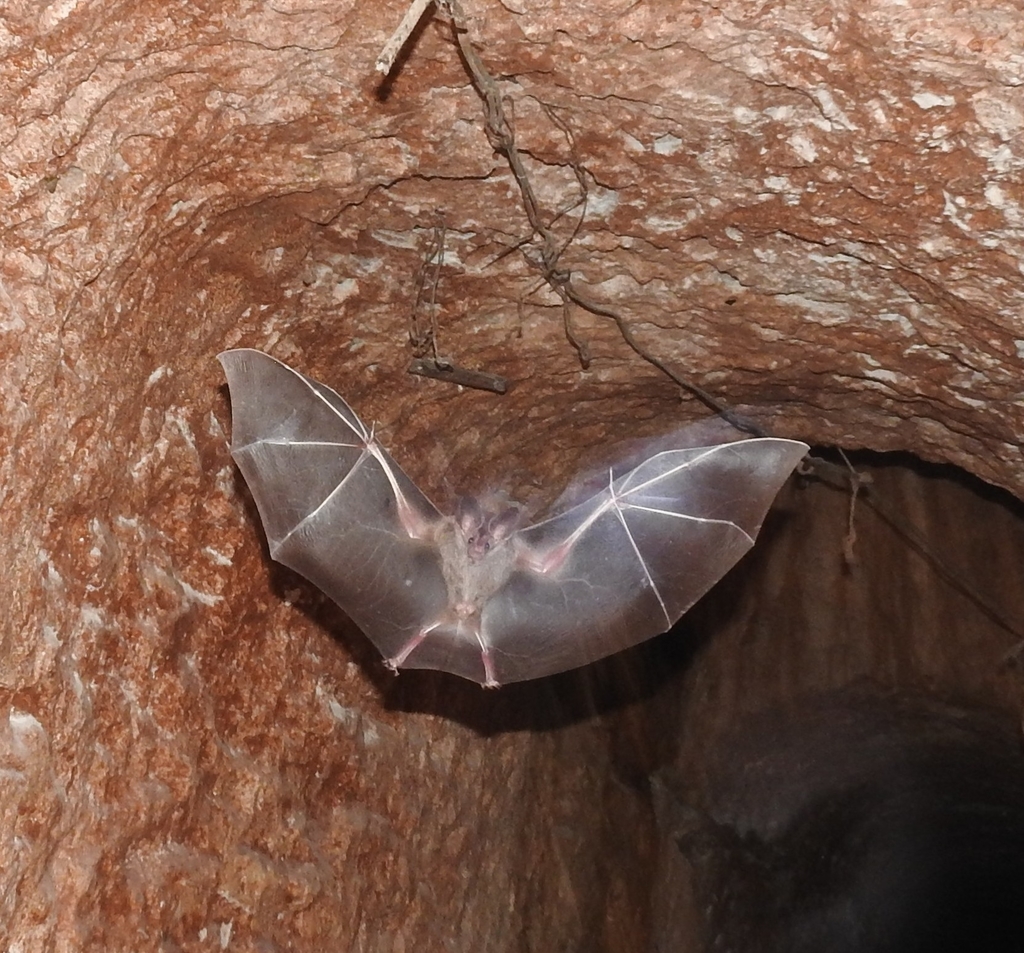
Woolly False Vampire Bat
Photo © Sebastián de Jesús Herrera Buenfil
Photo © Sebastián de Jesús Herrera Buenfil — CC BY 4.0 — Source: iNaturalist photo #188573094The big-eared woolly bat or (Peters's) woolly false vampire bat (Chrotopterus auritus) is a species of bat, belonging to the family Phyllostomidae. The name Chrotopterus is derived from Greek roots chariots (skin, color), and pteron (wing). The epithet auritus refers to the large ears. == Description == Big-eared woolly bats are very large predatory bats, the second largest bat species in the neotropics. Their body mass typically ranges from 75 to 96 grams (2.6 to 3.4 oz). The length of the forearm ranges from 79 to 83 millimetres (3.1 to 3.3 in). There are only three New World phyllostomid bats of comparable size. The dorsal hair is about 12 millimetres (0.47 in) long, which is longer than that most of phyllostomid species. They also possess two lower incisors, a trait typically shared with smaller bats. == Ecology == === Habitat === Big woolly-eared bats live in warm subtropical forests, usually roosting in caves and hollow logs, where prey is returned to before consumption. Geographically, they are found in southern parts of Mexico and extend through Northeastern South America, being found as far south as northern Argentina. They are typically found in areas that also host many other species of bat.…
Emas National Park
Brazil
+333 birds+23 mammals
Across the high plateaux of central Brazil, where the cerrado grasslands roll toward distant horizons under an immense sky, Emas National Park anchors one of South…
VIEW NATIONAL PARKSão Joaquim National Park
Brazil
+222 birds+9 mammals
Where the southern Brazilian highlands rise above the Atlantic Forest, São Joaquim National Park protects nearly 1,000 square kilometers of montane terrain that shifts between temperate…
VIEW NATIONAL PARKMontes Azules
Candelaria, Mexico
+395 birds+47 mammals
Where jungle-clad limestone plateaus plunge into canyon systems carved by the Usumacinta River, Mexico's most pristine rainforest reserve unfolds across the Lacandón region of Chiapas. Montes…
VIEW BIOSPHERE RESERVENo community photos yet. Log in to add the first one.
No community observations of this species yet.