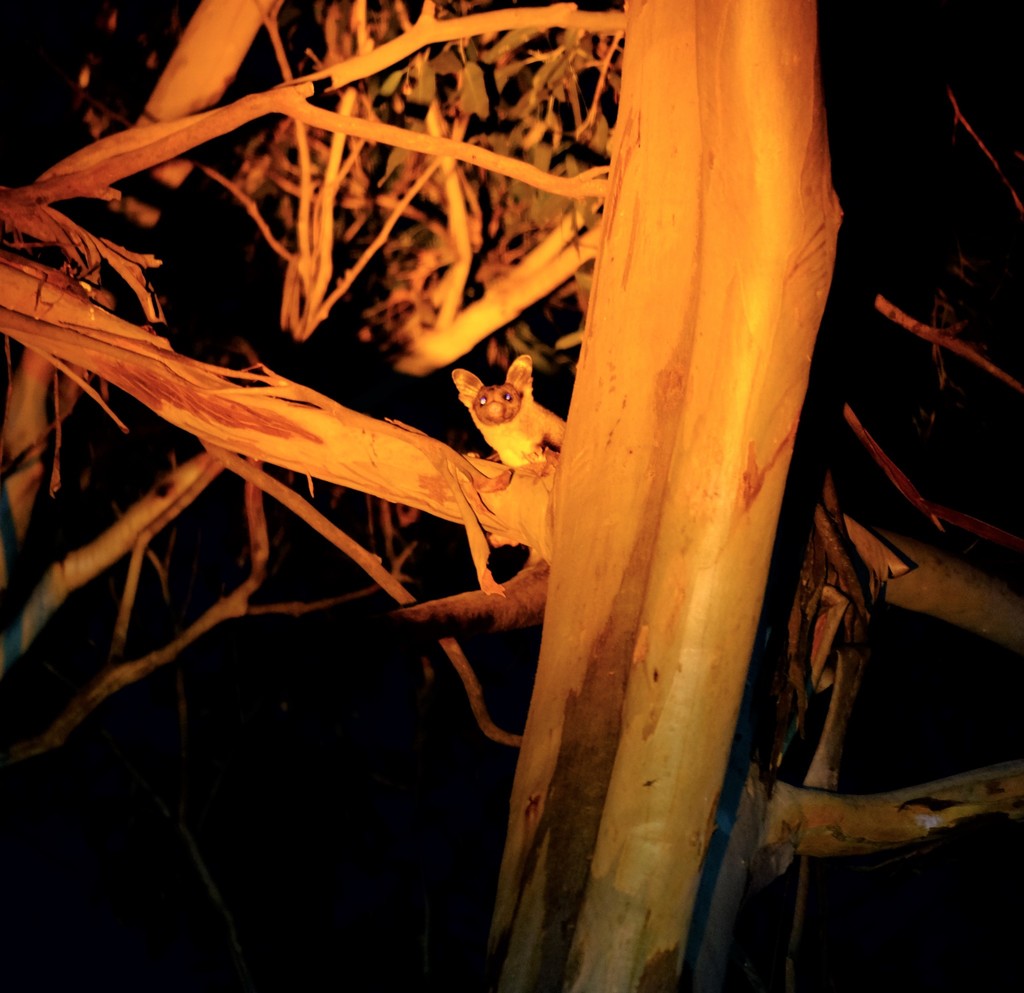
Yellow-bellied Glider
Photo © Peter Crowcroft
Photo © Peter Crowcroft — CC BY 4.0 — Source: iNaturalist #37451846Identification
The yellow-bellied glider, also known as the fluffy glider, is a medium-sized marsupial roughly the size of a rabbit. It weighs around 700 g, with a body length of about 30 cm and a distinctively long tail that can reach 48 cm. The species has grey-brown fur on its back and an off-white to orange or yellow belly, large pointed ears, and males are typically larger than females. It is the largest member of the genus Petaurus, the wrist-winged gliders, and bears some resemblance to the mahogany glider, though it is slightly larger.
Range & Habitat
The yellow-bellied glider inhabits native eucalypt forests in eastern Australia, ranging from northern Queensland south to Victoria. It occupies forests and woodlands at altitudes from sea level to 1400 metres, though in North Queensland populations are found above 700 m elevation. In the tropical north, the species exists in three distinct populations: on Mount Windsor Tableland, Mount Carbine Tableland, and in a linear habitat stretching from Atherton to Kirrama on the Atherton Tableland, collectively numbering around 6000 individuals. The species is more widespread in southern Queensland, New South Wales, and Victoria.
Behaviour & Diet
The yellow-bellied glider is nocturnal and arboreal, capable of gliding up to 150 metres and jumping distances of 100 to 114 metres. It is highly gregarious, spending daylight hours in leaf-lined tree holes shared with family members. Among the most vocal possum gliders, it produces a distinctive growling call used for communication that has been recorded from up to 500 metres away. Its diet comprises nectar, honeydew, insects, pollen, and tree sap from various eucalypts and other species. The glider obtains sap by biting distinctive V-shaped notches into smooth-barked trees to promote gum flow, typically on trunks and upper branches.
Best Time & Places to See It
As a nocturnal species, yellow-bellied gliders are best observed at night. In North Queensland, the three main populations on Mount Windsor Tableland, Mount Carbine Tableland, and the Atherton Tableland offer the most reliable viewing opportunities, though populations here are rare and vulnerable. The species is more commonly encountered in southern Queensland, New South Wales, and Victoria. Breeding occurs in spring in the south but throughout the year in northern Queensland, so seasonal timing may vary by location.
Photography Tips
Photographing yellow-bellied gliders requires nocturnal fieldwork with appropriate red-light or infrared illumination to avoid disturbing the animals. Focus on trees with smooth bark and evidence of V-shaped sap notches, as these are prime feeding locations. Look for gliders emerging from and returning to leaf-lined tree holes, particularly those shared by family groups. Listen for their distinctive growling calls to locate active individuals. A telephoto lens is advisable, as gliders spend much time high in the canopy. Patient observation of eucalypt forests at night will yield the best photographic opportunities.
Carnarvon National Park
Philadelphia, Australia
+179 birds+17 mammals
Across 15,000 square kilometres of inland Queensland, rugged sandstone plateaus rise above eucalypt woodlands and open grasslands, carved by creeks that have worn deep gorges into…
VIEW NATIONAL PARKHerberton Range National Park
Australia
+115 birds+10 mammals
Rainforest-clad ridges and rocky outcrops define this 324-square-kilometre reserve in far north Queensland, where the mountainous terrain of the Herberton Range rises through layered eucalypt woodland…
VIEW NATIONAL PARKMorton National Park
Australia
+253 birds+57 mammals
Across nearly 4,800 square kilometers of New South Wales's Southern Tablelands, rugged sandstone plateaus rise above sheltered valleys where cool-climate eucalypt woodland meets grassy heath and…
VIEW NATIONAL PARKGreat Sandy National Park
Australia
+306 birds+40 mammals
Where coastal dunes rise inland from the Queensland coastline, Great Sandy National Park encompasses a landscape of remarkable ecological diversity shaped by subtropical humid conditions year-round.…
VIEW NATIONAL PARKBlue Mountains National Park
Australia
+220 birds+43 mammals
Dramatic sandstone cliffs rise in tiers across this mountainous plateau west of Sydney, their rust-coloured faces weathered into amphitheatres and gorges where eucalyptus forest clings to…
VIEW NATIONAL PARKKosciuszko National Park
Australia
+211 birds+52 mammals
Where the Great Dividing Range reaches its highest peaks in southeastern Australia, Kosciuszko National Park encompasses a landscape of windswept plateaus, rocky ridges, and deep river…
VIEW NATIONAL PARKOxley Wild Rivers National Park
Australia
+202 birds+45 mammals
Where the New England Tablelands descend toward the coast, river gorges carve through temperate forests in a landscape of dramatic geological contrast. Oxley Wild Rivers National…
VIEW NATIONAL PARKNew England National Park
Australia
+169 birds+35 mammals
Temperate eucalypt woodlands and cool rainforest pockets define this upland reserve where granite peaks rise above the New England Plateau in northeastern New South Wales. Here,…
VIEW NATIONAL PARKBen Boyd National Park
Eden, Australia
+255 birds+47 mammals
Where the temperate forests of the far south coast meet towering sea cliffs, Ben Boyd National Park unveils one of New South Wales' most dramatic coastal…
VIEW NATIONAL PARKGreat Otway National Park
Australia
+255 birds+42 mammals
Temperate rainforest and wet eucalyptus woodland cloak the ridges and gullies of Victoria's Great Otway National Park, where persistent moisture and mild year-round temperatures sustain a…
VIEW NATIONAL PARKNo community photos yet. Log in to add the first one.
No community observations of this species yet.