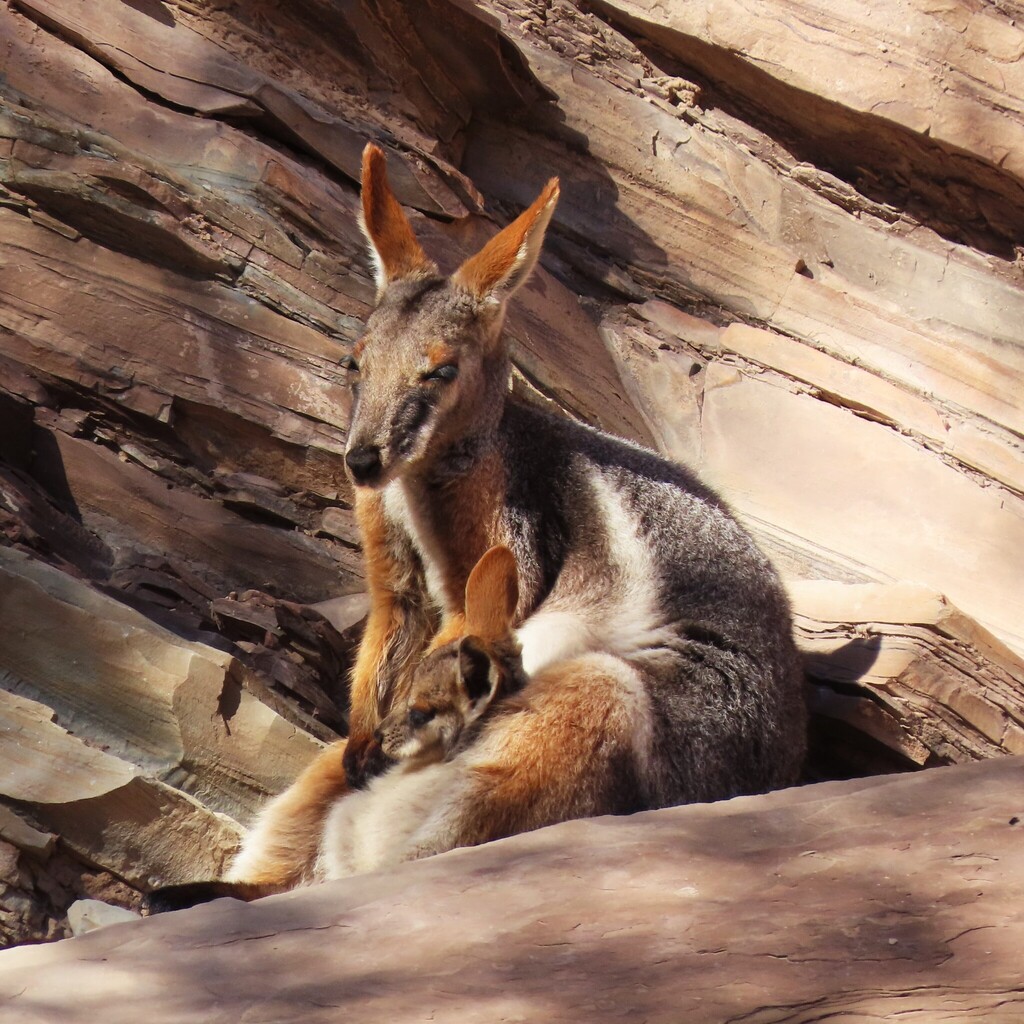
Yellow-footed Rock Wallaby
Photo © pimelea
Photo © pimelea — CC BY 4.0 — Source: iNaturalist #283843571The yellow-footed rock-wallaby (Petrogale xanthopus), formerly known as the ring-tailed rock-wallaby, is a member of the macropod family (the marsupial family that includes the kangaroos, wallabies, tree-kangaroos, and wallaroos). == Taxonomy == This species was first described by John Edward Grey in 1855 in the Proceedings of the Zoological Society of London. The description was based on two specimens (a male and a female), which were possibly collected from the Richmond River. The illustration that accompanied the published description was produced by Joseph Wolf. == Description == The yellow-footed rock-wallaby is grey to fawn-grey above and light-coloured below with a black mid-dorsal stripe from the crown of the head to the centre of the back. There is a distinct white cheek stripe, with ears ranging in colour from orange to grey-brown. The forearms and hind legs are bright yellow to rich orange to a light orange-brown. The tail is orange-brown irregularly ringed with dark brown and golden-brown, with the colour of the tip variable from dark brown to white. The head and body length is 480–650 mm (usually 600 mm), with tail length 570–700 mm (usually 690 mm), and weight 6–11 kg. == Distribution and habitat == This species of…
Ikara-Flinders Ranges National Park
Australia
+149 birds+10 mammals
Where ancient quartzite ridges rise across the semi-arid heart of South Australia, Ikara-Flinders Ranges National Park unfolds across nearly two thousand square kilometres of one of…
VIEW NATIONAL PARKVulkathunha-Gammon Ranges National Park
Australia
+97 birds+8 mammals
Granite ridges and quartzite peaks rise abruptly from the red earth of South Australia's mid-north, their steep slopes carved into gorges where seasonal waterfalls cascade through…
VIEW NATIONAL PARKNo community photos yet. Log in to add the first one.
No community observations of this species yet.