Birding TourModerate
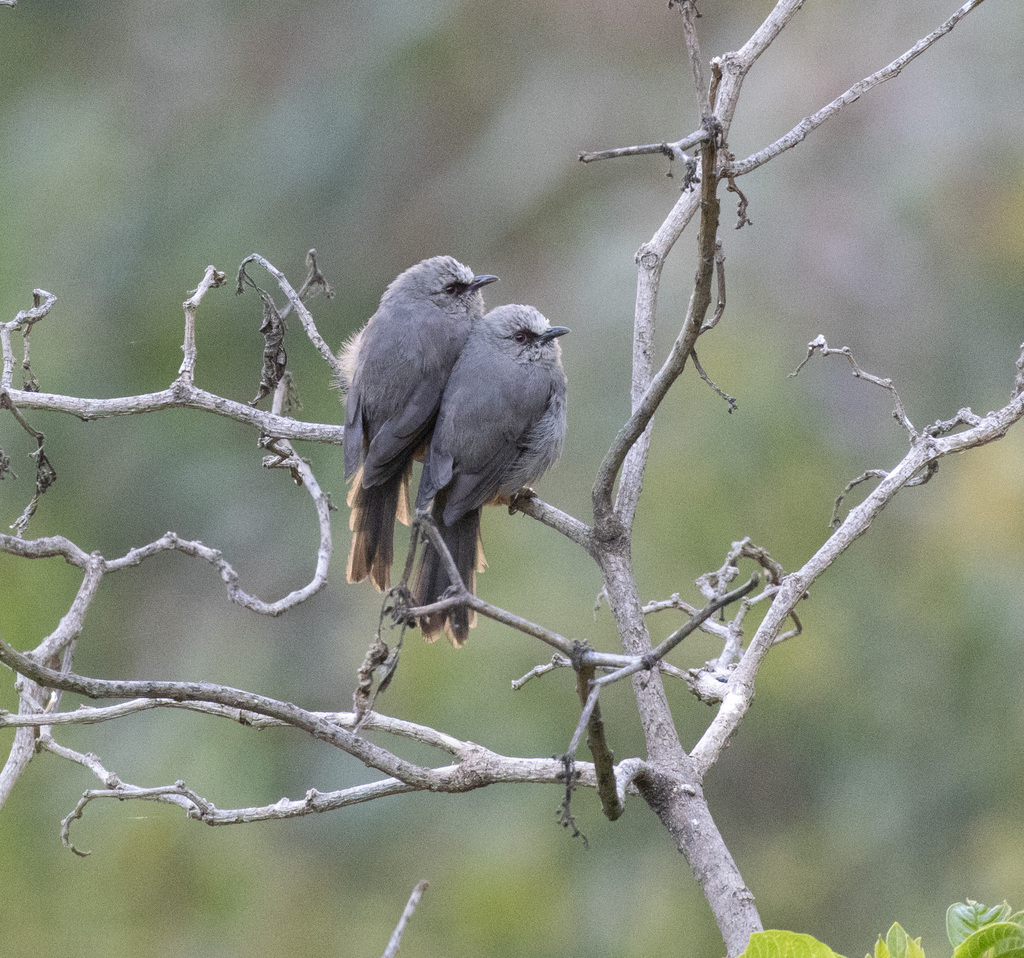
The Abyssinian catbird (Sylvia galinieri), also known as the juniper babbler, is a small passerine in the family Sylviidae, endemic to the highland forests and scrub of Ethiopia. Despite its name, it is unrelated to other birds called "catbirds." It is mostly grey, with black lores, a whitish forehead, and a chestnut vent. == Description == The Abyssinian catbird is a small-sized babbler. Its body is round with relatively short wings and legs. The bird's belly is white, but its upper parts are a lighter shade of grey that gradually fades to a darker shade moving to the backside of the bird. The head of the bird is a light shade of grey with dark highlights surrounding the eyes. The eyes themselves have a scarlet iris surrounding dark brown pupils. The beak is short pointed and black. Its wings are the darkest parts of its body having parallel bars of black along its length with the rest of the wing being grey. Its underside from its legs to its tail is a distinct orange that gives way to a tail that is about half the length of the bird itself. Abyssinian catbirds measure around 19 cm (7.5 in) in length.…
Ethiopia
+438 birds+7 mammals
Two crater lakes of contrasting chemistry define this remote corner of Ethiopia's Rift Valley, where soda lakes and freshwater basins create a mosaic of distinct aquatic…
VIEW NATIONAL PARKEthiopia
+397 birds+20 mammals
Where the Ethiopian highlands rise above 4,000 metres, the Bale Mountains create a landscape of stunning ecological extremes—from afroalpine grasslands swept by wind and mist to…
VIEW NATIONAL PARKDebark, Ethiopia
+120 birds+9 mammals
Where granite escarpments plunge thousands of metres into misty valleys, the Ethiopian highlands reveal a landscape of almost mythical drama. These volcanic plateaus, carved by ancient…
VIEW NATIONAL PARKNo community photos yet. Log in to add the first one.
No community observations of this species yet.
We'd love to hear from you. We'll reply as soon as possible.
Found an error? Have a suggestion? We read every message.
A compact view of how this species lives, moves and responds to its environment.
Select a card to explore the details.
Please confirm the photo rights and credit terms first.
I'm the author of this photo or hold the rights to it, and I keep full ownership. I grant Wild Atlas Guide a free, non-exclusive licence to display it on the site and in Wild Atlas Guide's own channels, including social media, always credited to me by my display name or the Instagram handle I choose to provide. I confirm it does not reveal a sensitive wildlife location or a recognisable person without their permission. I can withdraw future social use for this photo or ask for it to be removed at any time.
Please accept the photo rights and credit terms to continue.
Uploading…
We use cookies to measure traffic and improve WildAtlas. You decide. Privacy policy