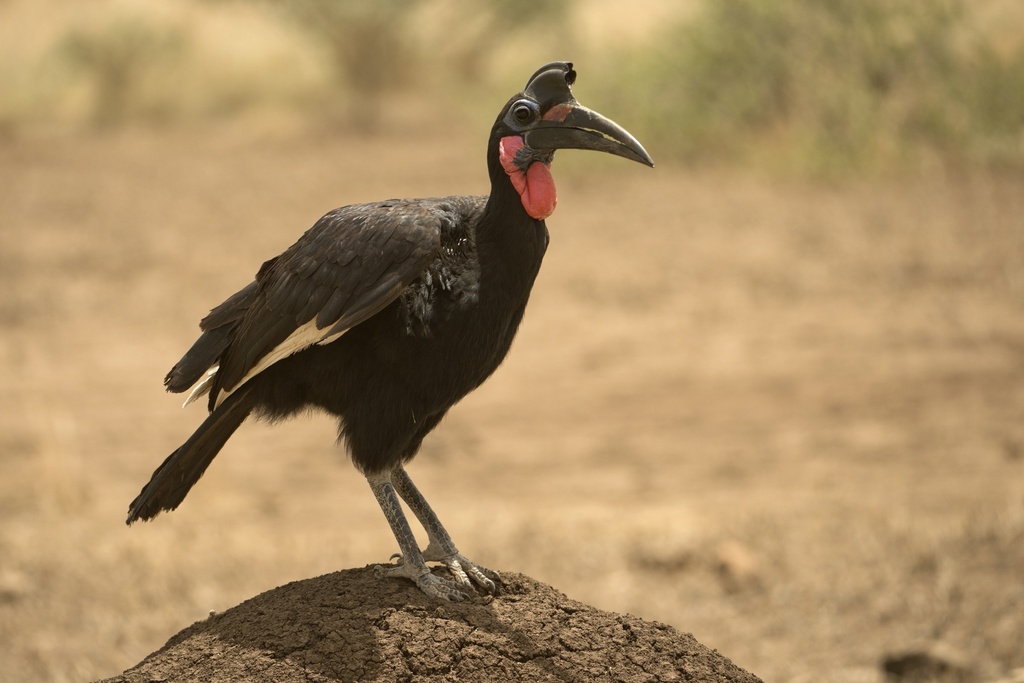
Abyssinian Ground Hornbill
Photo © Divya Mudappa
Photo © Divya Mudappa — CC BY-SA 4.0 — Source: iNaturalist photo #177517713Identification
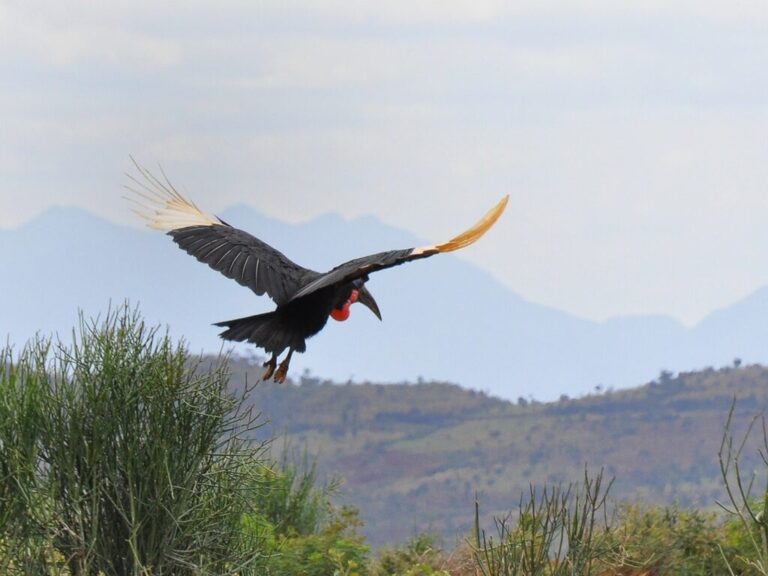
The Abyssinian ground hornbill is a large, imposing terrestrial bird measuring 90 to 110 cm in length and weighing approximately 4 kg. It is the second largest African hornbill species, distinguished by its black body feathers contrasting with white primary feathers visible in flight. The bird's most striking features are its bare facial patches and a short, open-ended black casque atop its long black bill, which has a reddish patch at the base of the mandible. Adult males display vivid bare blue skin around the eyes and an inflatable patch of red bare skin on the neck and throat, with the upper throat being blue. Females are smaller and similar in appearance but lack the colorful bare skin, which remains wholly dark blue. Distinctive long feathers resembling eyelashes surround the eyes, providing protection from injury. Juveniles appear dark sooty-brown with smaller bills and take approximately three years to develop full adult plumage and coloration.
Range & Habitat
Found exclusively north of the equator, the Abyssinian ground hornbill inhabits Northern sub-Saharan Africa from southern Mauritania, Senegal, and Guinea, extending east to Eritrea, Ethiopia, northwestern Somalia, northwestern Kenya, and Uganda. This species favors open habitats including savanna, sub-desert scrub, and rocky areas with short vegetation that facilitates its visual foraging technique. Unlike its southern relative, the Abyssinian prefers drier environments and can tolerate some habitat disturbance, though it requires large trees for nesting sites. The species has occasionally appeared in Florida following escapes or deliberate releases, but no breeding population has become established there.
Behaviour & Diet
Abyssinian ground hornbills are diurnal and highly terrestrial, living in pairs or small family groups across territories ranging from 2 to 100 square miles. They patrol their ranges primarily by walking and are reluctant fliers, taking to the air mainly when alarmed. Their diet is impressively varied, encompassing small vertebrates such as tortoises, lizards, snakes, and birds, alongside invertebrates including spiders, beetles, and caterpillars. They also consume carrion, fruits, seeds, and groundnuts. The species is particularly vocal, producing a deep, far-carrying booming call—"uh-uh, uh-uh-uh"—typically at dawn from perches or the ground, with males and females singing in duets. In captivity, these birds can live 35 to 40 years.
Best Time & Places to See It
Breeding seasons vary significantly across the Abyssinian ground hornbill's range, with West African populations breeding June through August, Nigerian and Ugandan birds breeding in January, and Kenyan populations as late as November. These timing differences allow travelers to plan visits to different regions according to their preference for observing breeding behavior or non-breeding birds. The species' preference for open habitats with short vegetation and its diurnal, ground-foraging behavior make it relatively conspicuous compared to many African birds, though patience and early morning visits when birds are most vocal will increase sighting chances.
Photography Tips
The Abyssinian ground hornbill's large size, striking facial features, and contrasting black and white plumage make it a rewarding photographic subject. Capture the distinctive bare blue and red facial patches and the impressive casque in detail using moderate telephoto lenses. The birds' reluctance to fly means ground-level or eye-level positioning can yield compelling portraits. Early morning sessions offer the best opportunities to photograph birds as they vocalize and become active. When birds take flight, the white primary feathers create dramatic contrast against the black body—position yourself to capture these moments. The open grassland and scrub habitats they favor provide clean backgrounds that emphasize the bird's bold coloration and impressive stature.
11 Days Safari to Uganda Including Gorilla Trekking.
Experience: This 11-day Uganda safari takes you through some of the country’s most spectacular wildlife destinations, including Murchison Falls National Park, Kibale Forest National Park, Queen Elizabeth National Park, Bwindi Impenetrable National Park, and Lake Mburo National Park. The journey includes rhino trekking at Ziwa Rhino Sanctuary, chimpanzee tracking in Kibale, the unforgettable experience of gorilla trekking in Bwindi, exciting game drives, boat cruises on the Nile River and the Kazinga Channel, and scenic countryside drives before returning to Entebbe. It is a well-rounded adventure combining wildlife, primates, and beautiful landscapes for a memorable Uganda safari experience.
Kidepo Valley National Park
Uganda
+478 birds+24 mammals
Where the Narus and Kidepo rivers carve through northeastern Uganda's semi-arid lowlands, a landscape of sparse acacia woodland, grassland, and riverine thickets creates one of East…
VIEW NATIONAL PARKMurchison Falls National Park
Uganda
+608 birds+33 mammals
Where the Victoria Nile compresses through a narrow gorge and explodes across a 45-meter precipice, the landscape speaks in thunder. Murchison Falls National Park sprawls across…
VIEW NATIONAL PARKLake Mburo National Park
Uganda
+505 birds+24 mammals
Rolling acacia woodland and scattered lakes define this intimate savanna preserve in southwestern Uganda, where the rift valley's geological drama shapes every water source and grassland.…
VIEW NATIONAL PARKToro-Semliki Proposed National Park
Uganda
+474 birds+5 mammals
Where the Albertine Rift's western escarpment rises above the Semliki River valley, a vast mosaic of forest, savanna and wetland converges to create one of East…
VIEW NATIONAL PARKQueen Elizabeth National Park
Uganda
+672 birds+30 mammals
Across the southwestern escarpment of Uganda, where the Western Rift Valley descends through ancient volcanic terrain, Queen Elizabeth National Park sprawls across more than 8,300 square…
VIEW NATIONAL PARKZiwa Rhino and Wildlife Ranch
Nakasongola, Uganda
+359 birds+11 mammals
Where papyrus wetlands merge into sprawling savanna, Uganda's central landscape opens into one of East Africa's most vital rhino recovery zones. Ziwa Rhino and Wildlife Ranch…
VIEW WILDLIFE SANCTUARYAbijata-Shalla Lakes National Park
Ethiopia
+438 birds+7 mammals
Two crater lakes of contrasting chemistry define this remote corner of Ethiopia's Rift Valley, where soda lakes and freshwater basins create a mosaic of distinct aquatic…
VIEW NATIONAL PARKBale Mountains National Park
Ethiopia
+397 birds+20 mammals
Where the Ethiopian highlands rise above 4,000 metres, the Bale Mountains create a landscape of stunning ecological extremes—from afroalpine grasslands swept by wind and mist to…
VIEW NATIONAL PARKMago National Park
Ethiopia
+128 birds+3 mammals
Where the Omo River cuts through southern Ethiopia's arid borderlands, Mago National Park sprawls across a landscape of dramatic escarpments, riverine forests, and semi-arid savanna that…
VIEW NATIONAL PARKAwash National Park
Didiga, Ethiopia
+473 birds+23 mammals
Where the Ethiopian Rift Valley carves through volcanic plateaus, a ribbon of riverine forest winds through acacia scrubland and grassland, creating a mosaic of habitats that…
VIEW NATURAL PARKNech Sar National Park
Arba Minch, Ethiopia
+191 birds+10 mammals
Where the East African Rift Valley plateaus drop dramatically toward the shore of Lake Abaya, a mosaic of habitats unfolds across sun-scorched savanna and acacia woodland.…
VIEW NATIONAL PARKYabelo Wildlife Sanctuary
Bedewera, Ethiopia
+359 birds+5 mammals
Where acacia woodlands meet volcanic plateaus in southern Ethiopia, a landscape of austere beauty unfolds across nearly 2,500 square kilometers. Yabelo Wildlife Sanctuary sprawls across semi-arid…
VIEW WILDLIFE SANCTUARYNo community photos yet. Log in to add the first one.