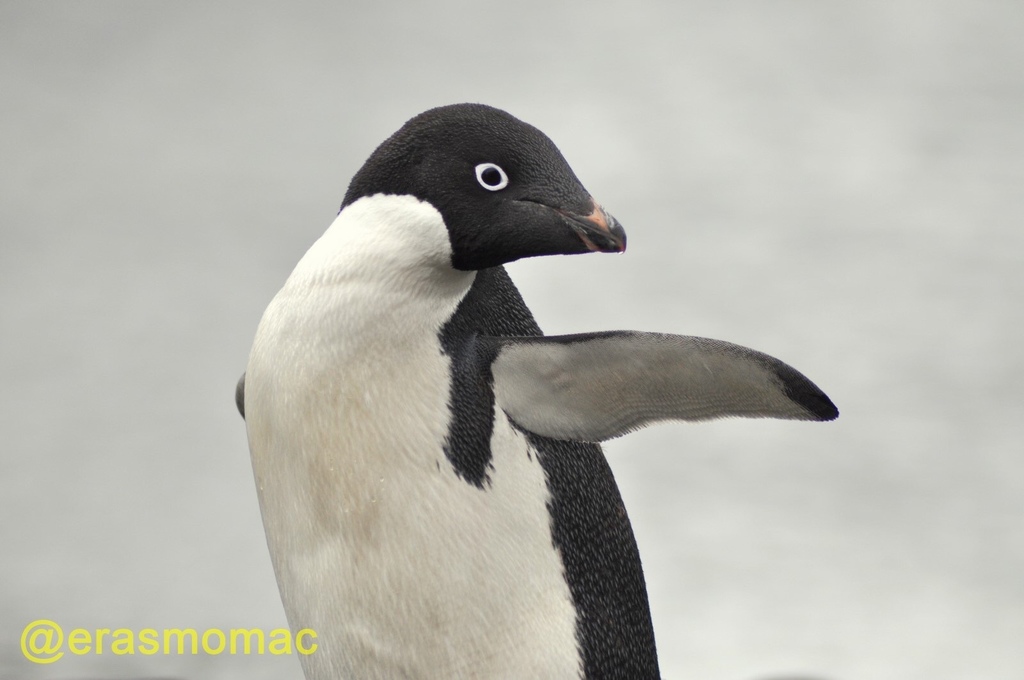
Adelie Penguin
Photo © Erasmo Macaya Horta
Photo © Erasmo Macaya Horta — CC BY 4.0 — Source: iNaturalist photo #12773663Identification
The Adélie penguin is a mid-sized bird measuring 70–73 cm (28–29 in) in length and weighing 3.8 to 8.2 kg (8.4 to 18.1 lb). Adults are distinctive: jet black on the head, throat and upper parts contrast sharply with snowy white underparts. A conspicuous white eye ring surrounding a black iris is a key identifying feature. The beak is largely covered in black feathers with only the tip exposed, which is primarily black with possible indistinct reddish-brown markings. The upper wing surface is black with a white trailing edge, while the underside is white with a narrow black leading edge and small black tip. Legs and feet are pinkish.
Immature birds are similar to adults but smaller, with a bluer tinge to their upperparts and white (rather than black) chins and throats. They lack the full white eye ring until at least a year old. Young birds can resemble chinstrap penguins, but the black on an Adélie's face extends below its eyes and lacks the distinctive black line under the throat. Additionally, the Adélie's bill is shorter and more heavily feathered than the chinstrap penguin's.
Range & Habitat
The Adélie penguin is the most widespread penguin species in Antarctica, common along the entire Antarctic coast. It is one of only four penguin species to nest on the continent itself, with breeding colonies scattered along Antarctica's coasts and sub-Antarctic islands including the South Orkneys, South Shetlands, South Sandwich Islands, Balleny Islands, Scott Island and South Georgia. The birds are much less common north of the 60th parallel south, though they have occasionally occurred as vagrants in Australia, New Zealand and southern South America.
During breeding season, Adélies require bare, rocky ground for nesting and will not nest on ice, preferring areas where wind or sun helps prevent snow accumulation. Colony sites may be up to 100 km (62 mi) from open water at the breeding season's start, though this distance decreases as pack ice breaks up. After breeding, adults typically move to ice floes or shelves to moult. In winter, they remain in the pack ice zone, with most moving north to areas with visible light, though some may migrate hundreds or thousands of kilometres away.
Behaviour & Diet
Adélie penguins are named after Adélie Land and were first discovered by French explorer Jules Dumont d'Urville in 1840. The genus name Pygoscelis derives from Ancient Greek words meaning "rump" and "leg", earning them the nickname "brush-tailed penguins" for their long, stiff tail feathers, which they regularly use for support as they walk.
These penguins obtain food through both predation and foraging, with a diet consisting mainly of krill and fish. They are well-adapted to life in extreme Antarctic conditions, capable of surviving hundreds of kilometres south of open water as long as breaks in the pack ice exist, and can forage in winter areas with up to 80% pack ice cover.
Best Time & Places to See It
The breeding season offers the best opportunity to observe Adélie penguins in their colonies along the Antarctic coast and sub-Antarctic islands. Major breeding sites include areas around the South Orkneys, South Shetlands, South Sandwich Islands, Balleny Islands, Scott Island and South Georgia. During winter months, birds are more dispersed across the pack ice zone, making them harder to locate but still observable in regions with visible light.
Most Antarctic wildlife expeditions and cruises include visits to established Adélie penguin colonies during the austral summer (October to February), when birds are ashore breeding and raising chicks. This season provides the most accessible and rewarding viewing opportunities for travellers.
Photography Tips
The Adélie's striking black-and-white plumage and distinctive white eye ring make for compelling photographs. Their compact size and active behaviour in colonies offer excellent opportunities for capturing characteristic poses and interactions. The contrast between their dark upperparts and white underparts is particularly striking when photographing birds both on land and in water.
For the best results, photograph during the austral summer when colonies are active and light conditions are favourable during the extended daylight hours. The white eye ring and facial markings are key details worth capturing with close-up shots. Action shots of birds waddling on rocky terrain or diving into water showcase their distinctive behaviour and habitat preferences.
Deception Island
Gabriel de Castilla Base, Antarctica
+26 birds+10 mammals
Steaming geothermal vents pierce a landscape of blackened volcanic sand and ice, where the earth's raw power still trembles beneath your feet. This horseshoe-shaped caldera, flooded…
VIEW ISLAND & ARCHIPELAGOCuverville Island
Cuverville Island, Antarctica
+19 birds+10 mammals
Granite peaks and sculpted ice define this windswept archipelago off the Antarctic Peninsula, where steep rocky shores plunge into waters thick with drifting brash ice. Cuverville…
VIEW ISLAND & ARCHIPELAGONeko Harbour
Neko Harbour, Antarctica
+18 birds+10 mammals
Towering peaks of fractured ice rise abruptly from gunmetal waters, their faces scarred by millennia of glacial advance and retreat. This pocket of the Antarctic Peninsula…
VIEW PROTECTED LANDSCAPEParadise Bay
Brown Station, Antarctica
+18 birds+9 mammals
Where the Antarctic Peninsula's rugged coastline meets the Southern Ocean, Brown Station stands sentinel over Paradise Bay—a protected landscape of ice-carved inlets, towering glacial faces, and…
VIEW PROTECTED LANDSCAPEBrown Bluff
Brown Bluff, Antarctica
+23 birds+9 mammals
Where rust-colored volcanic peaks pierce the Antarctic Peninsula's icy realm, a geologist's dreamscape unfolds beneath towering cliffs of iron oxide and ancient lava. Brown Bluff rises…
VIEW PROTECTED LANDSCAPEPort Lockroy
Port Lockroy, Antarctica
+19 birds+9 mammals
Towering peaks of black rock pierce through Antarctic pack ice on the Gerlache Strait, where one of the continent's most accessible harbors cradles a living microcosm…
VIEW PROTECTED LANDSCAPEHalf Moon Island
Cámara Base, Antarctica
+25 birds+8 mammals
Jagged volcanic peaks rise from the cobalt waters of the South Shetland Islands, their slopes carpeted in moss and lichen where hardy vegetation clings to windswept…
VIEW ISLAND & ARCHIPELAGOPetermann Island
Petermann Island, Antarctica
+16 birds+9 mammals
Icebound cliffs rise dramatically from the Bellingshausen Sea, their weathered faces sculpted by millennia of Antarctic wind and tide. This slender wedge of rock and ice,…
VIEW ISLAND & ARCHIPELAGOPaulet Island
Paulet Island, Antarctica
+20 birds+6 mammals
Windswept ice and weathered rock converge at this remote Antarctic outcrop, where jagged peaks pierce through perpetual pack ice and glacial moraines descend toward cobalt waters.…
VIEW ISLAND & ARCHIPELAGODanco Island
Danco Island, Antarctica
+17 birds+10 mammals
Dramatic black rock pierces the Antarctic Peninsula's icy waters, crowned with permanent snow and ringed by calving glaciers that thunder into the sea. This volcanic outcrop…
VIEW ISLAND & ARCHIPELAGOWilhelmina Bay
Wilhelmina Bay, Antarctica
+20 birds+10 mammals
Sheer cliffs of black volcanic rock plunge into waters so pristine they reflect the Antarctic sky like polished obsidian. This remote western Antarctic inlet, ringed by…
VIEW PROTECTED LANDSCAPELemaire Channel
Orne Harbour, Antarctica
+25 birds+13 mammals
Where granite peaks plunge into steel-grey waters, the Lemaire Channel carves one of Antarctica's most dramatic passages. This narrow strait, squeezed between the Antarctic Peninsula and…
VIEW PROTECTED LANDSCAPENo community photos yet. Log in to add the first one.
No community observations of this species yet.